30 free pages · print · PDF · colour online · updated 3 September 2026
Horse coloring pages you can print, save as a PDF, or colour right now
Horse coloring is the quiet work of filling a black line drawing of a horse with colour — mane, coat, meadow, sky — until the page looks like a story you made. This set is 30 original drawings from ColoringVemsy. Every picture is clean line art on white paper. Three buttons sit on top of each picture: Print, PDF, and Online coloring. Nothing to sign up for. Nothing to pay.
Print sends only that drawing to your printer. PDF saves a real A4 file to your device. Online coloring opens the same line art in our online studio with the fill bucket ready. The book button below packs all 30 into one file you can staple.


On this page — tap to open the contents
- The 30 printable pages
- How these pages work
- What makes a good horse coloring page
- Print, PDF or colour online
- How to print so the lines stay bold
- Crayons, pencils and markers by age
- Toddlers, kids, teens and adults
- Classroom, homeschool and parties
- Scenes and breeds in this set
- Why horse coloring helps the hand and the hour
- How to colour a horse
- Make a horse coloring book at home
- Horse coloring in the online studio
- More free pages on ColoringVemsy
- Questions parents ask first
How these 30 horse coloring pages work
This page is built for a real afternoon, not for a pop-up. You do not scroll through a thumbnail wall first. The drawings themselves are the start. Each card shows the full line art. The three choices sit on top of the picture so a child can point and a grown-up can tap without hunting.
Print opens a clean sheet with only that drawing, then calls your printer box. PDF downloads a one-page A4 file with the title on it. Online coloring loads this exact picture into the ColoringVemsy studio. The fill tool is already selected. That is the whole loop.
If you want the stack in one go, use the book button at the top. It is a real file on our server, the same idea as our dog coloring book, so a school Chromebook can open it without extra scripts.
Every filename is written for search and for folders: the words describe the scene. When you upload or save a file, you can still find “waterfall” or “carousel” later. That is dull on purpose. Dull filenames keep a classroom laptop tidy.
What makes a good horse coloring page
A good page here is not a tiny horse lost in a grey scribble. It is a horse a crayon can actually reach. Four things have to be true at once: a thick outer line, big open shapes, a face with an expression, and a background that invites colour without turning into a maze.
Thick lines give a young hand a wall to stop against. A line about two millimetres wide on paper is enough. Hairline art looks fancy on a phone and fails on a kitchen table. These drawings keep the outline bold so the horse stays the star when the page is printed at 100 percent.
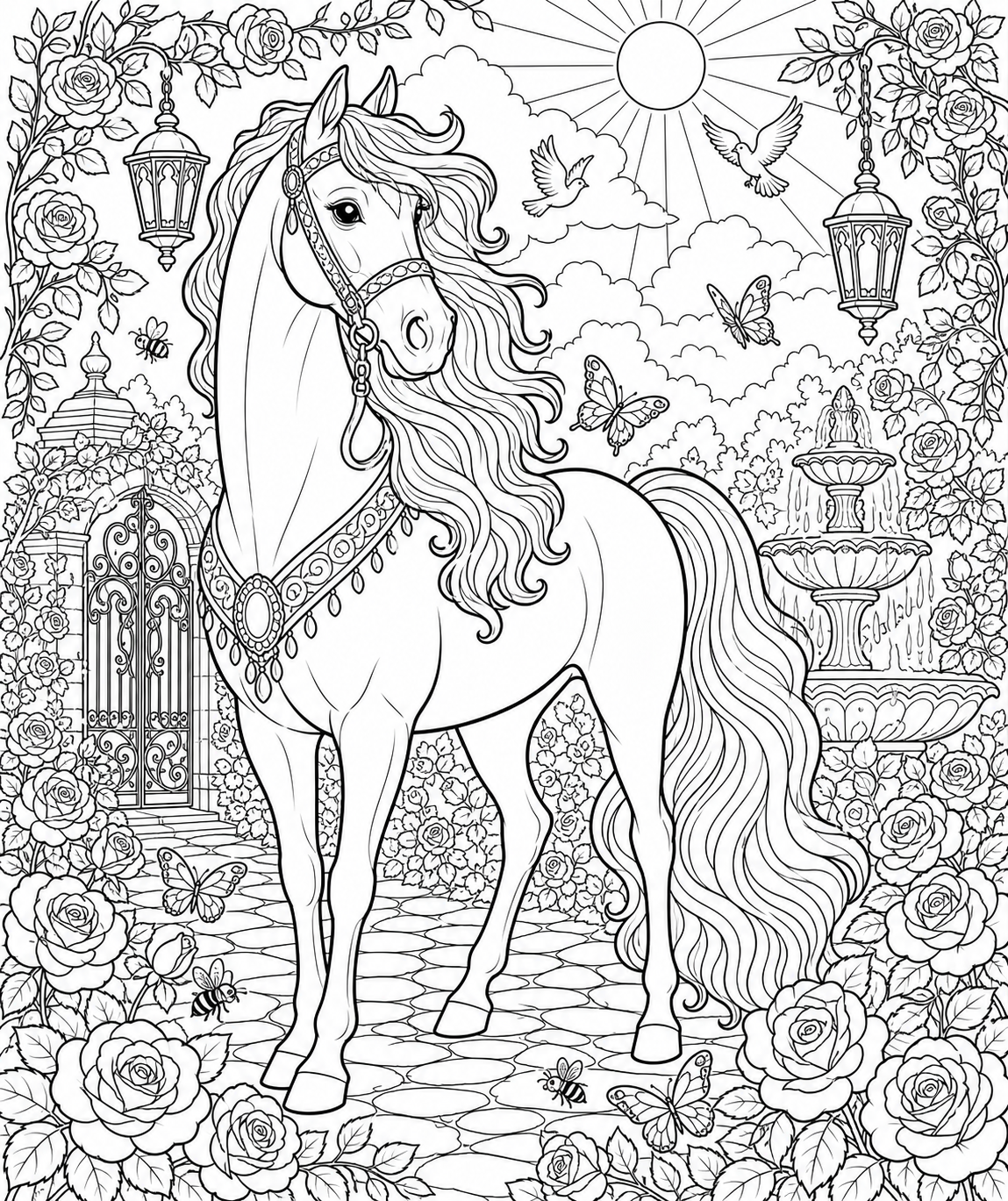
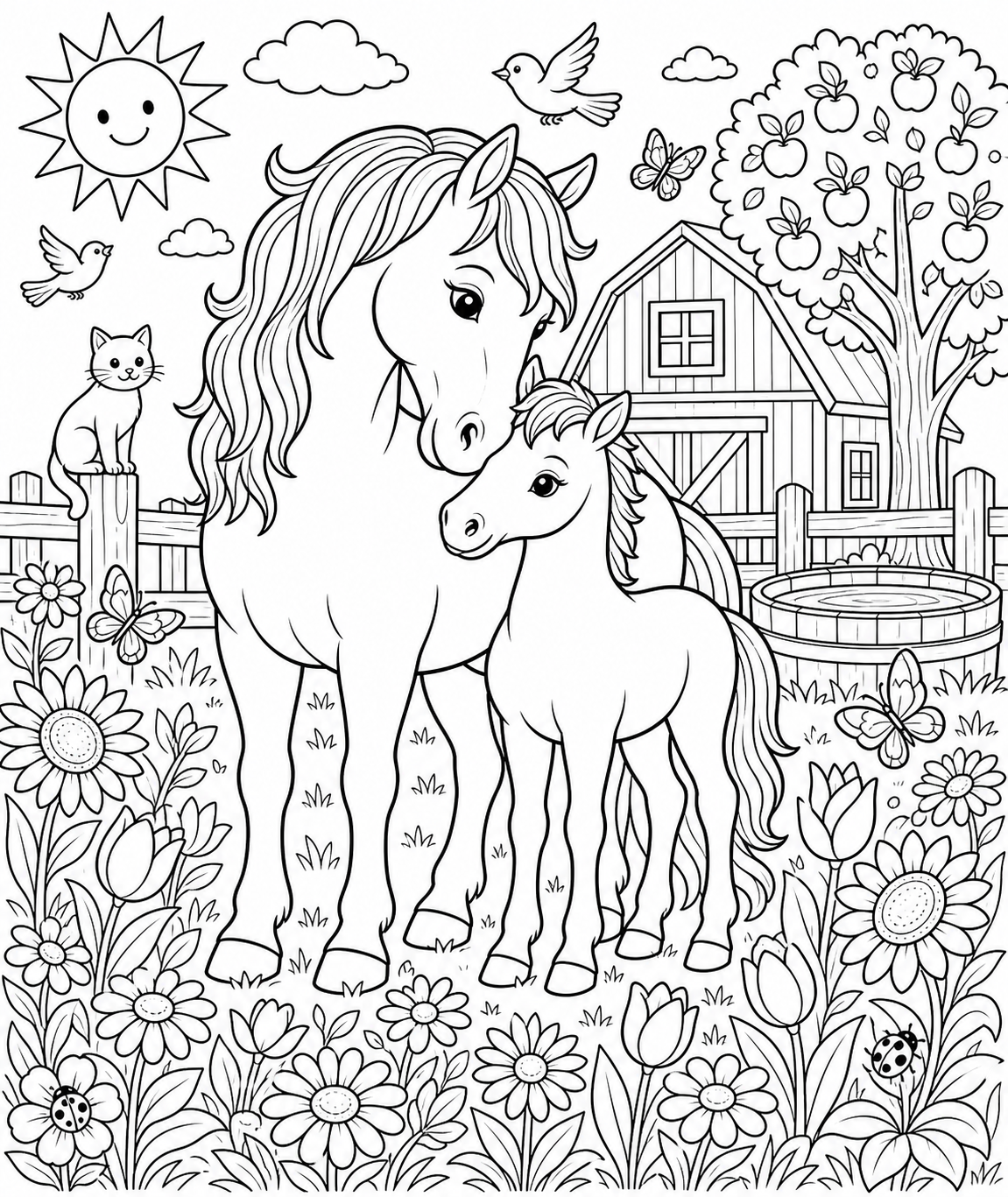
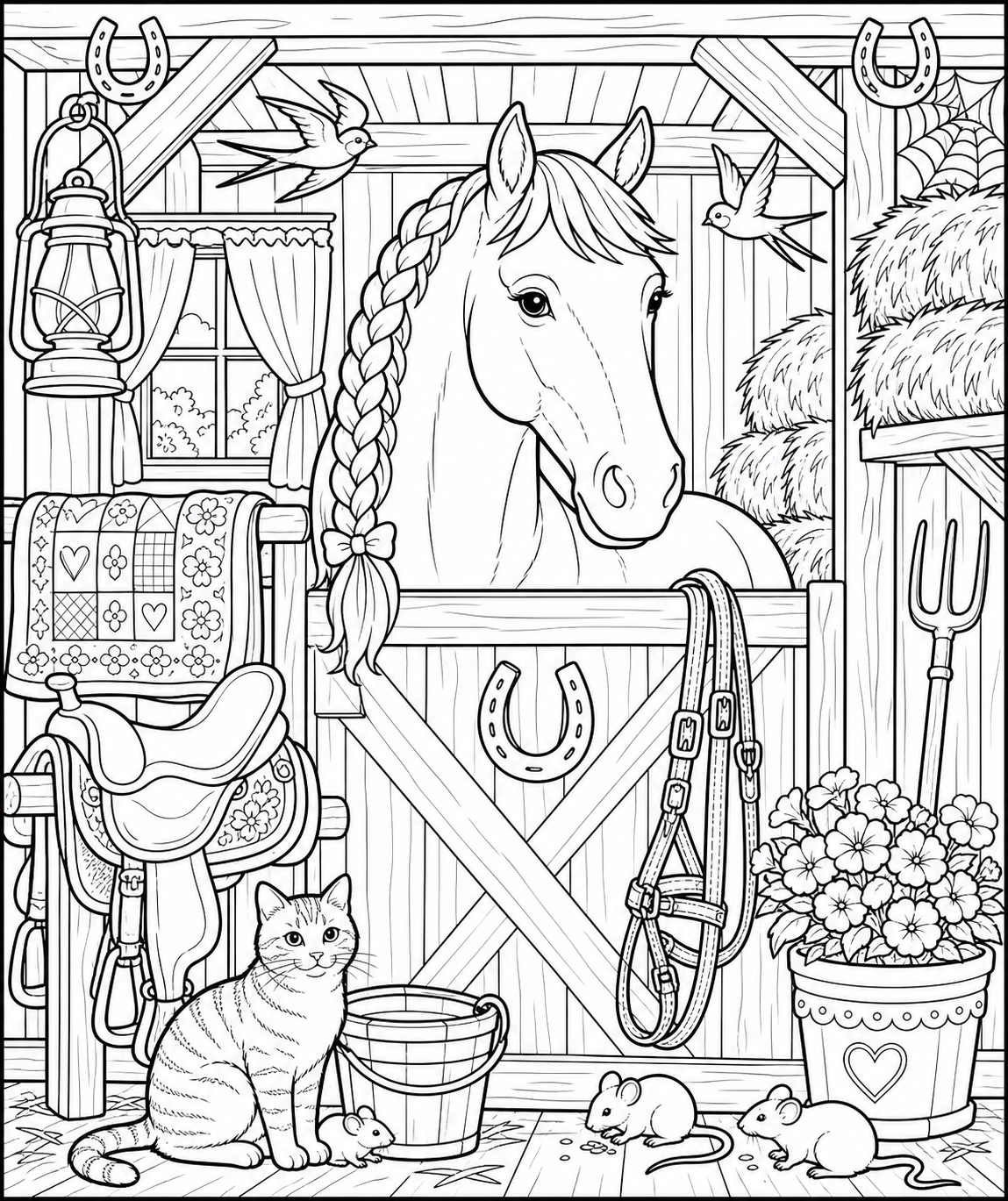
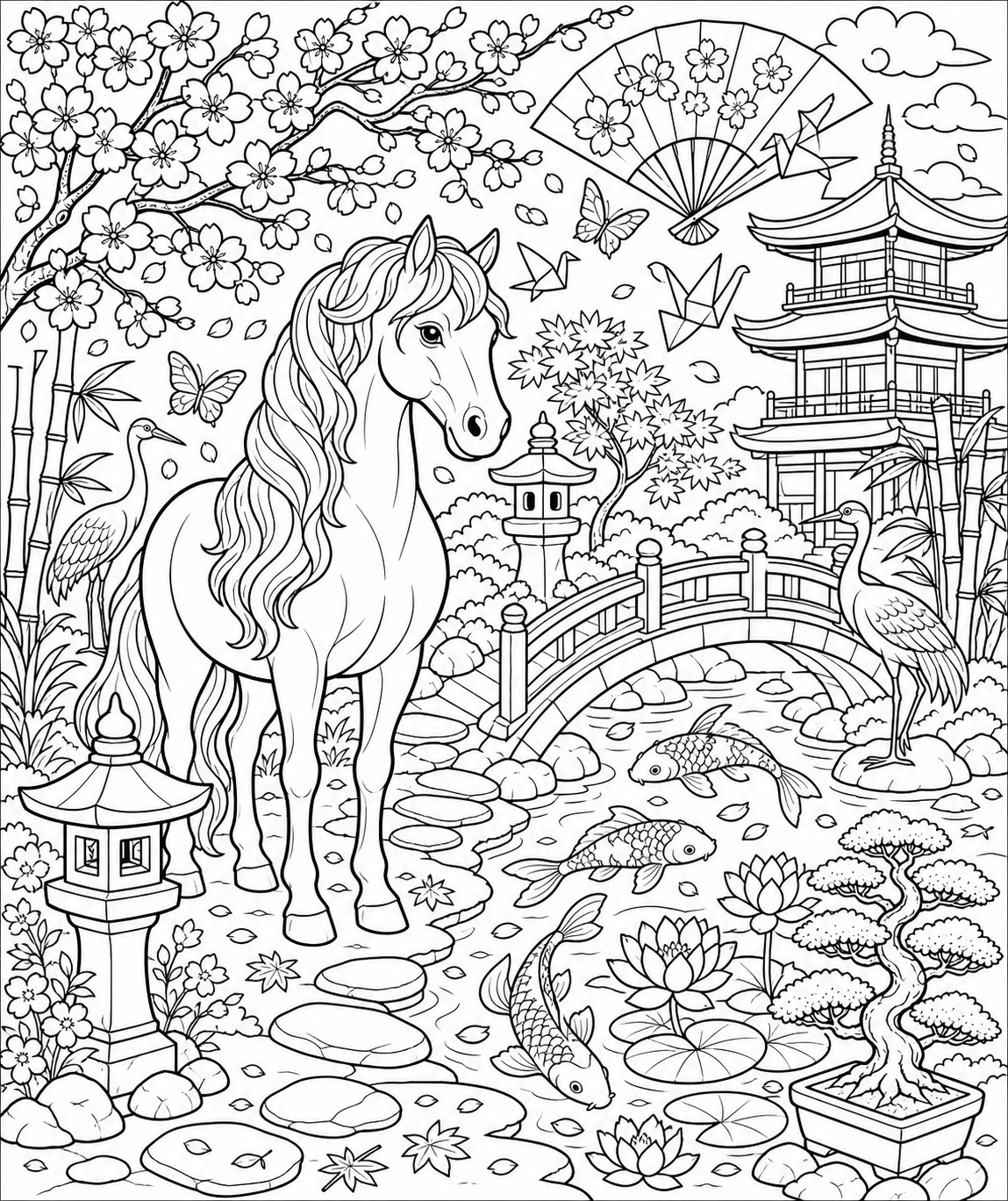
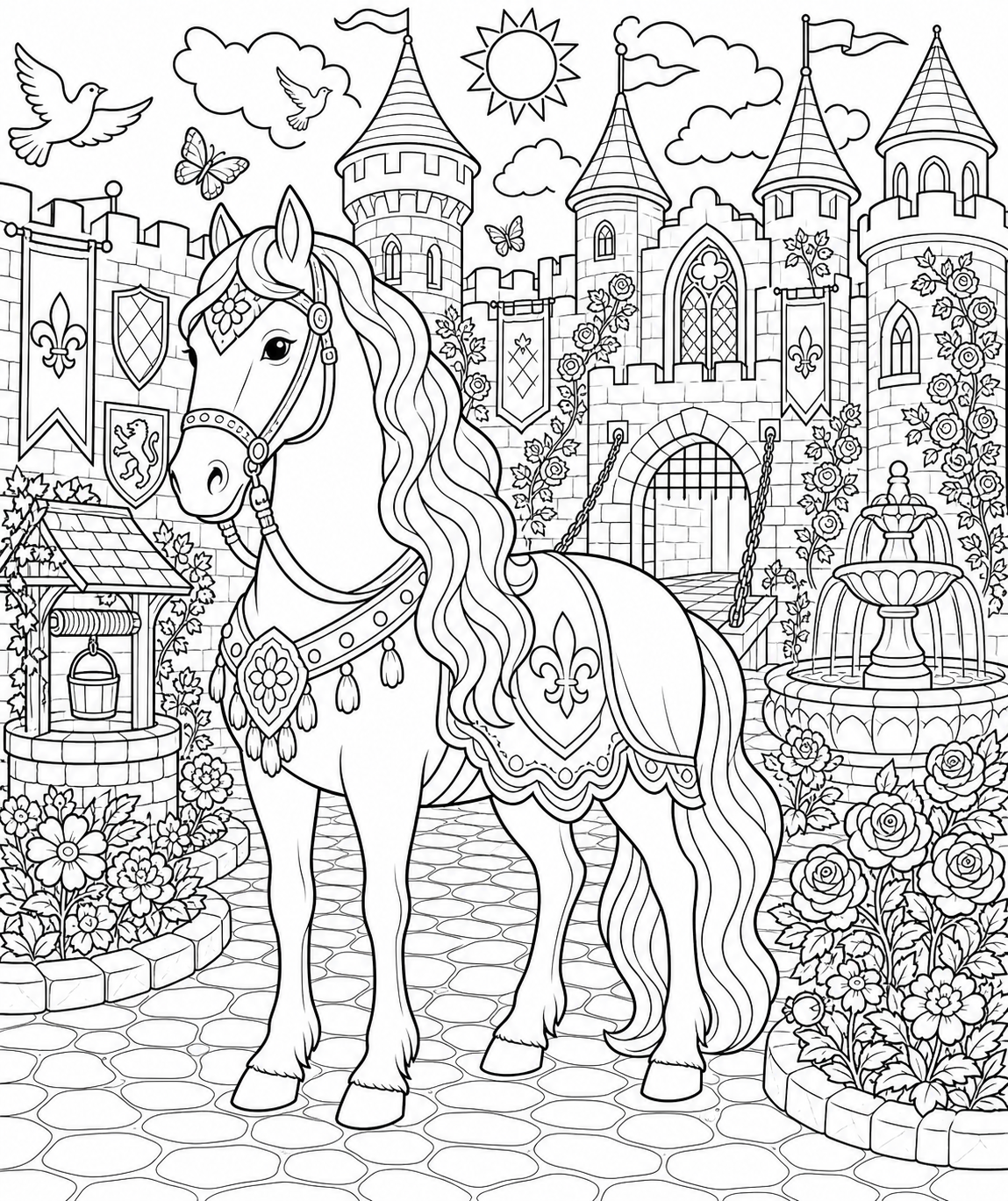
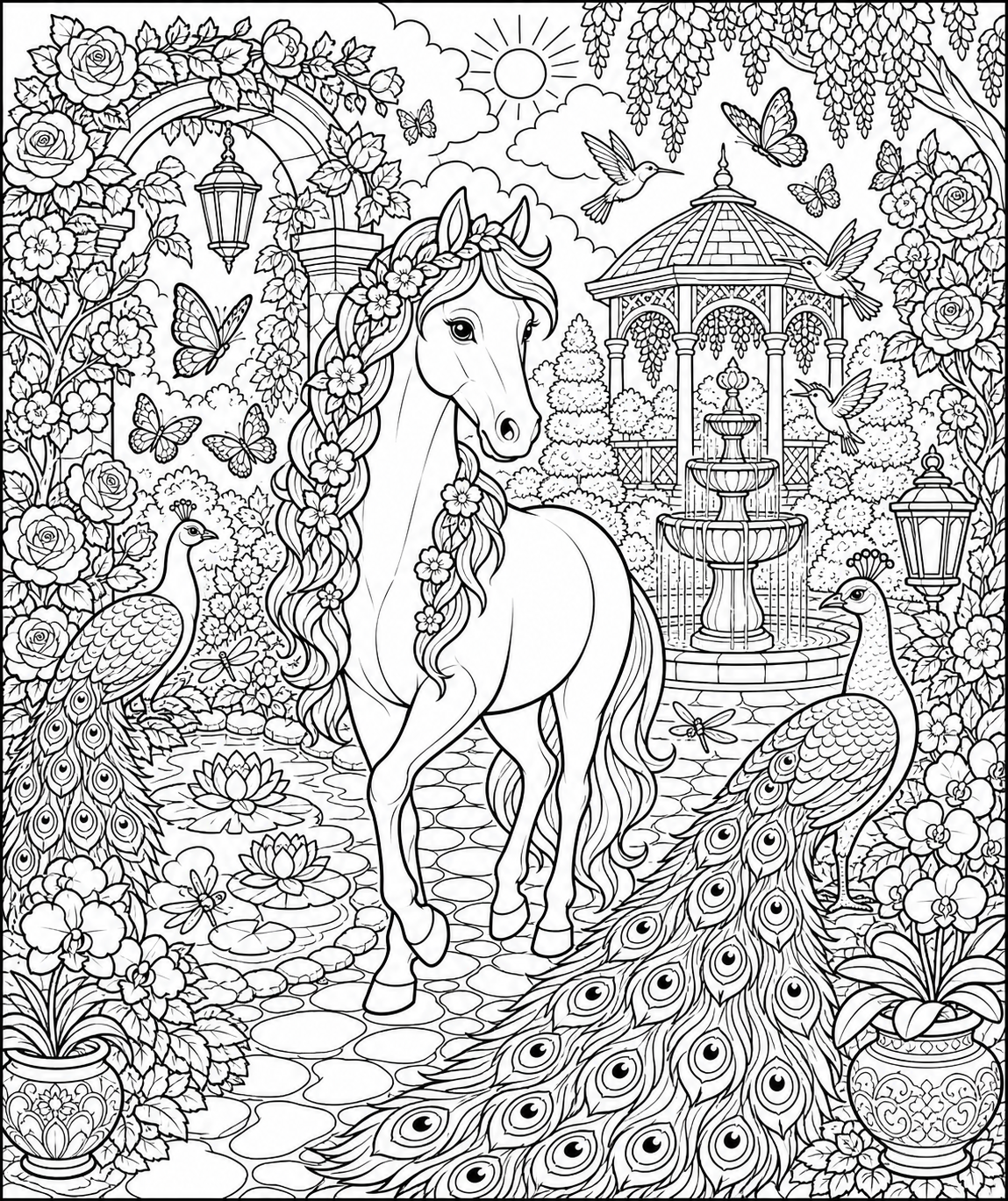
Big shapes matter as much as the outline. A mane drawn as many wavy strands is fun for an eight-year-old and torture for a three-year-old. That is why this set mixes pages. The mare and foal, the barn, and the beach give large bodies and simple skies. The peacock garden, the Japanese garden and the castle courtyard give extra pattern for a child who asked for “harder.”
Expression is the part publishers skip. Children colour characters. A horse with a soft eye and a lifted ear is a someone. A silhouette is a diagram. Horse coloring works when the child decides the animal is proud, sleepy, wild or kind, and then picks a coat colour to match that decision.
The last rule is reach. If a shape is narrower than a crayon tip, the page ends with white gaps and a complaint. Texture here is suggested with a few marks — a handful of stones, a few leaves, a row of tiles — not a thousand scales. That is how a horse coloring page gets finished instead of abandoned.
A true horse still sits under the fun. Manes fall the right way. Hooves have the right idea. Arabian heads are refined; draft legs are feathered; a mustang stands like it might leave. If a child later looks up the horse on Britannica or the horse article on Wikipedia, the drawing will not fight the facts.
Print, PDF or colour online: pick a path
Horse coloring does not have to be paper. It also does not have to be a screen. Both routes use the same artwork, so you are not choosing a lesser version.
Choose print when the goal is the hand. A crayon has to be pushed. That push is the exercise. Put a scrap sheet under the page. Give the child two colours to start, not the whole tin. Twenty minutes at a table with no other tab open is still the classic set-up, and it still works.
Choose PDF when you need the file to travel. A PDF survives a teacher’s laptop, a library printer and a grandparent’s email. Each PDF on this page is one drawing on an A4 sheet with its name at the top. You can keep the set in a folder named horses and find any scene by title.
Choose online coloring when there is no printer, or when the child wants to try nine colours on one mane and change their mind. The studio undoes. Paper does not. The American Academy of Pediatrics family media guidance is the sensible referee here: it is about what fills the hour, not about treating a tablet as a forbidden object.
A useful house rule is one printed page after supper and one online page on a travel day. The drawings stay familiar. The tool changes. Children notice the difference and still recognise the horse.
How to print horse coloring pages so the lines stay bold
Printing is where a good page most often gets ruined, and usually because the printer tries to be helpful. Set these options once. After that, every page from this set comes out the size you intended.
| Setting | Pick this | Why it matters |
|---|---|---|
| Scale | 100% or Actual size | Shrink-to-fit thins every line. A 90% print turns a wall into a hairline. |
| Page size | A4, or Letter in the US | The PDFs are built for both. Either fits with a quiet margin. |
| Margins | None or Minimum | Big margins shrink the horse. Small horses are harder to fill. |
| Colour mode | Greyscale or Black and white | Colour mode spends three cartridges to print black and can leave a grey halo. |
| Draft mode | Off | Draft lines look broken. A broken line gives a child nowhere to stop. |
| Two-sided | Only for the book | Single pages print one side so markers do not bleed onto the next sheet in the tray. |
Paper is the other half. Ordinary office paper at 80 gsm is fine for crayons and pencils. Felt tips will ghost through, so slide a scrap underneath or move to 120 gsm for a birthday pile. If lines look pale, the file is not the culprit — these files are pure black on white. Draft mode or a tired cartridge is.
Print four horse coloring pages at a time so there is always a spare for the shape a child decides to “fix.” Put the date on the back in pencil. Finished pages are artwork. Dating them turns a pile of scraps into a folder a family actually keeps.
The Print button on each card is the short path: it opens only that picture, then the printer box. If a popup is blocked, open the PDF instead and print from there. Both routes are the same drawing.
Which crayons, pencils and markers suit each age
The tool decides how a child feels about the drawing more than the drawing does. A three-year-old with a fine marker will fail. The same child with a fat wax crayon will fill a belly and feel competent. Treat this as a floor, not a ceiling.
| Age | Best tool | Skip for now | What to notice |
|---|---|---|---|
| 2 to 3 | Jumbo wax crayons | Pencils, fine markers, paint | Fist grip. Big strokes. Colour anywhere on the horse is a win. |
| 4 to 5 | Standard crayons, thick washable markers | Detail pencils, watercolour sets | Tripod grip starts. They begin stopping at the line. |
| 6 to 7 | Crayons plus pencils for eye and hoof | Tools that need steady pressure | Two colours on one horse. Opinions about the mane. |
| 8 and up | Pencils, felt tips, cheap watercolour pans | Nothing — let them try | Layering, sky, ground, and a favourite page they will repeat. |
| Adults | Fine liners, coloured pencils, mildliners | — | Slow fills, patterned backgrounds, a quiet hour that is not a phone. |
Wax crayons remain the default because they do not dry out and they forgive a heavy hand. Markers feel grown-up and they bleed. Pencils teach pressure. None of this is a test. Horse coloring is practice that looks like play, which is why children will do it twice.
If you buy one extra thing, buy a clipboard. A page that rotates stays in reach of a short arm. The NAEYC notes on play are a useful reminder that this kind of table work still counts as play when the child chose the horse.
Horse coloring for toddlers, kids, teens and adults
Horse coloring is not one age. The same animal scales up. A toddler needs three big shapes. A nine-year-old wants a castle wall to pattern. An adult wants a winter forest that takes an evening. This set was drawn to cover that spread without splitting into “baby pages” and “serious pages.”
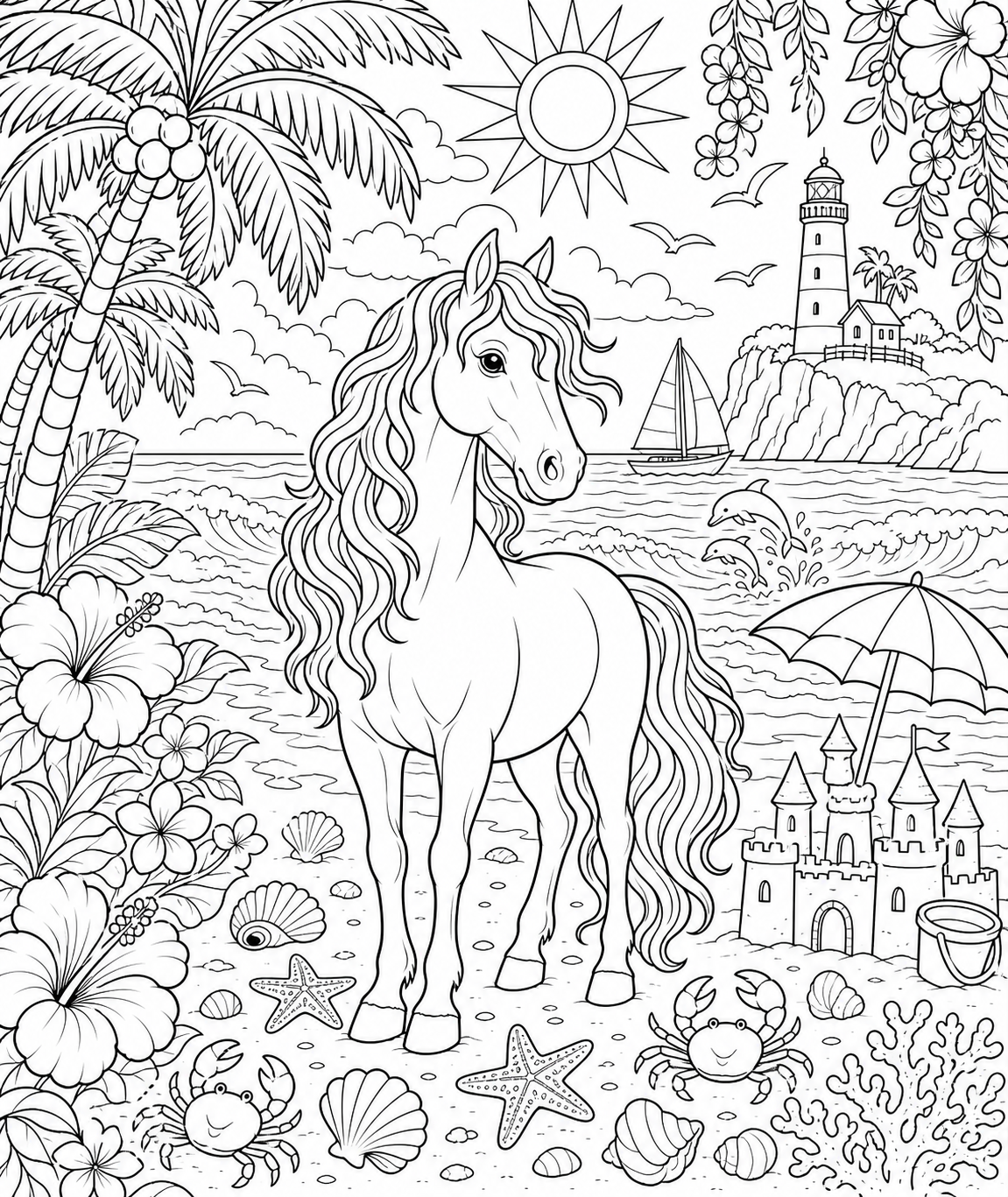
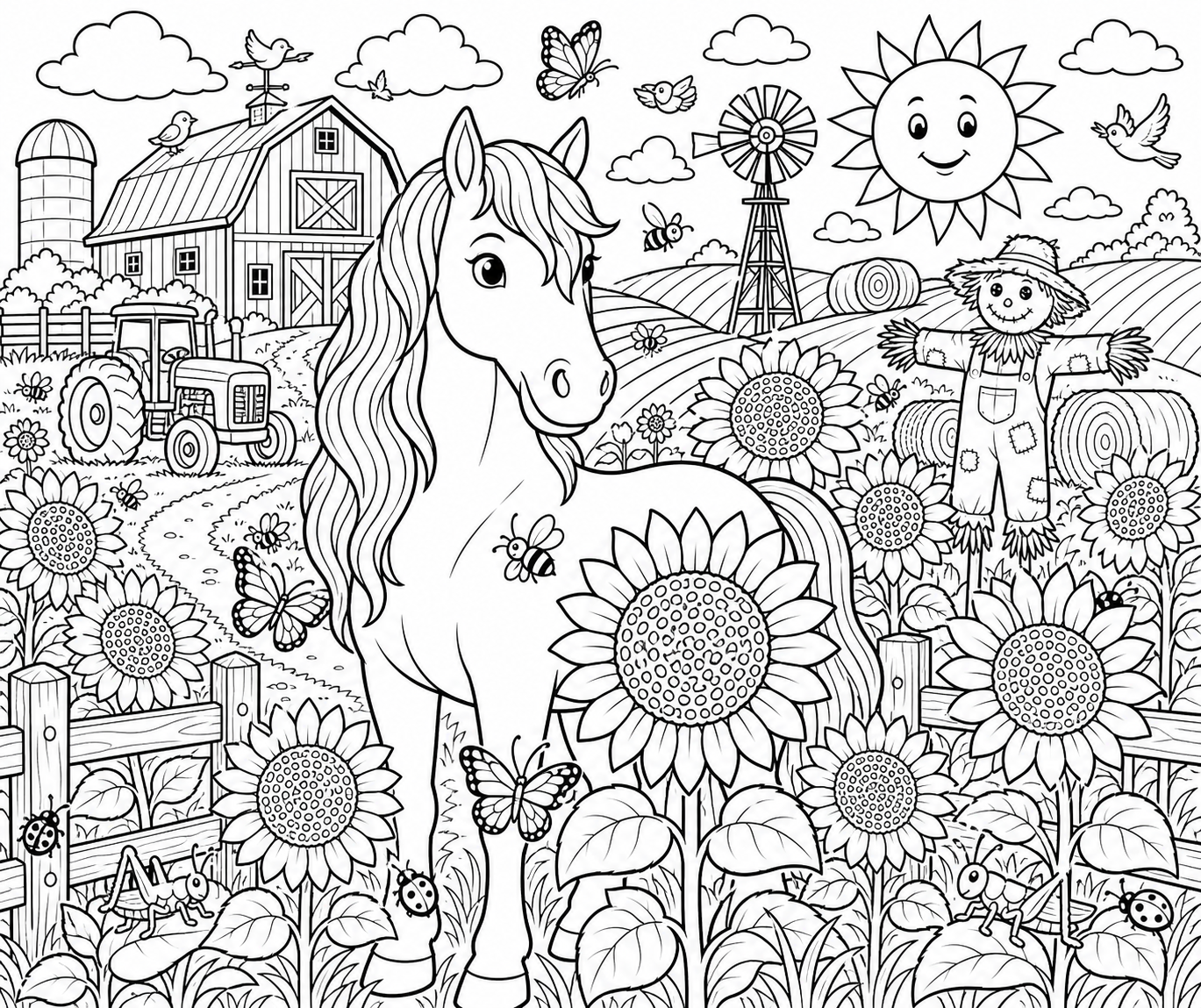
For ages two to four, start with the mare and foal, the barn, the beach, or the sunflower field. Large bodies. Clear sky. A few flowers that can be any colour. Sit beside them for two minutes and colour the grass yourself. Parallel work is the most reliable start ever invented.
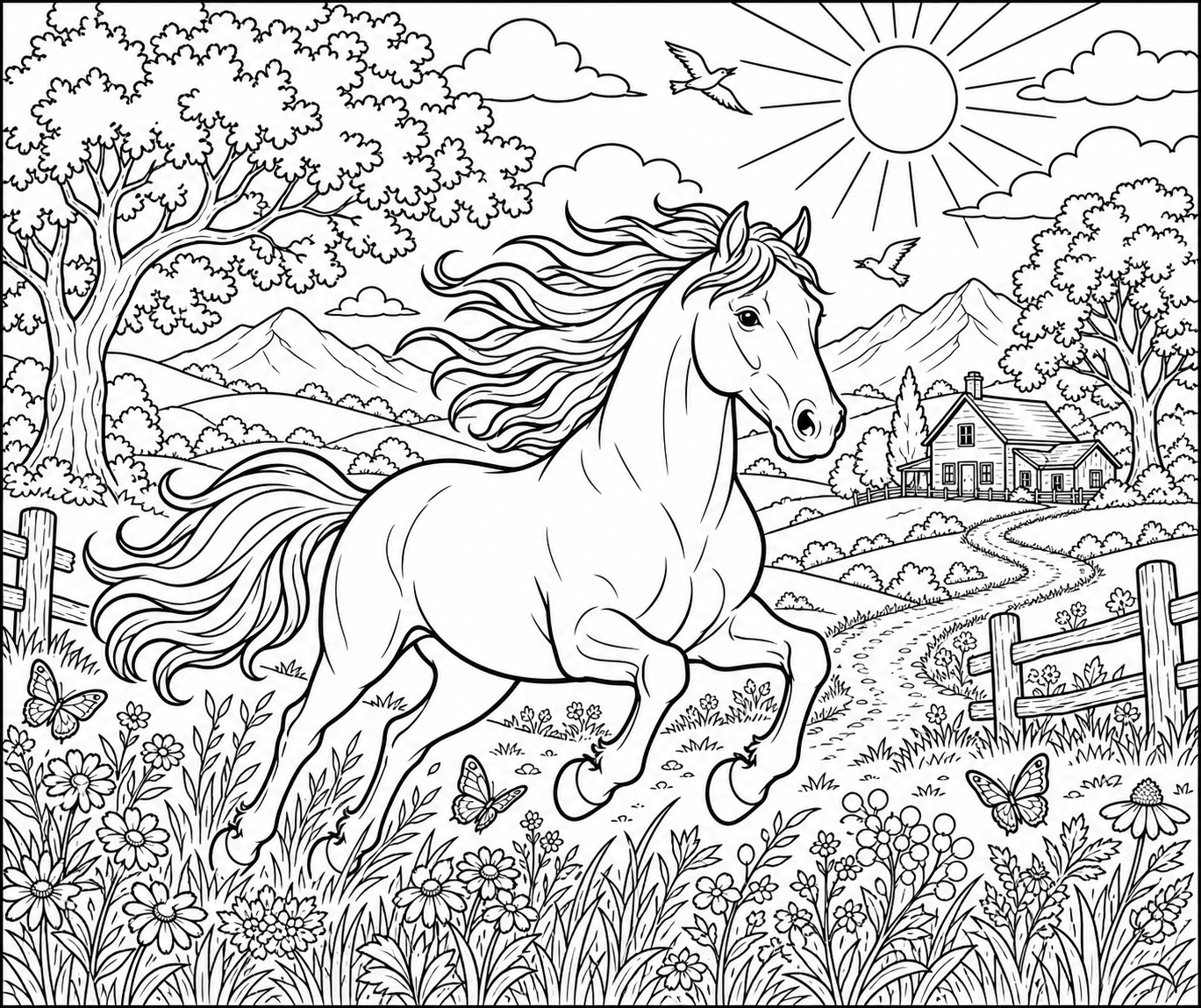
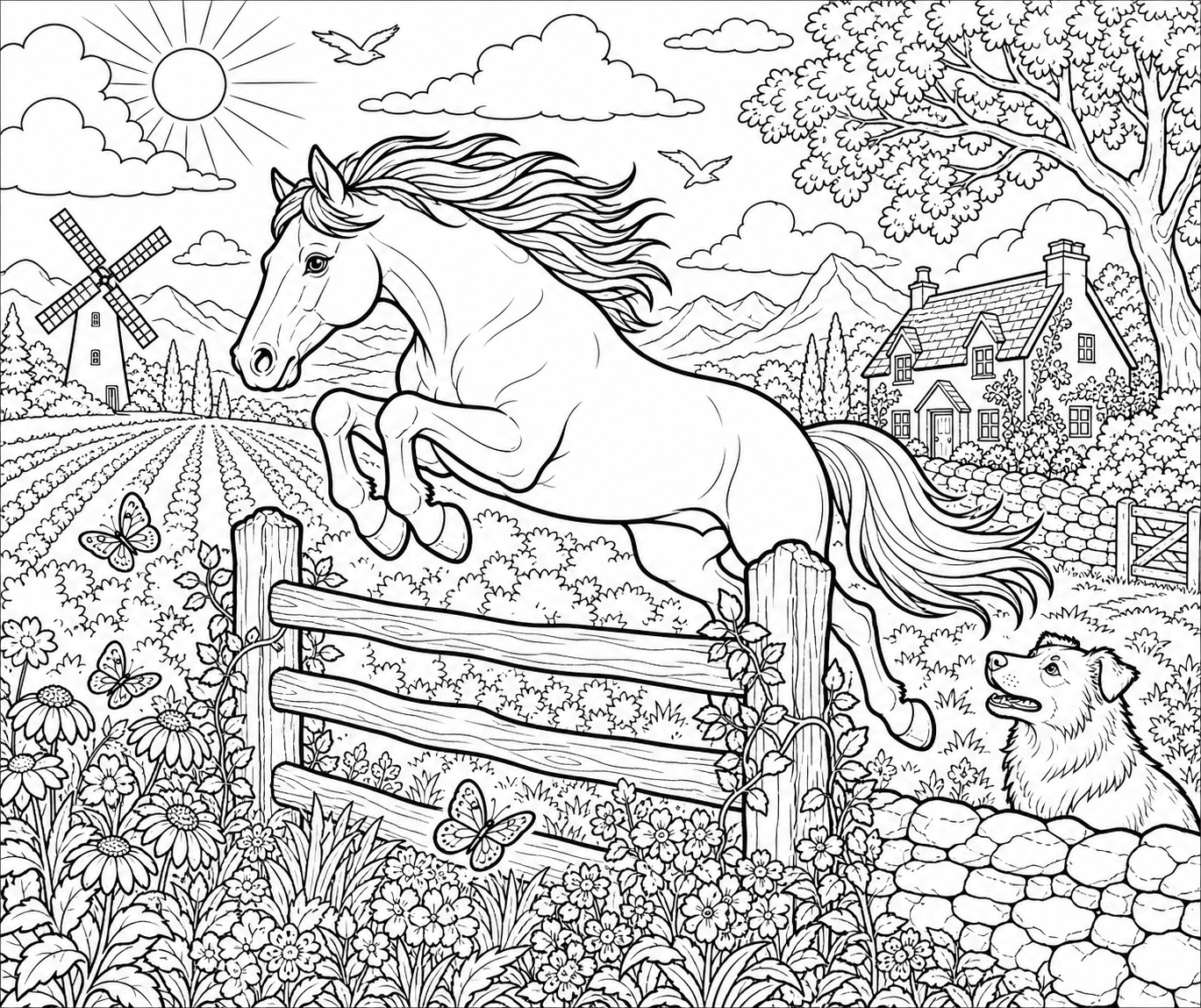
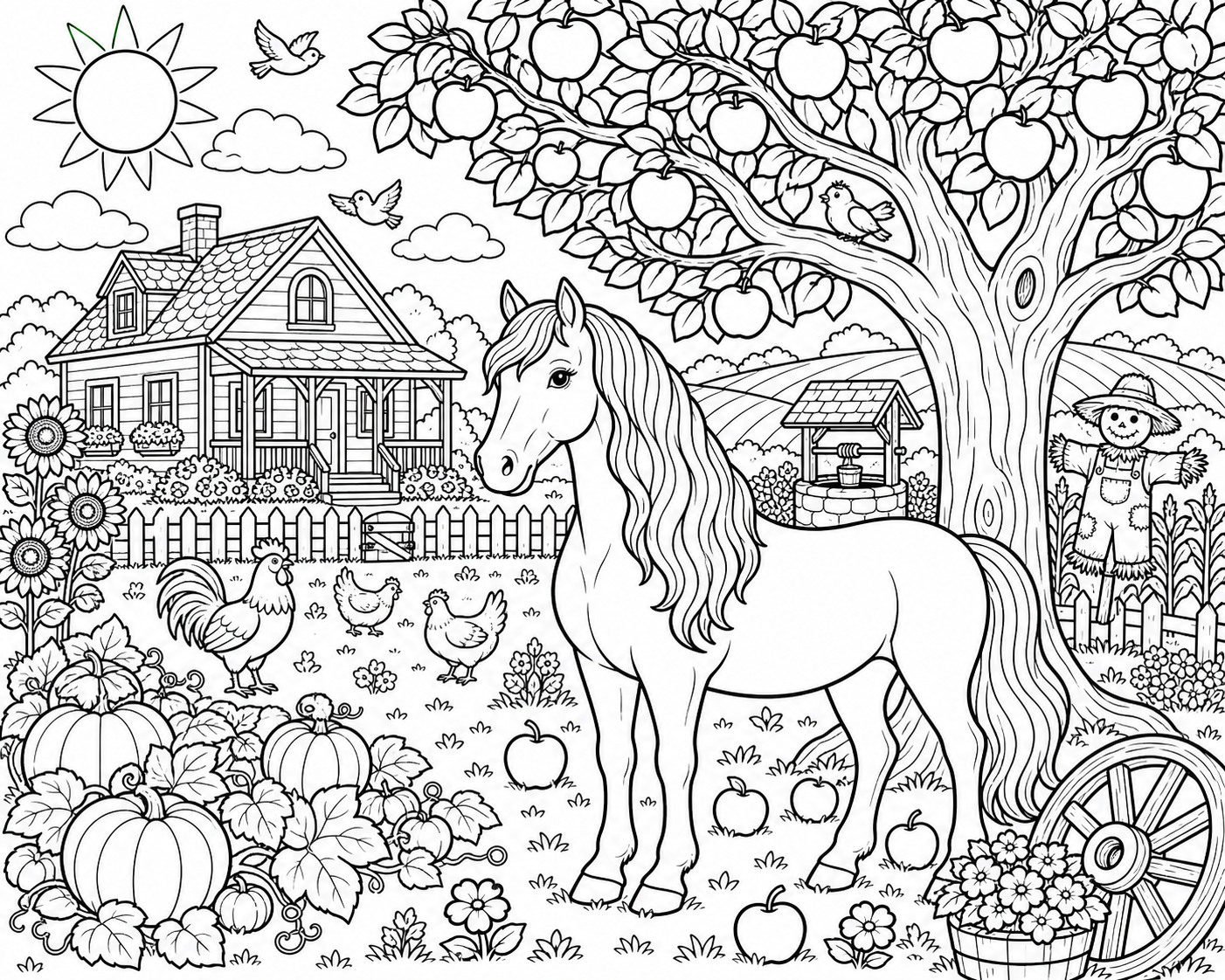
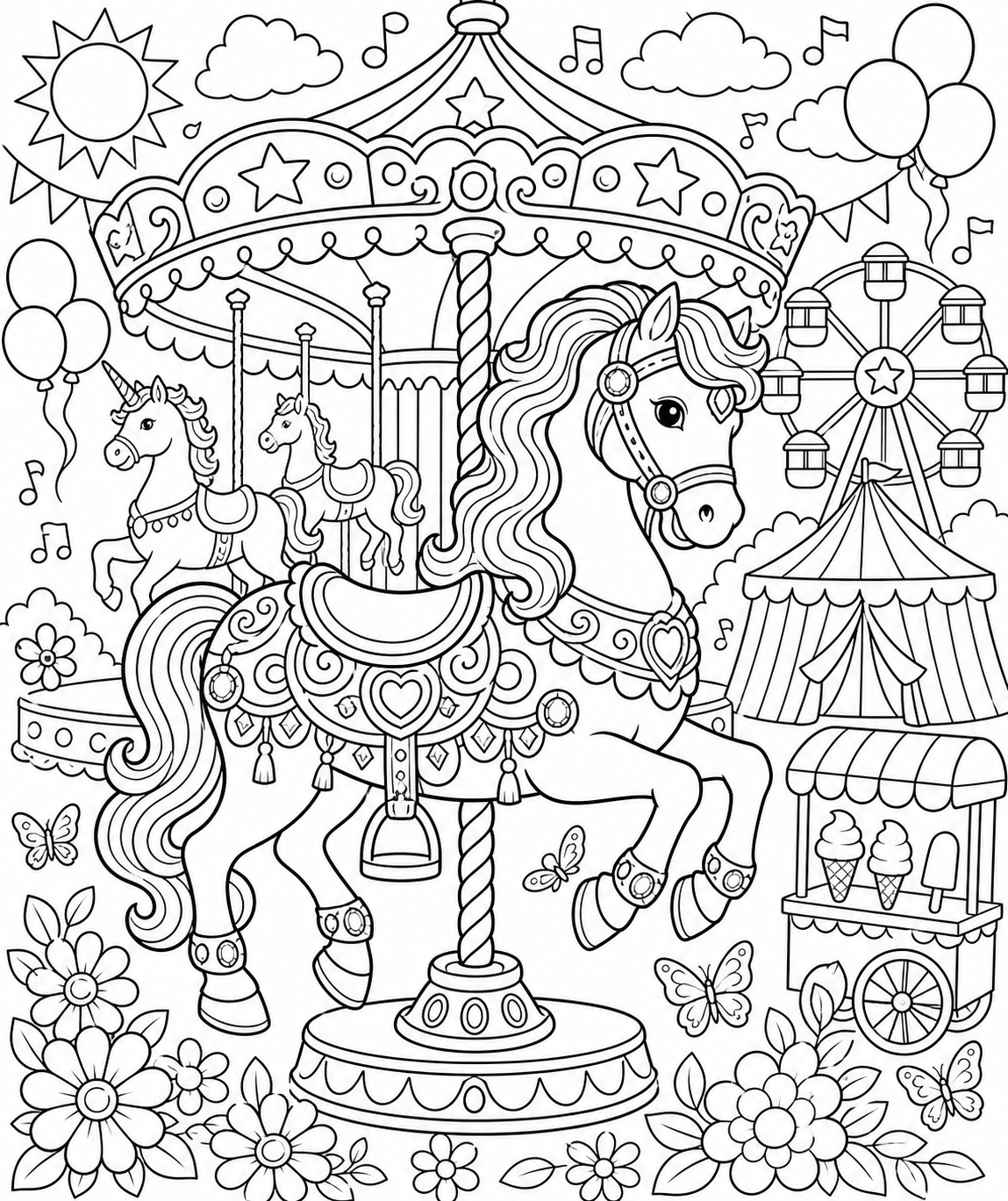
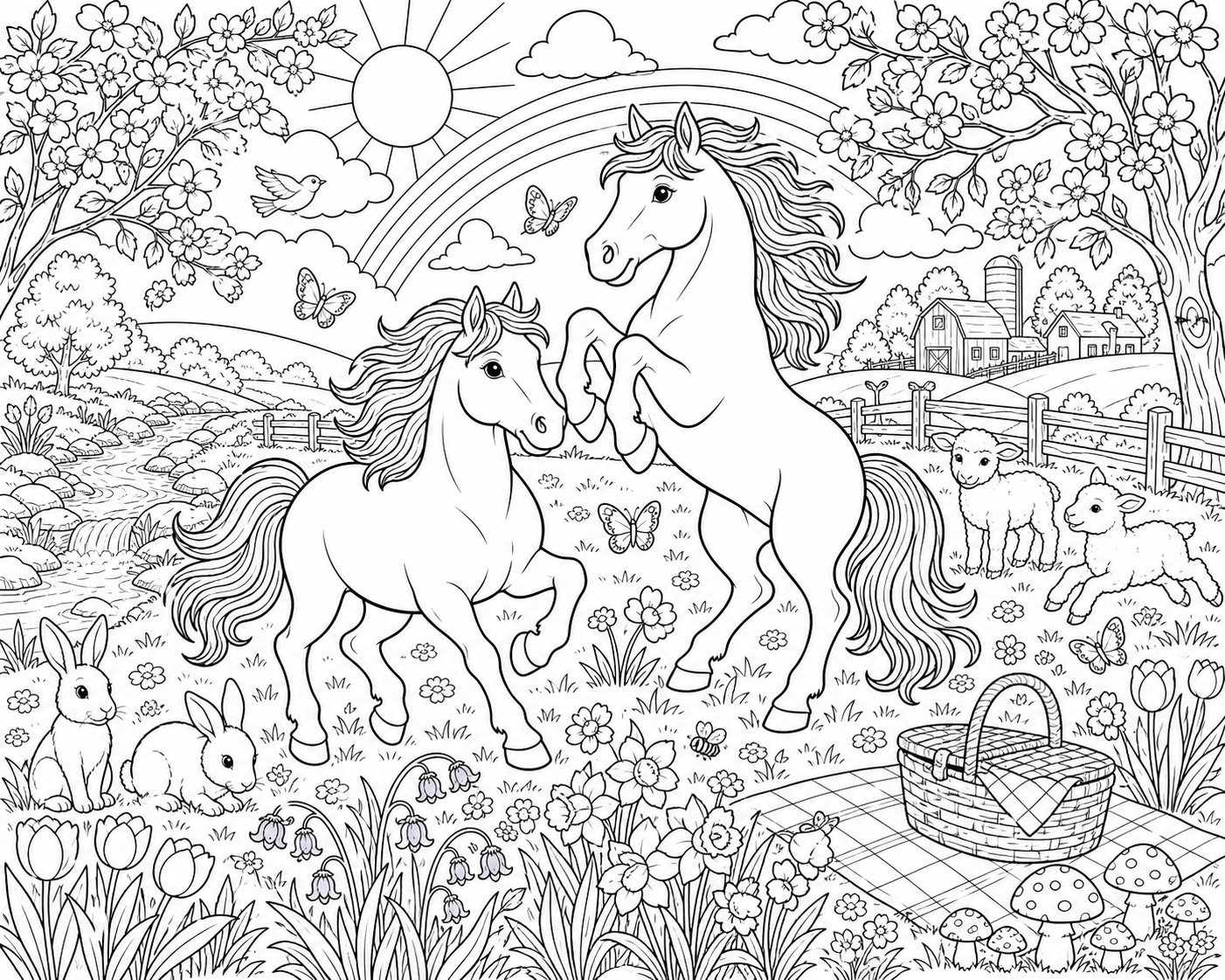
For ages five to seven, add the countryside gallop, the apple tree, the fence jump, the carousel and the spring meadow with two horses. The extra background is now a feature. Ask one question: “Where is this horse going?” The answer becomes the sky colour.
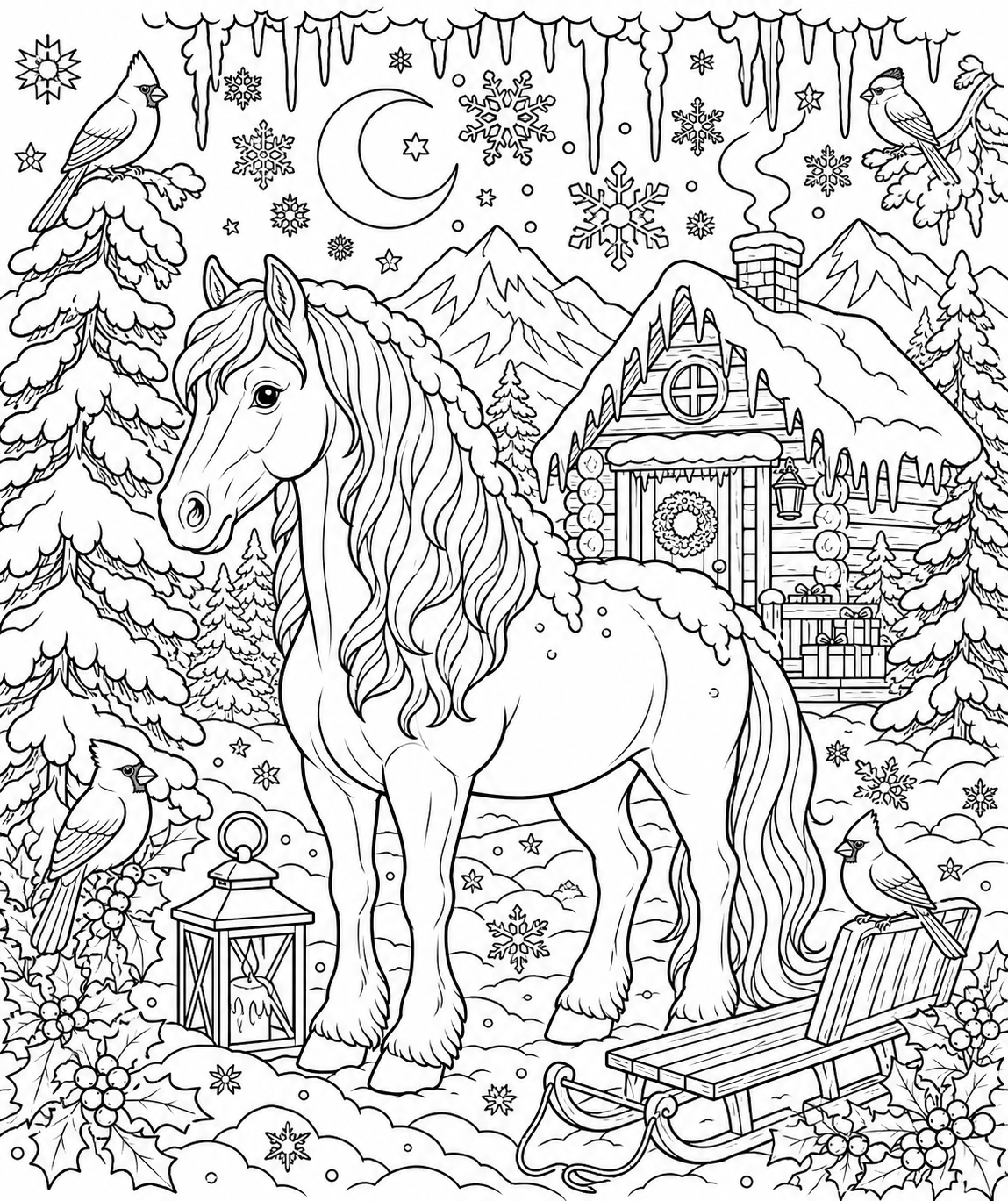
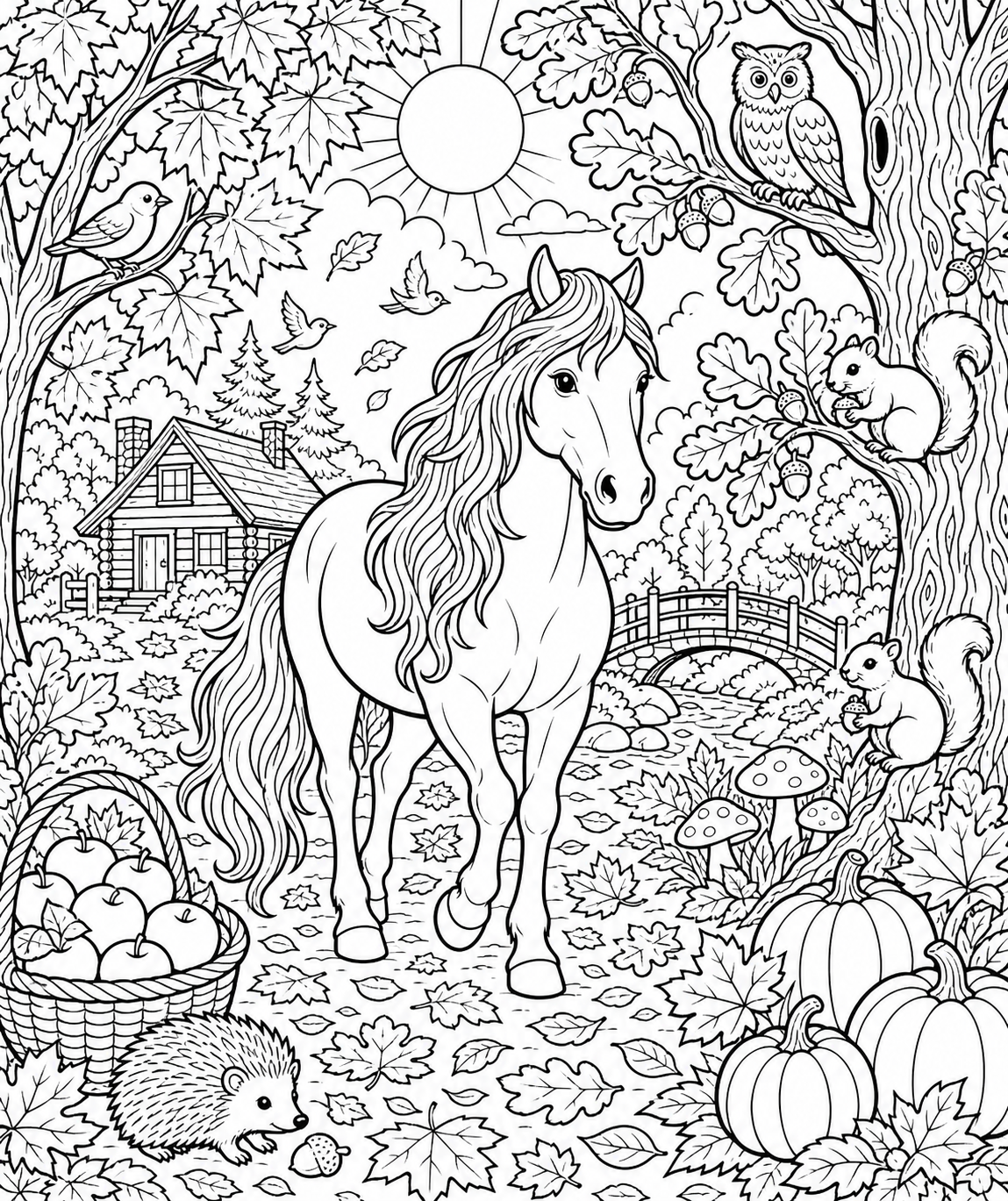
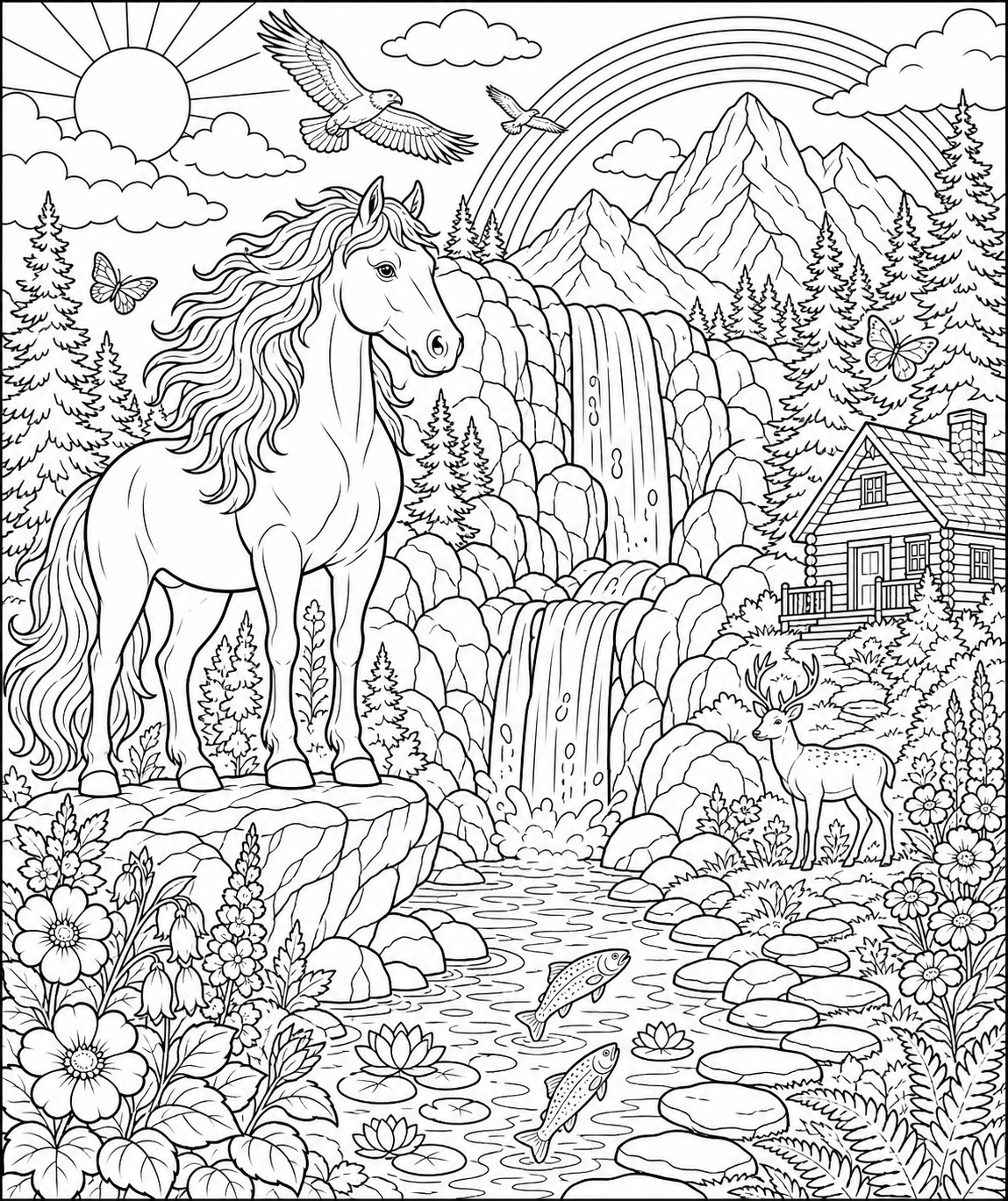
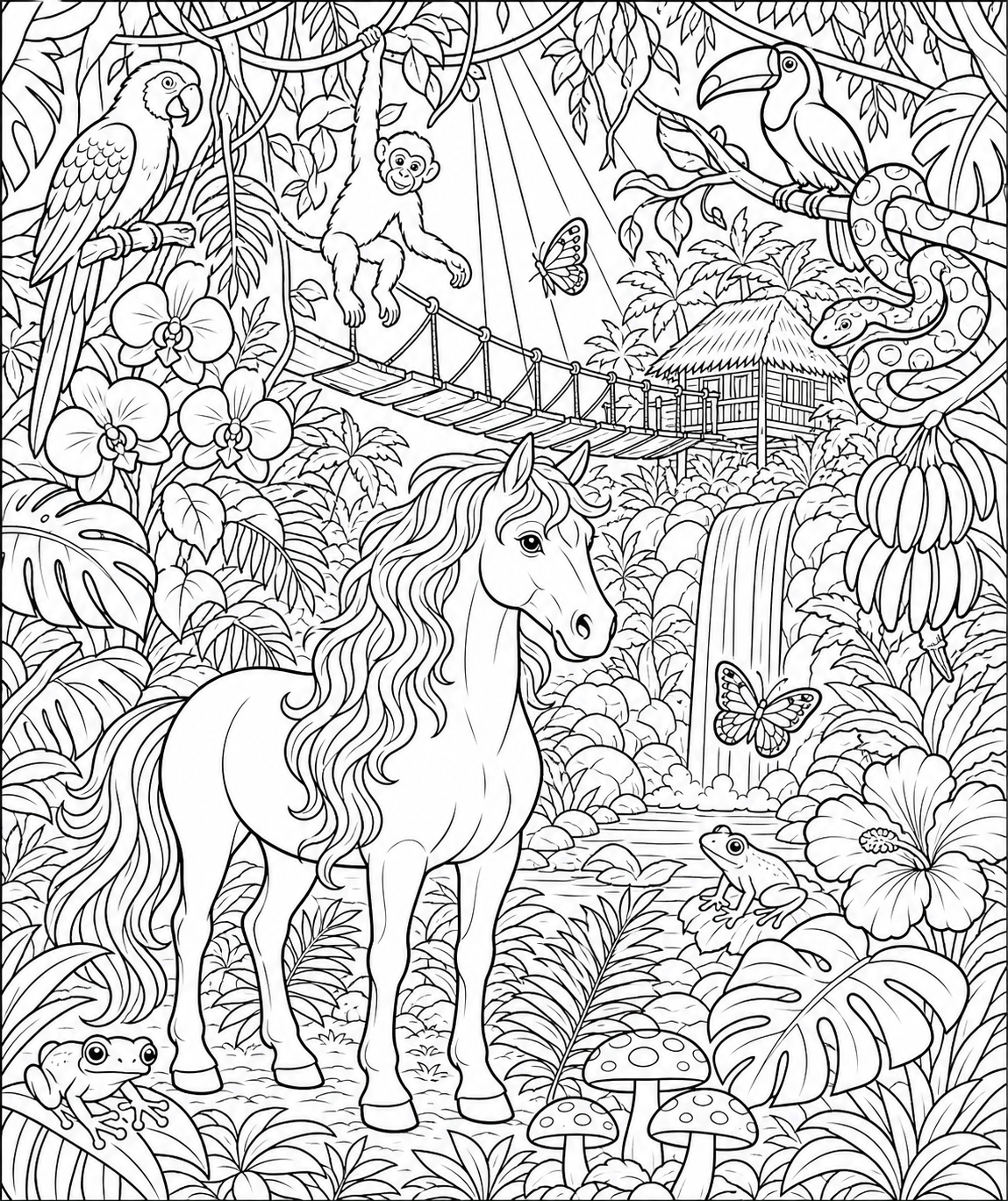
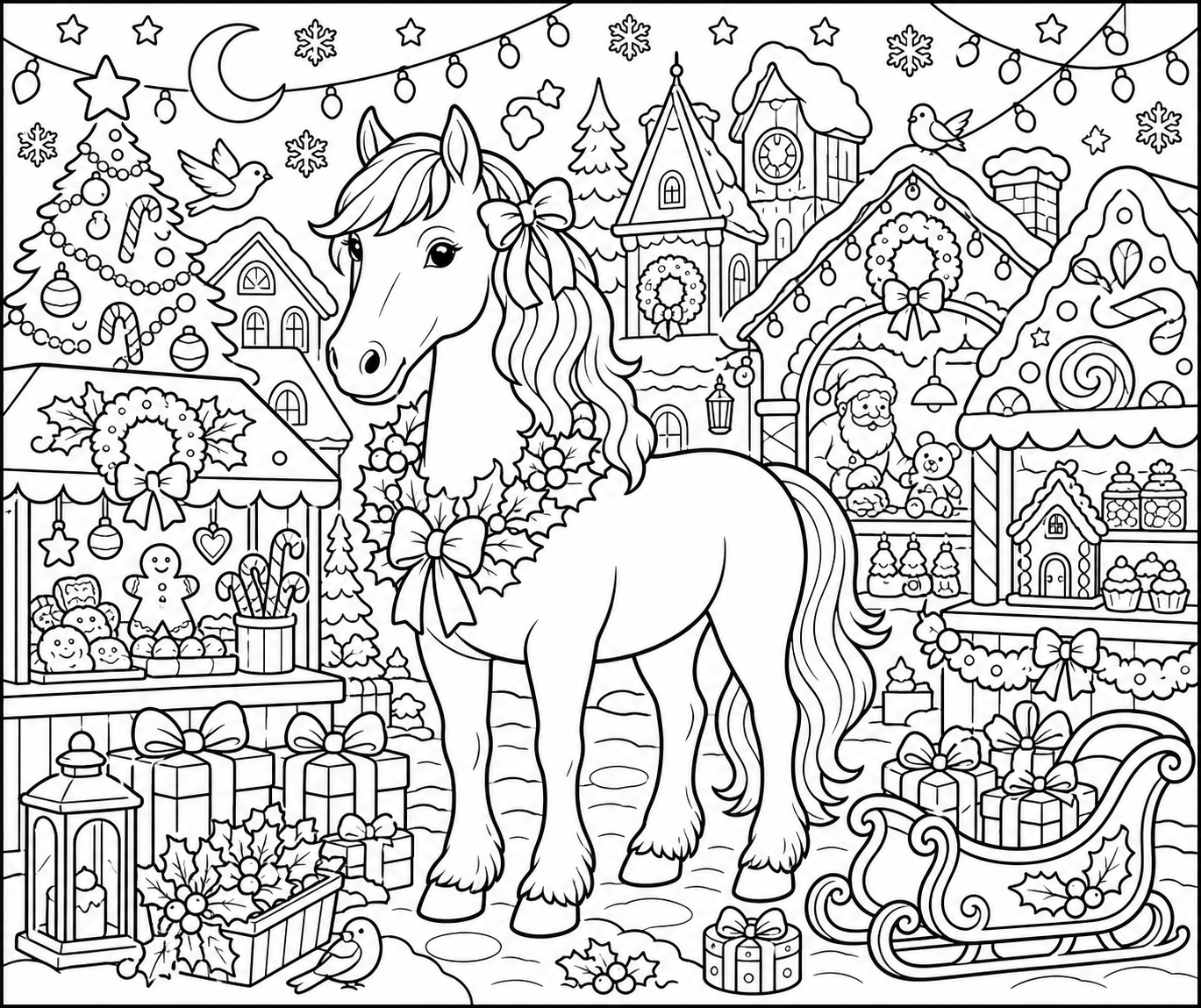
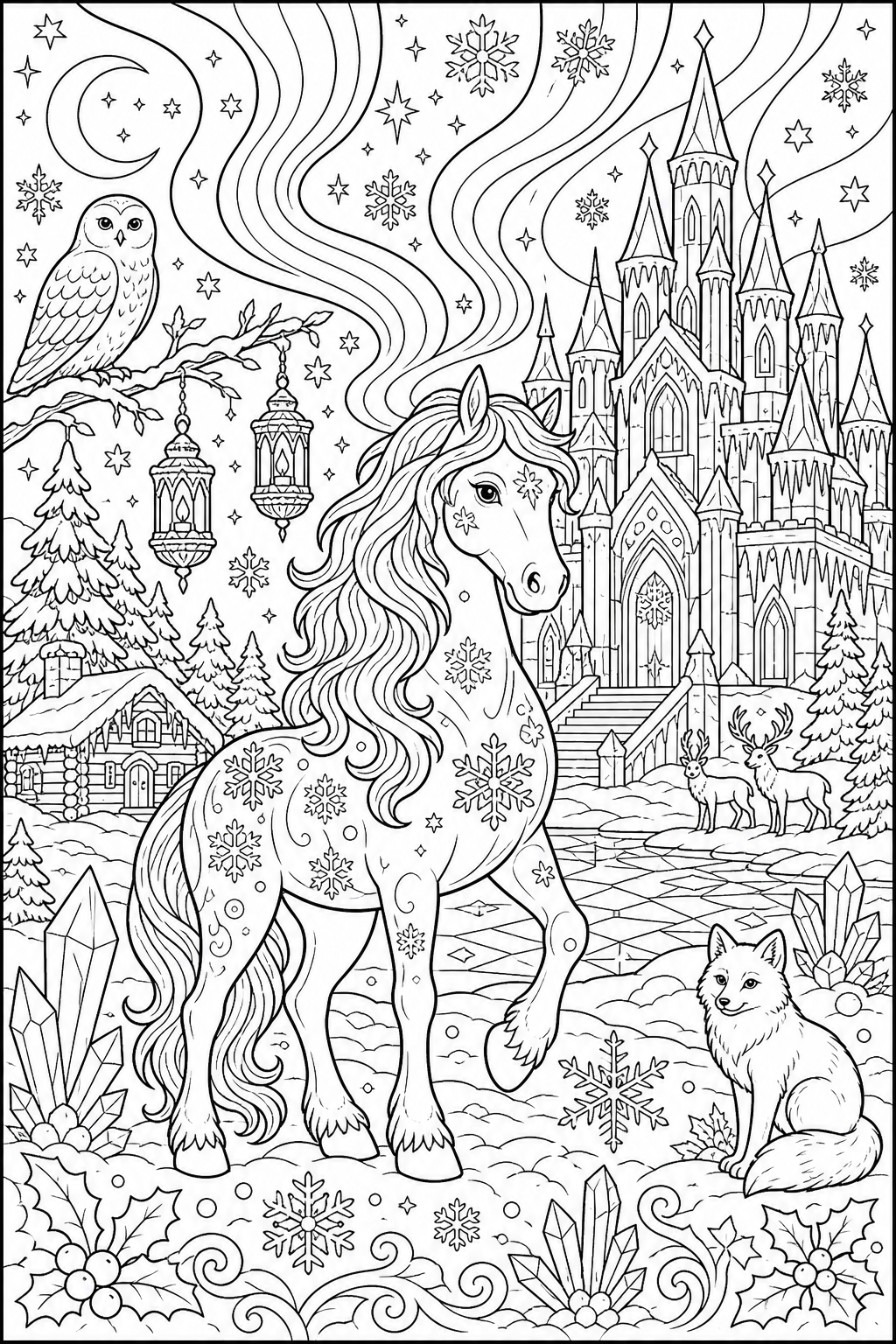
For ages eight to twelve, the Japanese garden, the peacock garden, the waterfall, the autumn forest, the castle, the ice palace and the Christmas market will hold an afternoon. These are still colouring pages, not mandalas. The horse stays large. The extra work is optional detail around it.
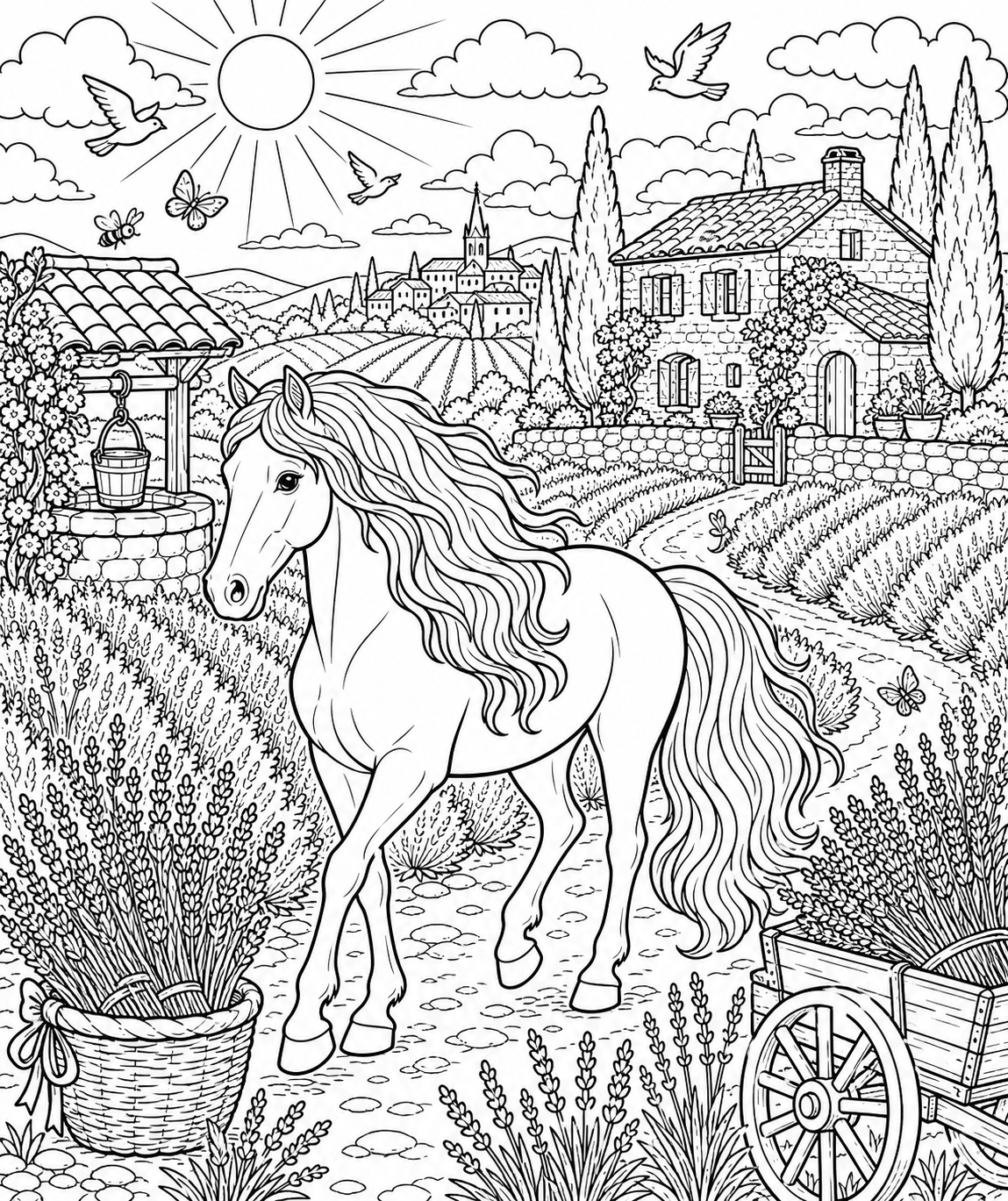
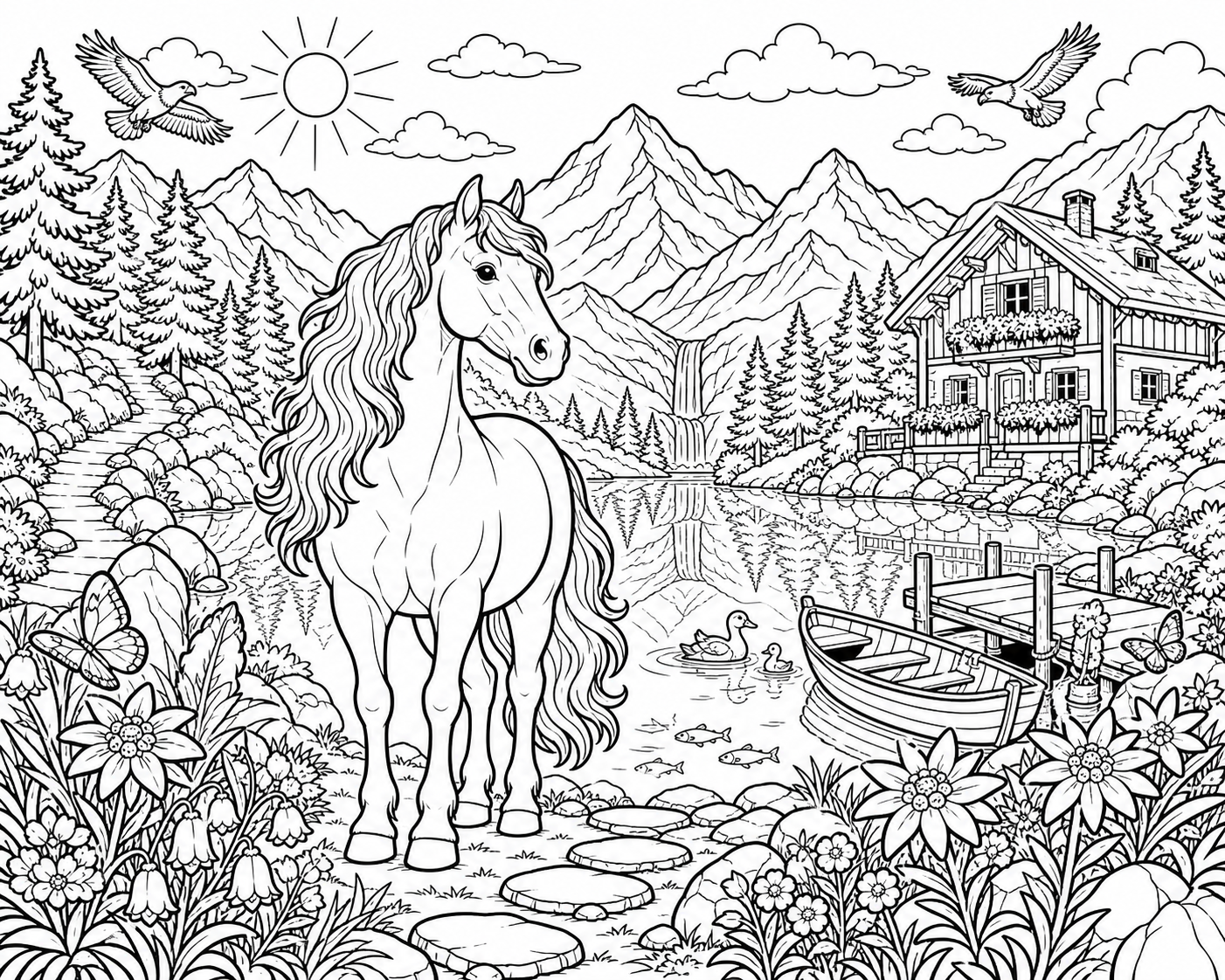
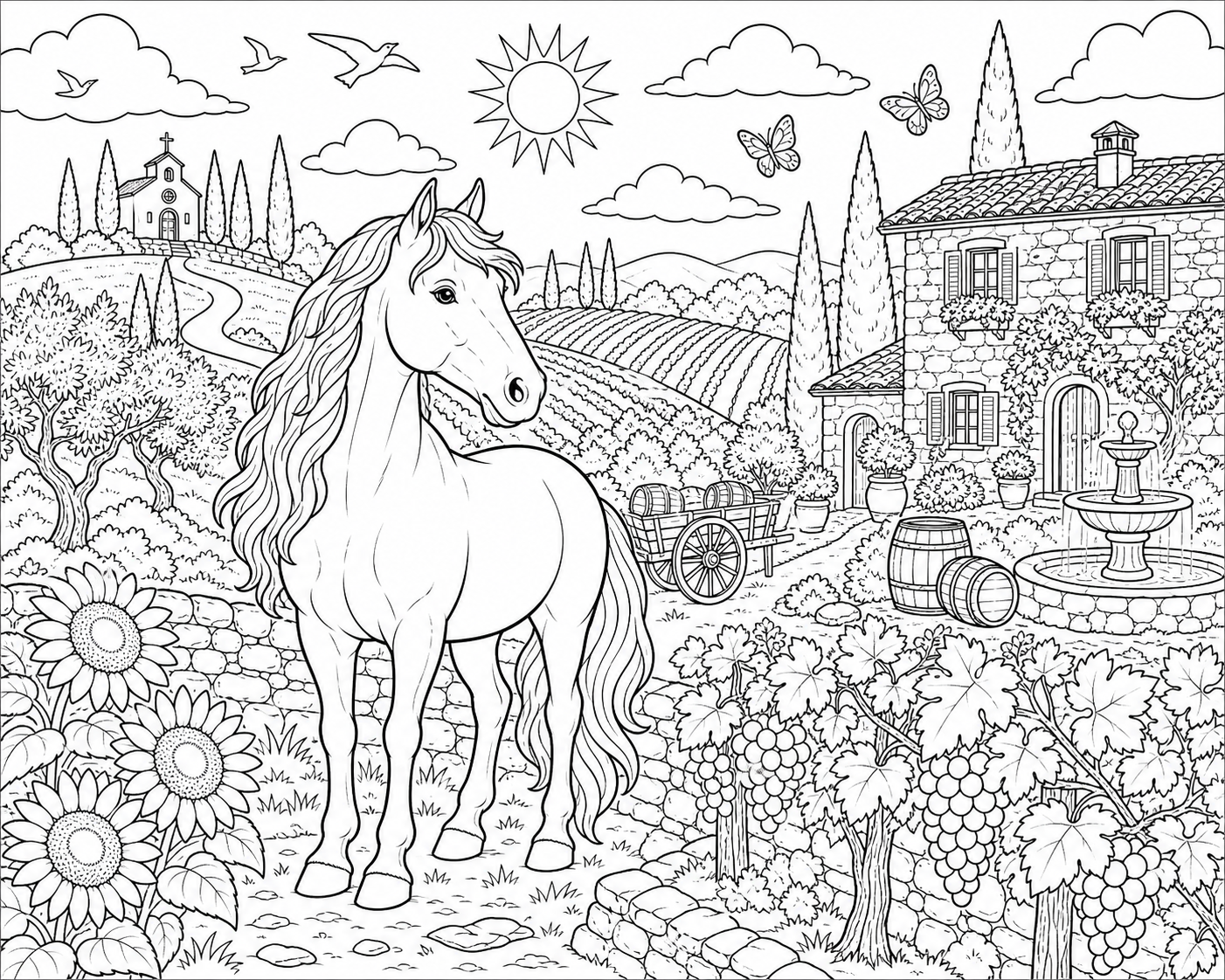
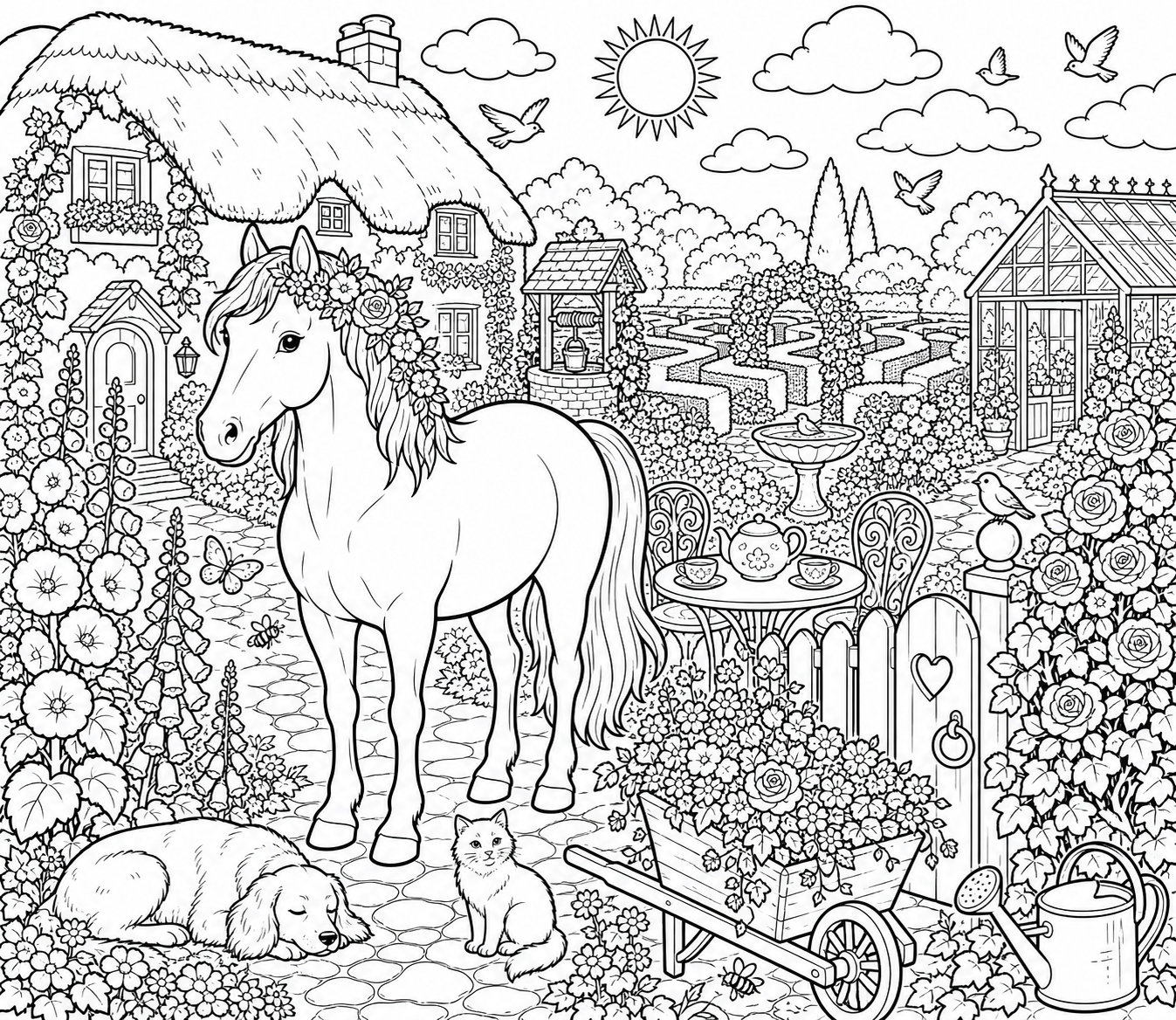
Teens and adults often want the lavender field, the Tuscany vineyard, the alpine lake, the northern lights and the English cottage garden. The lines are still friendly. The scenes are the kind you would hang on a fridge without irony. Horse coloring at this age is a way to keep the hands busy while a podcast runs, and it is a better evening than another scroll.
If two ages share a table, print one easy page and one detailed page. Swap when someone is done. The set is built for that mix. That is why there are 30, not ten.
Classroom, homeschool and party ideas
A horse page is one of the rare jobs that works for a mixed-age group on a floor at once. The set-up that holds for an hour is simple: one page per child plus spares, a shared crayon box per four children, a clipboard or table edge so a child can rotate the paper, and a wall or a line of pegs for finished work.
For a birthday, run it as a rule instead of a waiting time. “Give your horse a background that tells a story” gets a beach, a castle or a night sky on half the pages, and it stops the child who finishes in ninety seconds from wandering. Then hang everything and vote on categories no child can lose: best mane, bravest jump, quietest barn, most surprising sky.
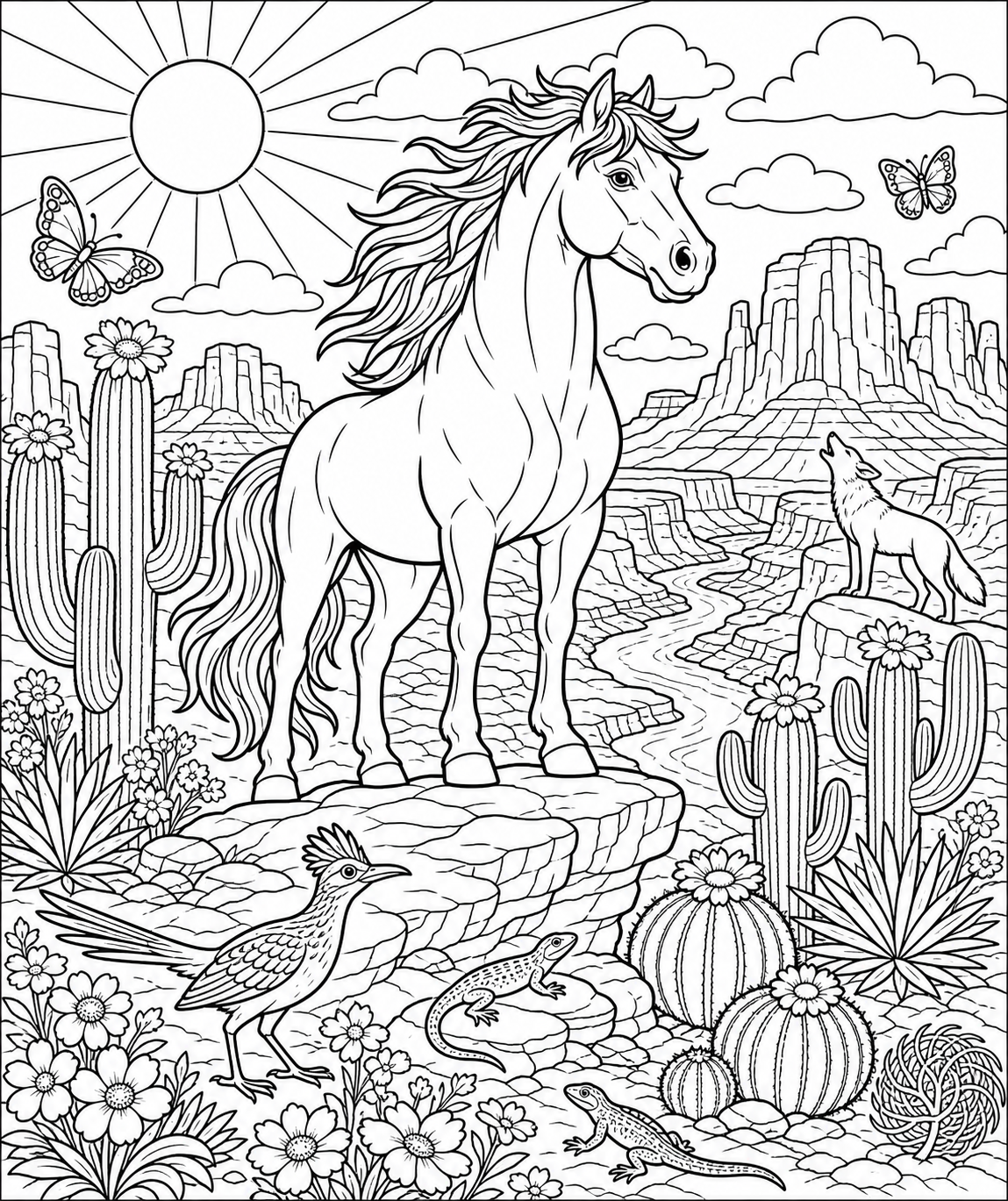
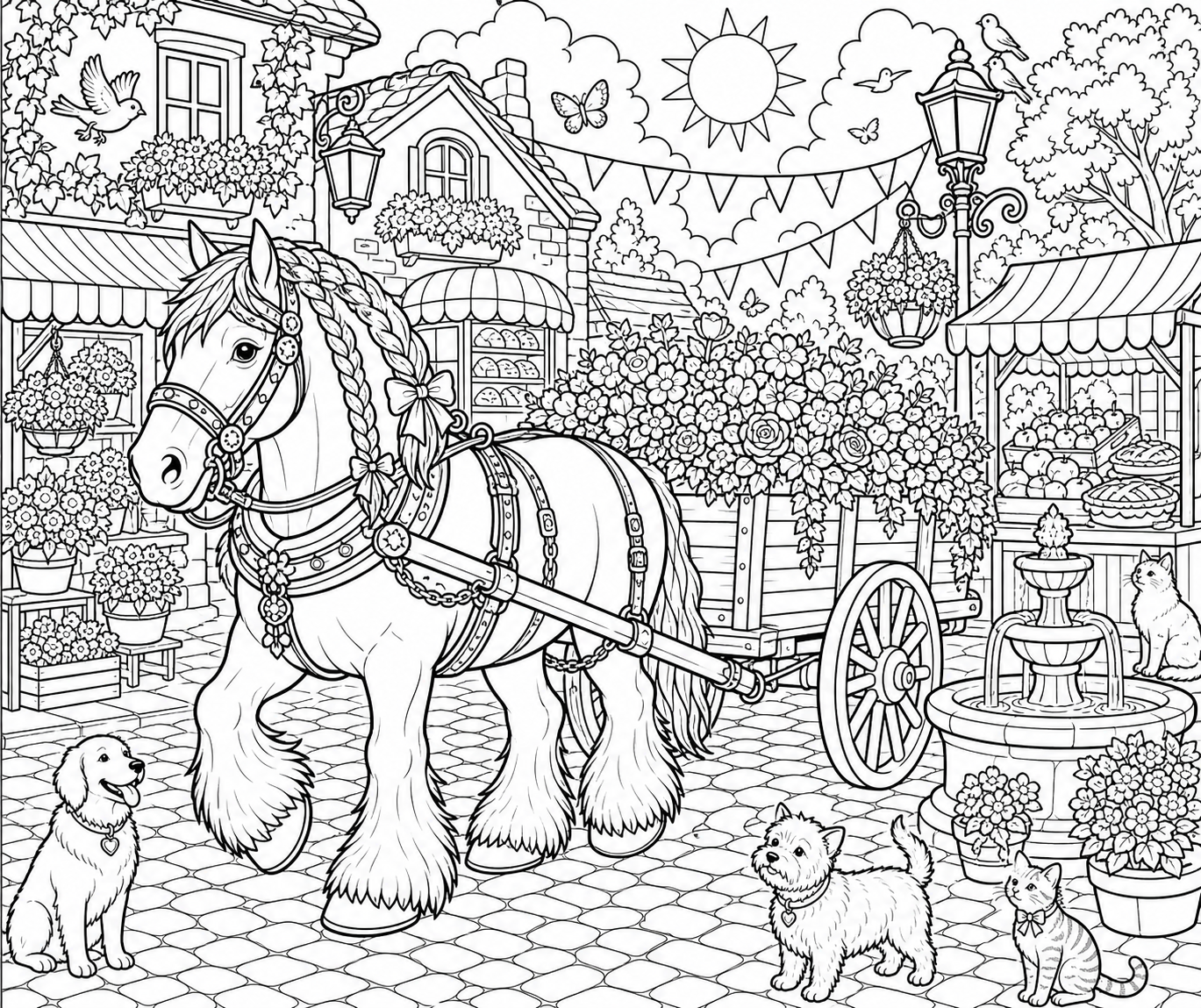
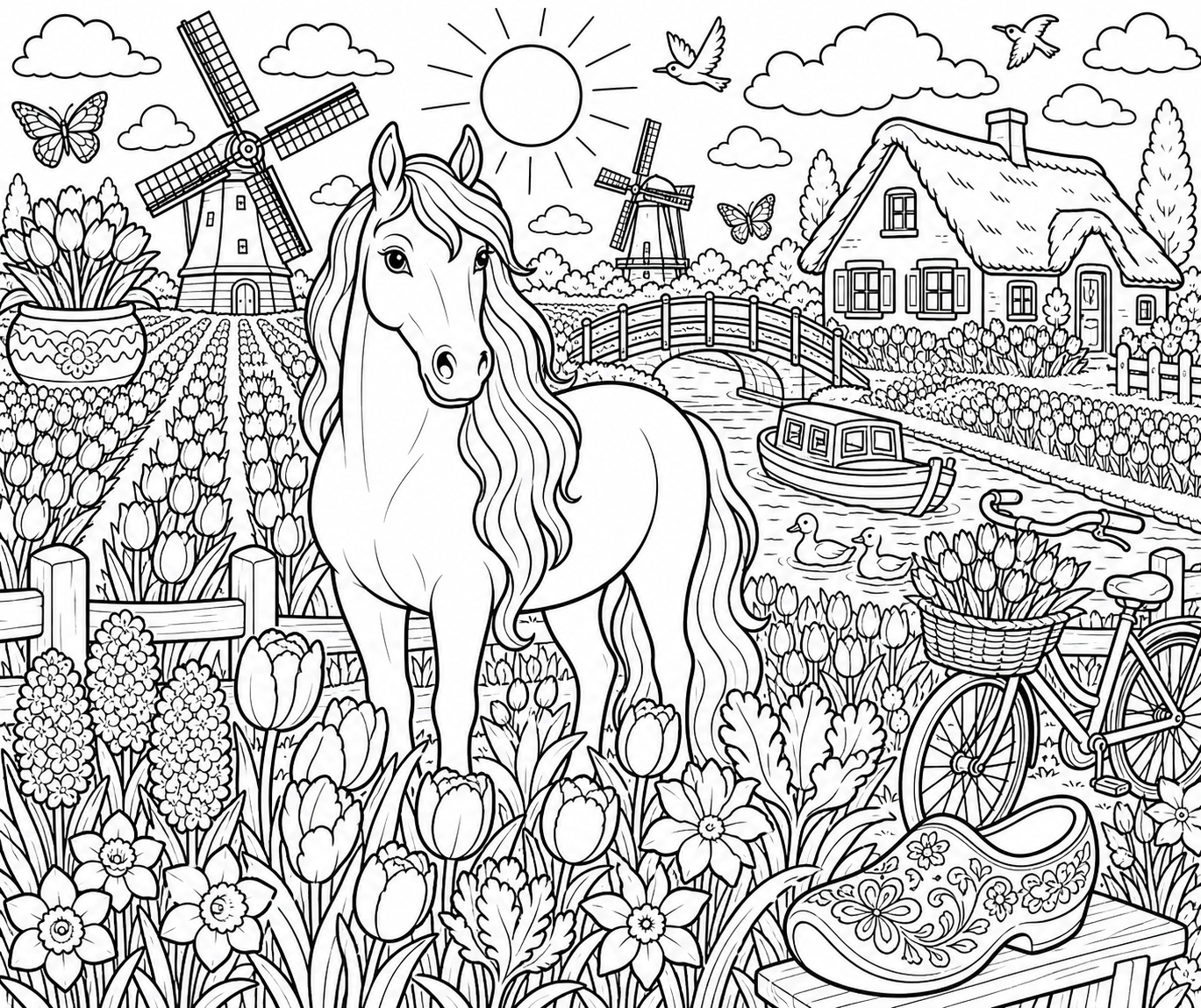
For a classroom, one horse coloring page covers more than art. The desert mustang pairs with a map. The Dutch tulips pair with a windmill. The Japanese garden pairs with a season. The draft horse and wagon pair with a local history talk about work animals. Add a one-line caption — what is the horse doing? — and the hour becomes writing practice with a crayon in it.
Homeschool days can treat the book PDF as a week. One page a morning. Date the back. By Friday you have a small stack that looks like a project, because it is one. Horse coloring is not a reward you withhold until the maths is done. It is a warm-up that makes the next pencil easier to hold.
Keep a few copies of our dinosaur coloring and cat colouring pages in the same box. When a child is done with horses, the box still has a job. The horse category on this site is the shelf those extra pages live on.
Scenes and breeds inside this horse coloring set
The 30 drawings are not 30 copies of one pony. They move through places a child can name and a few a child will ask about. That asking is part of the fun. The page is the hook. The world around the horse is the extra.
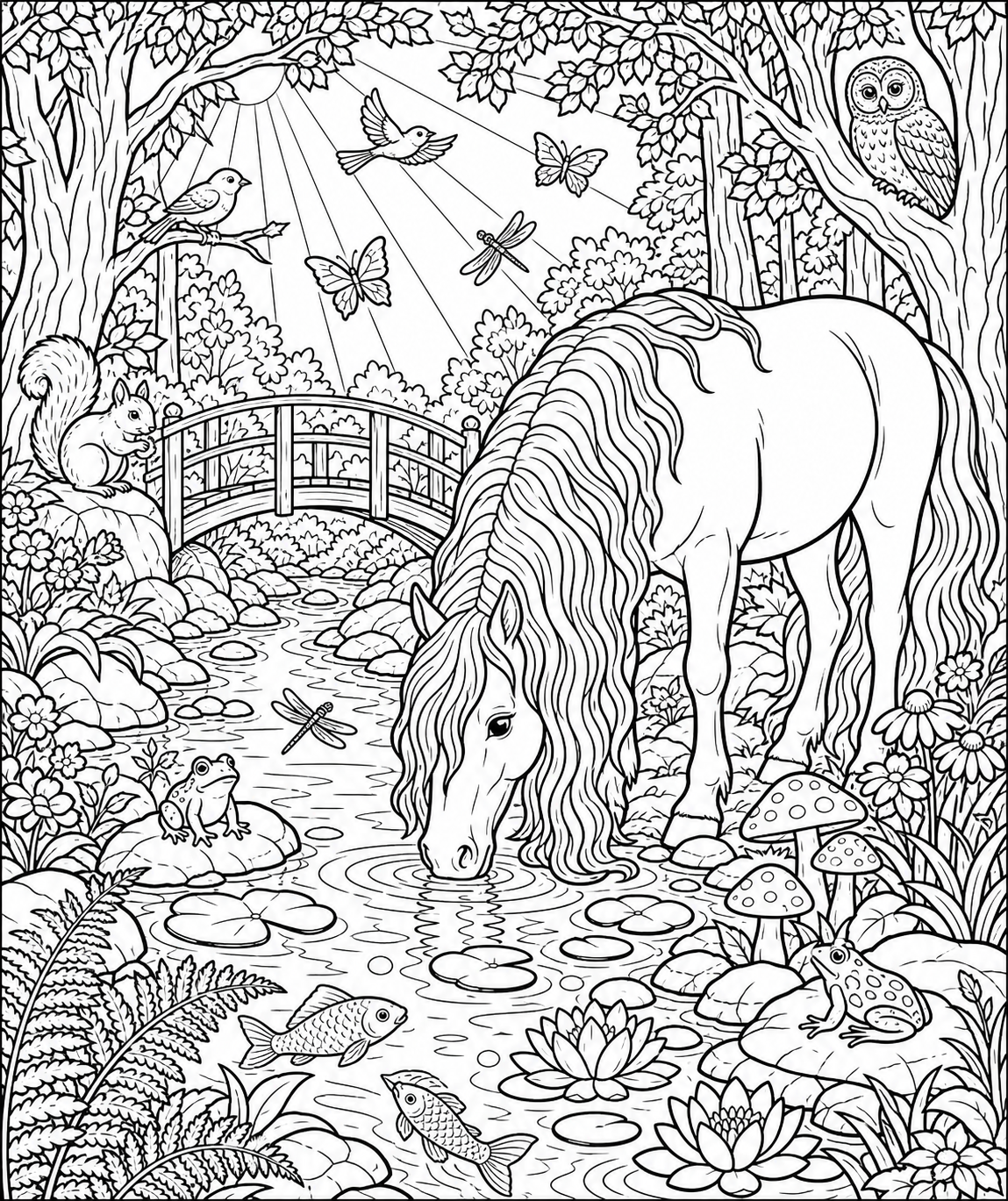
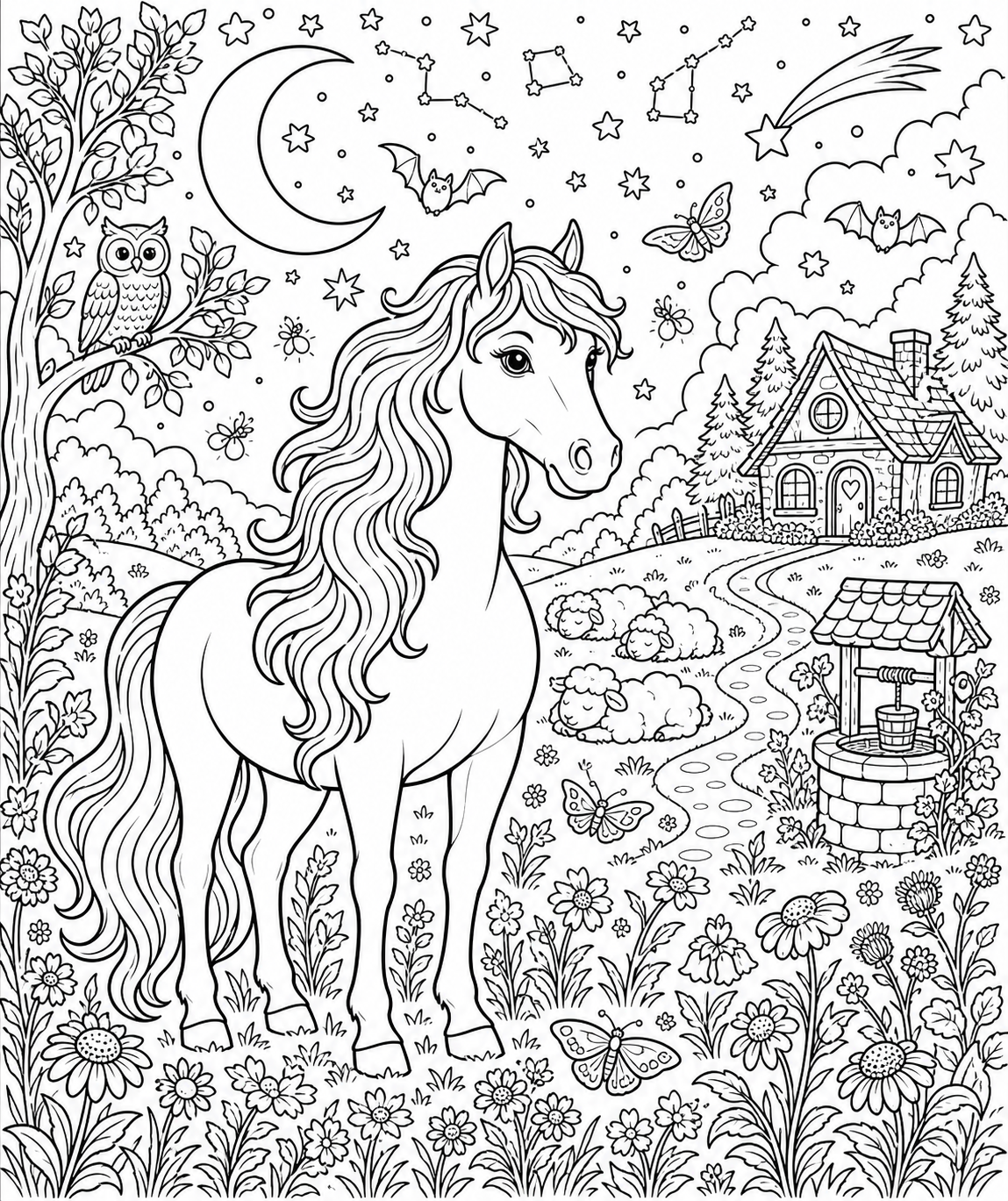
Farm and home sit first: the rose garden Arabian, the countryside gallop, the mare and foal, the barn, the forest stream, the fence jump, the apple tree, the sunflower field. These are the pages most families print twice.
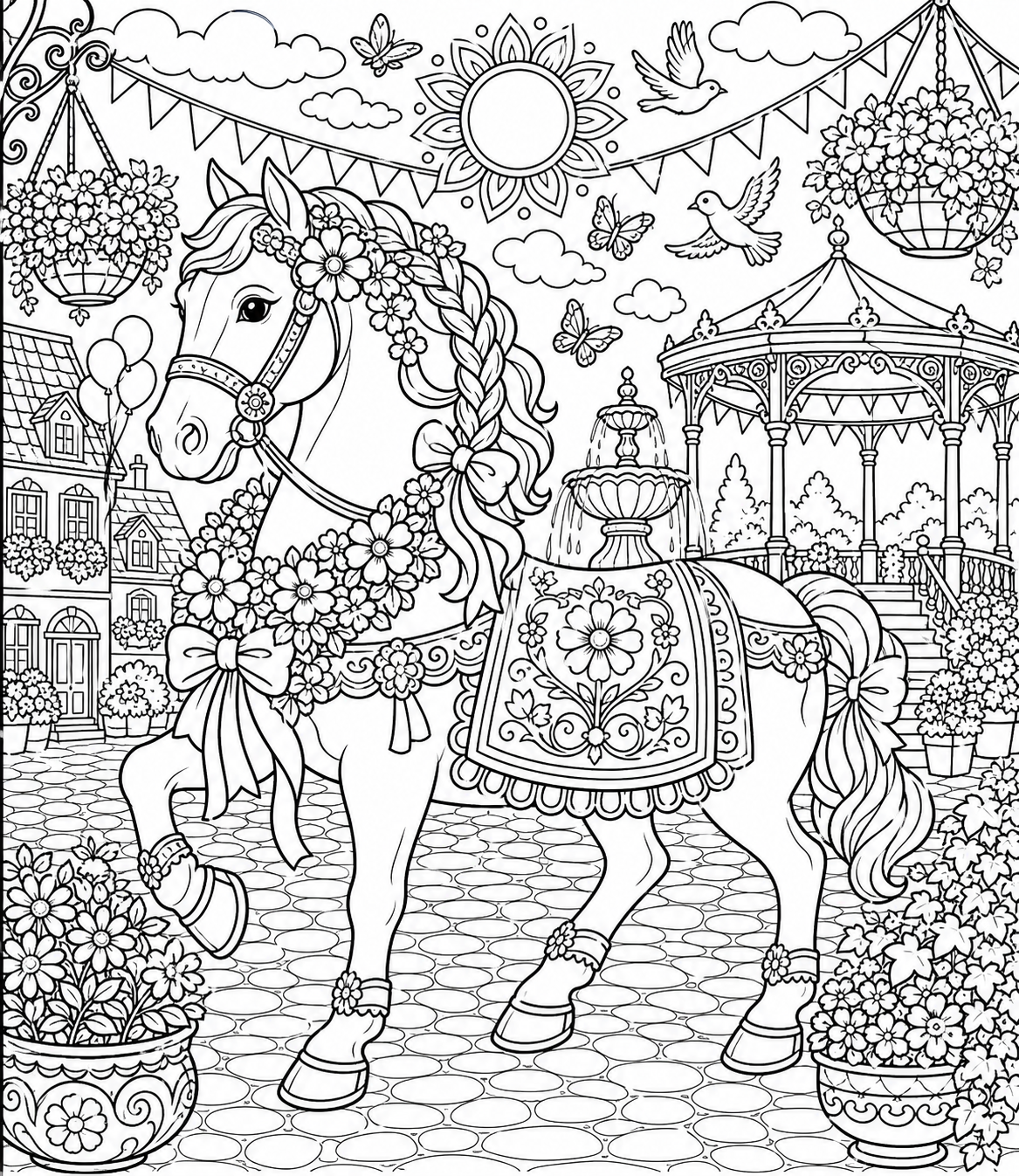
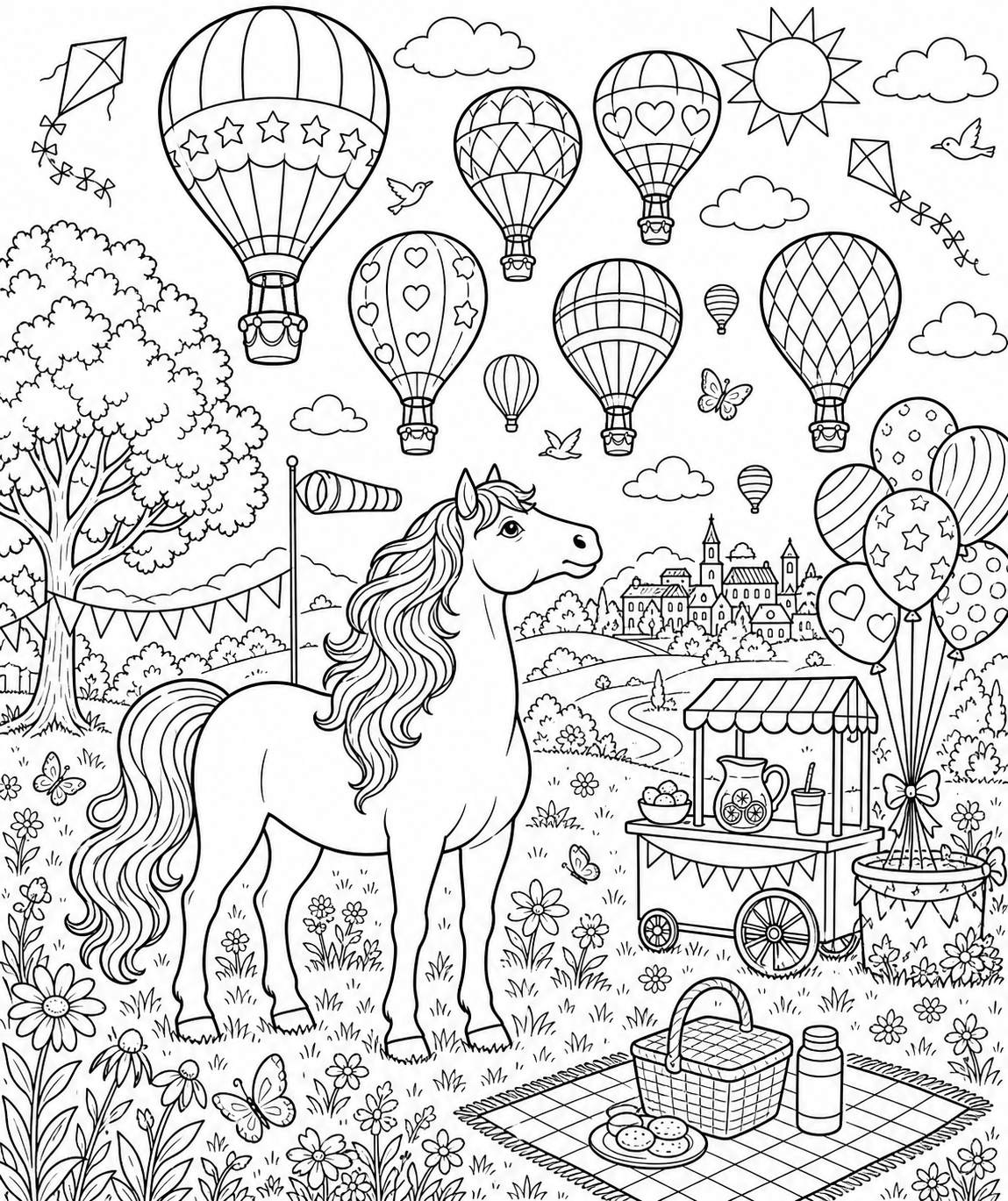
Celebration pages come next: the parade horse, the carousel, the flower wagon, the balloon festival, the Christmas market. They carry ribbons, stalls and lights — lots of small colour decisions that older children like.
Travel pages do the rest of the work. A tropical beach. A desert canyon mustang. Autumn trees. A mountain waterfall. Cherry blossom and a koi pond. A moonlit meadow. A castle courtyard. Two horses in spring. Lavender in Provence. An alpine lake. Dutch tulips. A peacock garden. A rainforest. A Tuscany vineyard. An ice palace under the northern lights. An English cottage garden.
You do not need to lecture. If a child asks what an Arabian is, you can say it is a breed known for a floating trot and a fine head, and then colour the bridle. If they ask about mustangs, you can say they are free-roaming horses in the American West. The FEI is the international home of horse sport if an older child wants the official side of riding. The activity does not have to become a worksheet. It only has to stay honest.
Adults who colour for calm often pick one “hard” page a week and leave the easy ones for visiting kids. That split is why the set is wide. A house with one printer can serve both.
Why horse coloring helps the hand and the hour
Horse coloring looks like a simple activity. For a four-year-old it is a full-body job of small muscles. The hand must hold a tool, the wrist must steer, the fingers must control pressure, and the eyes must tell the hand where the wall of the line is. That cluster is fine motor control. It is the same cluster a child needs for a pencil hold, a scissors line and a first letter.
Horses happen to be a good vehicle for that practice. A mane is a set of curves. A back is a long stroke. A hoof is a small shape that asks for a stop. A fence is a set of rectangles. A sky is a wide rest. Compare that with a page of tiny stars, and a horse page uses more of the hand without wearing it out.
There is also a motivation effect adults pretend not to notice. Children will colour a boring rectangle for three minutes and a horse for twenty. Horses sit in a sweet spot: familiar from stories, big enough to feel important, gentle enough for a younger child, detailed enough for an older one. That is the trick of a good horse coloring page. It looks like play and quietly does the practice a therapist would charge for.
For grown-ups the benefit is the hour itself. A detailed page gives the eyes a single job. Shoulders drop. The podcast can run. You end with a thing you can stick on a fridge, which is more than most evenings on a phone produce. If art as a calm habit interests you, the APA overview of the arts is a straight place to read more. This page is simply the paper.
None of this requires talent. Horse coloring is not drawing class. The lines are already there. The child supplies the decision. Decision is the skill.
How to colour a horse: mane, coat, sky and ground
Start with the outline. Trace the horse coloring page’s outer line in a dark colour, then fill inside it. Young children stay inside a drawing far longer when the border is a path they already walked.
Pick a coat colour second, not first. Bay, chestnut, black, grey, palomino, paint, or an invented purple — all of those are allowed. Real coats have a slightly lighter muzzle and a slightly darker mane. If a child wants accuracy, that one note is enough. If they want a rainbow mane, that is also horse coloring. It is their horse.
Do the mane in a second colour even when the coat is brown. A same-colour mane disappears. A flaxen mane on a chestnut, a black mane on a bay, a white mane on a grey — those pairs make the drawing pop from across the room. Strands can be two shades if the child has the patience.
Leave a little white on purpose. A shine on the neck, a white star on the forehead, a sock on one leg. White is a colour when the rest of the page is full. Children who colour every millimetre sometimes lose the horse. A small save of paper brings it back.
Sky and ground last. A simple band of blue and a simple band of green already place the animal in a world. The detailed pages in this set already give you flowers, tiles, snow and water. You do not have to invent a background. You only have to pick hues. Two colours are enough on a tired day. Ten are fun on a rainy Saturday.
Online, use the fill bucket for big shapes and the brush for the mane. On paper, fat crayons for the body and a pencil for the eye. That split keeps the session from turning into a fight with a single stubby tool.
Turn this set into a horse coloring book at home
The top button already builds the book for you: a cover and 30 horse coloring pages, one per sheet. Print it double-sided, flip on the long edge, and staple twice on the spine. Write a name on the cover. That is a book. It survives a school bag.
If you would rather make a thinner book, print ten pages you actually like and fold them. The farm set makes a gentle book. The travel set makes a longer one. Horse coloring as a booklet feels different from a loose sheet. Children treat a spine with more care, and they will finish a book they would not finish a pile.
Leave the back of the last sheet blank on purpose: “draw your own horse here.” The blank page is where colouring turns into drawing. Keep it. The modern colouring book began as a teaching tool, not as the end of drawing. A stack of these pages is a warm-up. The horse they draw next will look more like a horse because the hand already knows the parts.
If your paper supplier prints a little tree on the pack, the label usually means something. The FSC site explains the marks. That is a decent five-minute lesson for a nine-year-old who has started noticing logos, and it sits naturally beside a colouring session about farms and forests.
Horse coloring in the ColoringVemsy online studio
The Online coloring button on each card is not a generic sandbox. It sends that exact file into the studio: the same rose garden, the same waterfall, the same carousel. The address carries the image and the title, so the tab says the name of the page you picked.
Tap a closed shape to fill it. Draw your own line across a big sky if you want two colours instead of one. Undo is free. Save a PNG when you like the result, or print the coloured version. The studio guide on the online coloring page lists every tool in one line each.
Phone, tablet and laptop all work. A finger is a fill tool. Pinch to zoom on a detailed mane. Horse coloring on a bus is the same drawing you would have printed at home. That continuity is the point of putting the three buttons on top of the picture instead of hiding them in a menu.
If you arrived from another animal, the studio still remembers how to load a page from a link. Our dog coloring set and the dinosaur set use the same pattern, so a child who learned the buttons once can move across the site without a new lesson.
More free colouring pages on ColoringVemsy
Horse coloring sits inside a growing shelf of animal line art. When this set is done, these take over the table without a new account or a new app.
ColoringVemsy home · Horse category · Dinosaur coloring · Dog coloring · Coloring cat · Lion · Tiger · Elephant · Dog category · Cat category · Dinosaur category · Online studio
The home page shows a coloured version beside the line art for each animal, which is useful when a child wants to see “what it could look like” before they start. What you see on this page is the line art itself, because that is the page you came to fill.
Horse coloring questions parents and teachers ask first
Are these horse coloring pages free?
Yes. Every horse coloring drawing here is free to view, print, download as a PDF, and colour in the online studio. There is no sign-up, no watermark and no page you have to unlock.
What do the three buttons on each picture do?
Print opens only that horse coloring page and calls your printer. PDF saves a one-page A4 file with the title on it. Online coloring opens the same line art in our studio with the fill bucket ready.
Is the book a real PDF?
Yes. The top button downloads a cover plus all 30 horse coloring pages, one drawing per sheet. Print double-sided and staple the spine. Each picture also has its own one-page PDF if you only need one scene.
What age is horse coloring for?
About age two through adult. Start toddlers on the mare and foal, the barn or the beach. Save the Japanese garden, peacock garden, castle and ice palace for older children and adults. Horse coloring scales with the amount of background, not with a different animal.
Can I use these in a classroom?
Yes. Print one horse coloring page per child plus spares. Please link to this page rather than re-hosting the files, so the drawings keep their credit and their free terms. For a school pack with a different layout, write to us — classroom requests are almost always a yes.
Will horse coloring work on a phone?
Yes. Tap Online coloring on any card. The same picture opens in the studio. It works on a phone, tablet or laptop. Save the finished work as a PNG or print it later.
What colour should a horse be?
Any colour the child chooses. Bay, chestnut, black, grey and palomino are the common real coats. A purple horse is a decision, which is exactly what a horse coloring page is for. A slightly lighter muzzle and a different-colour mane will make any choice look finished.
Why are the buttons on top of the picture?
So you can see the horse coloring page and the three actions in one glance. Print, PDF and Online coloring sit on the drawing they belong to. There is no separate gallery to tap through first.
Updated 3 September 2026 · 30 original pages · ColoringVemsy · Back to the pages
Pingback: Tiger Coloring Pages — 20 Free Printable Tiger Coloring Pages for Kids & Adults (PDF)
Pingback: Elephant Coloring Pages — 10 Free Printable Elephant Coloring Pages for Kids & Adults (PDF)
Pingback: Coloring Dinosaur Pages — 10 Free Printable Coloring Dinosaur Pages for Kids & Adults (PDF)