Dinosaur busy book printables — 10 Free Cut-and-Match Activity Sheets
Dinosaur busy book printables bring ten new dinosaur scenes together with clear picture-matching boards and shuffled cut-out cards. Match three pairs on each sheet, then color the dinosaur and its background. Adults prepare and supervise the cards.
Choose a volcano camp, flower garden, crystal cave, lighthouse bay or another new setting. All ten sheets have the same dimensions and layout. Free to download, with no sign-up or watermark. Loose cards are not suitable for children under three or children who mouth small objects.
- 🦕 10 new scenes
- ✂️ Cut + match
- 🧒 Ages 3–6 supervised
- 📕 Free PDF
- 🖨 A4 + US Letter
For cut-out use, print single-sided. The shared book-bar double-sided option is only for uncut pointing/coloring copies.
10 Dinosaur busy book printables to download
View a sheet, download it, or open it for online coloring. For matching, print single-sided and have an adult cut the three bottom cards. Place each card on the identical target picture. Online coloring is not an interactive matching game.
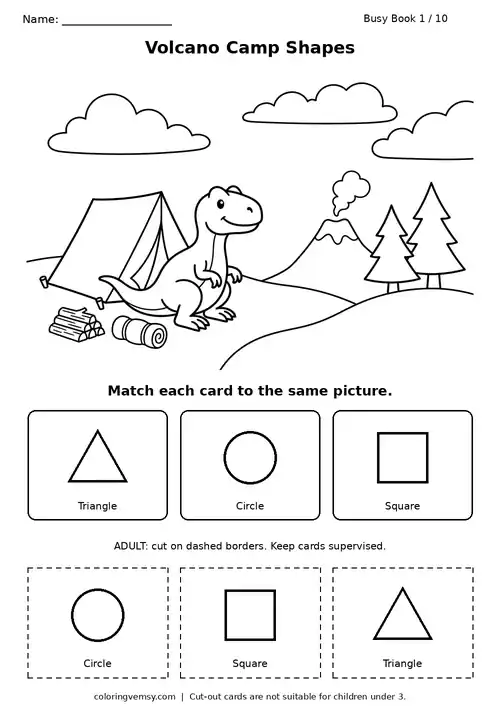
1. Allosaurus Volcano Camp
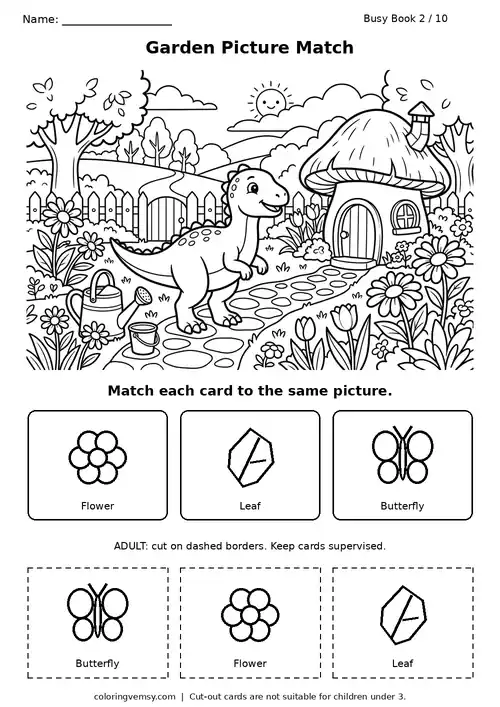
2. Heterodontosaurus Garden Cottage

3. Amargasaurus Orchard Picnic
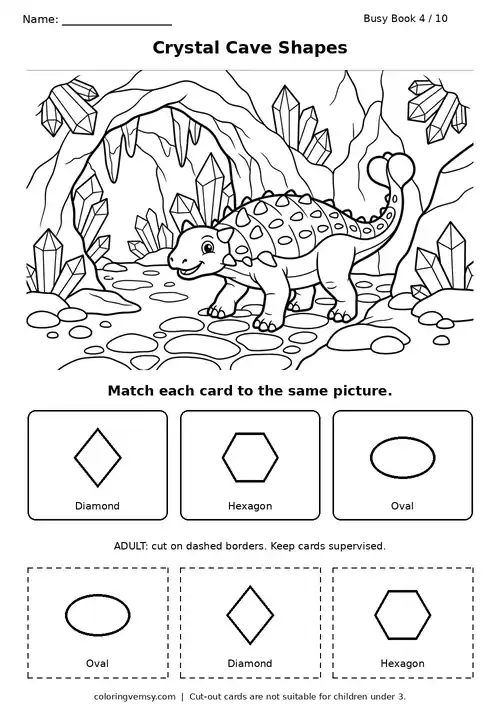
4. Euoplocephalus Crystal Cave
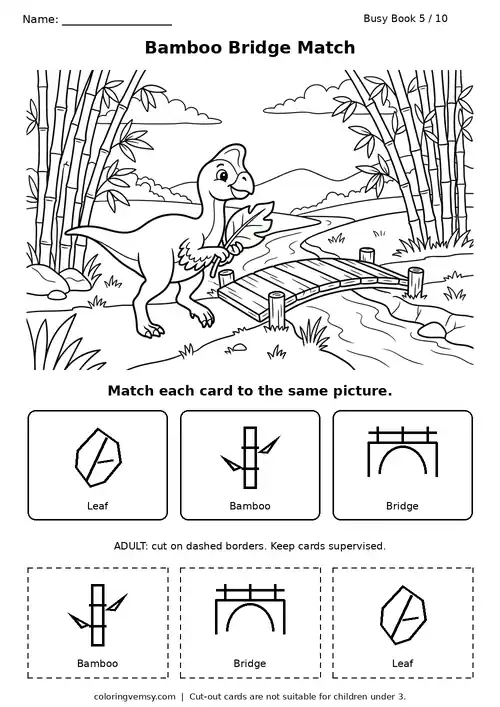
5. Oviraptor Bamboo Bridge

6. Centrosaurus Lighthouse Bay
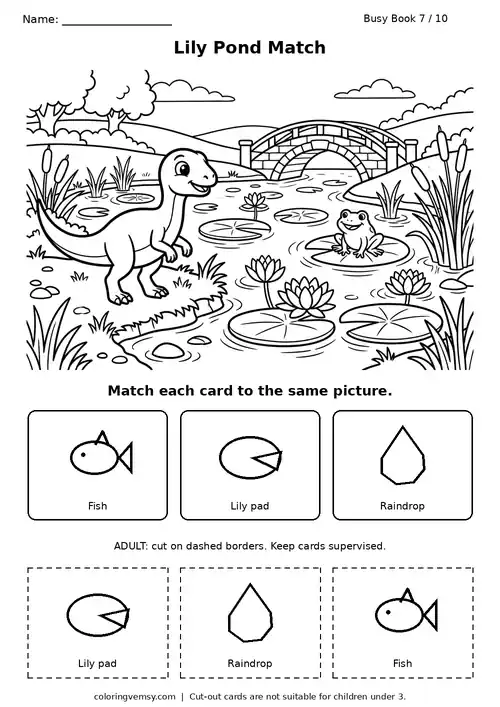
7. Dryosaurus Lily Pond
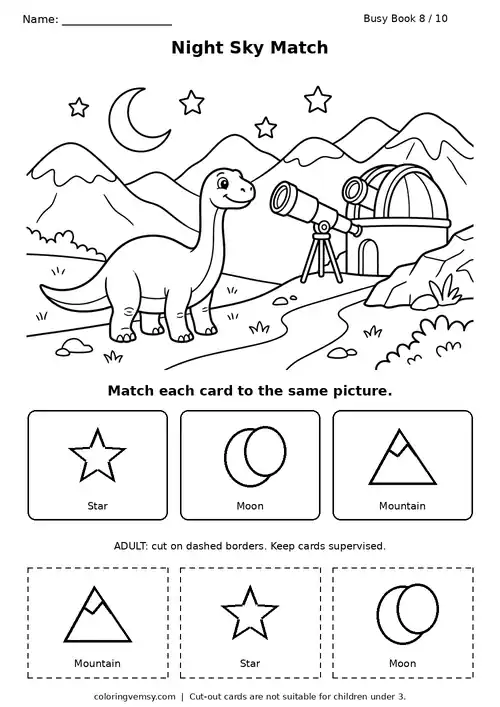
8. Plateosaurus Mountain Observatory
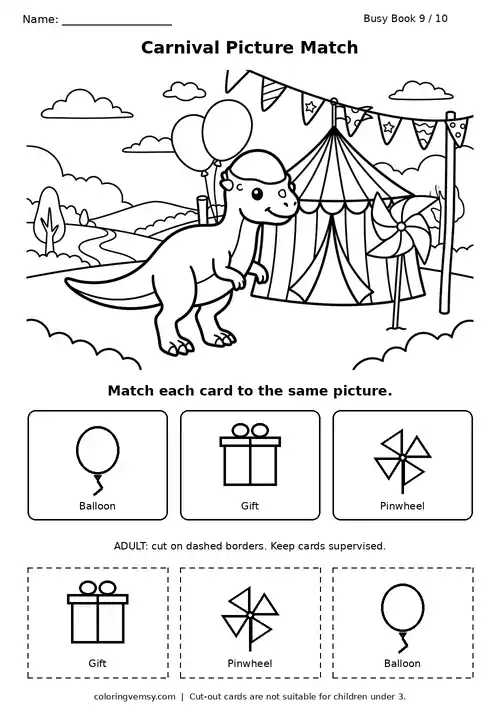
9. Prenocephale Carnival
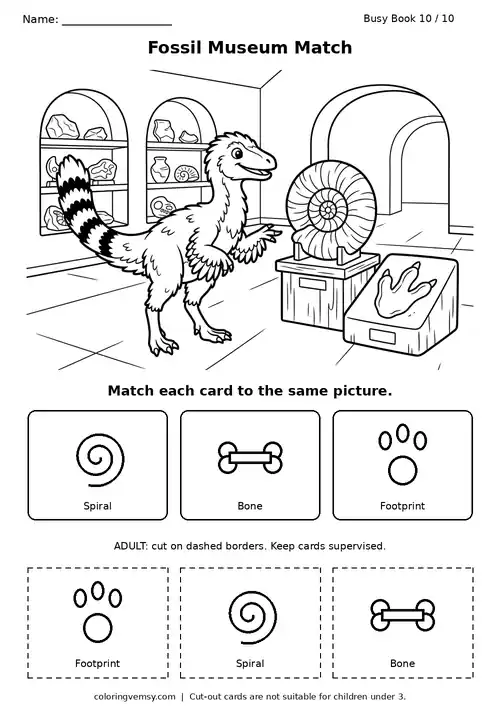
10. Sinosauropteryx Fossil Museum
Same size, clear pairs: these Dinosaur busy book printables use 500 × 707 px WebP images, about 19–43 KB each. Full worksheet masters are all 1000 × 1414 px. Each target and matching card uses the same icon drawing.
📑 Table of Contents
- What is inside the busy book?
- Meet the ten new dinosaur activity pages
- How to download and print
- Skills children can practice through matching
- Choose an easy starting point
- Prepare cut-out cards safely
- Color the different backgrounds
- Extend the matching game
- Ideas for preschool, home and small groups
- Frequently asked questions
What is inside these Dinosaur busy book printables?
A busy book gives a child a small task they can touch, move and repeat. This collection uses a simple picture-to-picture matching format: three target pictures appear beneath a dinosaur scene, and three matching cards sit at the bottom of the same sheet. A grown-up cuts out the cards, and the child places each one over its matching target.
There are ten different scenes, from a volcano campsite to a fossil museum. Every sheet follows the same layout, so children can learn the routine once while exploring a different setting each time. The black-and-white artwork can also be colored, making each activity a little art project as well as a matching game.
These Dinosaur busy book printables are suggested for ages three to six with adult supervision. The loose cards are not suitable for children under three or children who still mouth paper and small objects. An adult should prepare the pieces, stay nearby during use and collect every card afterwards. Coloring the uncut sheet is an alternative when loose pieces are inappropriate.
What this pack does and does not include
The download contains a cover and ten activity sheets. Each activity sheet includes its own matching board and three cut-out cards, giving thirty cards across the collection. There are no separately supplied hook-and-loop dots, scissors, binder pockets or storage envelopes. You can use the paper cards directly on the table; extra assembly materials are optional.
Ten new scenes and their matching activities
All dinosaur illustrations in these Dinosaur busy book printables were made for this pack rather than reused from earlier pages. Each has a different background, while the final page size, target-box size and card size stay consistent. The characters are playful cartoons, not scientific identification diagrams.
1. Allosaurus Volcano Camp
An Allosaurus camps beside a volcano and tent. Match the triangle, circle and square cards to their target boxes. Talk about each outline before coloring the campsite.
2. Heterodontosaurus Garden Cottage
A little garden visitor explores a cottage among flowers. Match flower, leaf and butterfly pictures. Notice that the card icons are simpler than the decorative background, so always compare them to the target boxes.
3. Amargasaurus Orchard Picnic
A long-necked picnic guest rests among apple trees. Match the apple, pear and basket icons. Children can name the objects before placing a card, then invent a menu for the picnic.
4. Euoplocephalus Crystal Cave
An armored dinosaur explores a cave full of crystals. Match the diamond, hexagon and oval. Compare corners and curved edges, using a finger to follow each outline if helpful.
5. Oviraptor Bamboo Bridge
A beaked dinosaur stands beside a bridge and bamboo grove. Match the leaf, bamboo and bridge cards. This page offers different outlines to compare without adding more than three pieces.
6. Centrosaurus Lighthouse Bay
A horned dinosaur visits a bay with a lighthouse and boat. Match shell, boat and sun cards. After matching, decide what weather the seaside visitor might enjoy.
7. Dryosaurus Lily Pond
A small dinosaur meets a frog beside a pond. Match fish, lily pad and raindrop pictures. Look closely at the cut-out section of the lily pad rather than choosing only by size.
8. Plateosaurus Mountain Observatory
A long-necked visitor looks through a telescope near the mountains. Match star, moon and mountain icons. The scene invites a gentle conversation about nighttime without requiring any astronomy facts.
9. Prenocephale Carnival
A dome-headed dinosaur enjoys a carnival tent and balloons. Match balloon, gift and pinwheel icons. The festive background doubles as a coloring activity once the three cards are in place.
10. Sinosauropteryx Fossil Museum
A fluffy-tailed guide shows a fossil display. Match spiral, bone and footprint icons. The spiral is a simple matching symbol, while the illustrated museum includes a more decorative fossil exhibit.
Match cards to the identical icons in target boxes, not objects in the background. The illustrated scenes are for coloring and conversation.
Download and print the busy book
The book button downloads all ten Dinosaur busy book printables together in one PDF, with a cover at the front. Use Download beneath an individual image when you only need one activity. The PDF is laid out on A4 paper; choose Fit to page when using US Letter so the card edges remain visible.
- Print activity sheets single-sided. Cutting cards from the bottom of one sheet must not remove artwork or cards printed on its reverse.
- Use a test print first. Check that all three target boxes and all three dashed card borders appear completely.
- Choose portrait orientation. Every final sheet has the same tall layout and the same arrangement of activities.
- Keep scaling consistent. Print replacement copies at the same settings if you want the new cards to fit existing boards.
- Select black-only or grayscale. The activity pages use black-and-white line art; the book cover has color accents.
Ordinary paper works for a supervised table activity. A heavier paper can be easier for some children to move, provided your printer supports it. Test your chosen material before making a full set. The compact download prioritizes convenient sharing, so inspect a printed sample before preparing a large classroom batch.
The View button opens a worksheet image separately. Online coloring opens the same sheet in the coloring tool; it does not create draggable matching cards. Printing and adult preparation are needed for the hands-on cut-and-match activity.
What children can practice through matching
Using Dinosaur busy book printables gives children opportunities to look closely, compare features and make a choice. A child may notice that two pictures have the same outline, turn a card to check it, or reject a tempting match because one detail is different. Naming those observations makes the activity more useful than simply placing cards quickly.
- Visual comparison: noticing the outline, internal marks and orientation of a picture.
- Shape vocabulary: talking about circles, triangles, squares, diamonds, hexagons and ovals.
- Everyday vocabulary: naming a basket, shell, bridge, balloon or footprint.
- Hand-eye coordination: moving a large paper card toward a chosen target.
- Turn taking: choosing one card at a time during a shared activity.
- Explaining a choice: saying or showing what makes two pictures alike.
These are opportunities for practice, not promises of a developmental outcome. A printable is only one part of a varied day that can include blocks, pretend play, outdoor movement, books and free drawing. There is no need to complete every page to make the activity worthwhile.
Comment on an observable strategy: “You checked the corners” or “You turned the card before choosing.” Avoid comparing children by speed. Some children will match immediately, while others enjoy discussing the scene first. A thoughtful pause is not a mistake and does not need to be hurried.
Choose an easy starting point
Begin with a small amount of material. Three cards can be manageable, but one target and its matching card may be a better introduction. Cover the unused targets with a sheet of paper and add another only when the child seems ready.
| Starting point | Suggested sheets | Adult support |
|---|---|---|
| First matching activity | 1 Volcano shapes, 4 Crystal shapes | Offer one or two cards and point out a clear outline. |
| Comfortable with matching | 3 Orchard, 6 Lighthouse, 9 Carnival | Offer all three cards and invite a brief explanation. |
| Enjoys looking closely | 2 Garden, 5 Bamboo, 7 Pond | Discuss the features that distinguish each picture. |
| Ready for a mixed set | 8 Night sky, 10 Museum, then two boards | Mix six cards while keeping the activity supervised. |
Within these Dinosaur busy book printables, children can also choose a favorite scene independently of difficulty. If the museum picture is irresistible, use it first and reduce the number of cards. Familiarity with a dinosaur name is not required; describing the animal as a “fluffy-tailed dinosaur” or “long-neck dinosaur” works perfectly well.
If a child has trouble lifting a flat card, an adult can model sliding it across the table instead. Keep the surface uncluttered and avoid adding fastening pieces solely to make the activity look more elaborate. The simplest version is often the easiest to understand.
Prepare and use the cut-out cards safely
Before offering Dinosaur busy book printables to a child, read the sheet instructions and check every card. The dashed rectangles mark the cut-out boundaries. The solid rounded boxes above them are matching targets and should stay attached to the activity board.
- An adult cuts the cards. Keep scissors out of reach when they are not being used.
- Count the pieces. Each sheet starts with three cards; collect the same three after playing.
- Check the age and behavior of the child. Do not offer loose cards to children under three or anyone who mouths small objects.
- Skip unnecessary small accessories. Loose magnets and small fasteners can introduce additional hazards and are not needed.
- Inspect optional protective materials. If you laminate, follow product directions, avoid sharp corners and supervise use.
- Store the set securely. Put boards, cards and any tools away from younger siblings after the activity.
The cards are intentionally broad rectangles, but that does not remove the need for supervision. Paper can be folded, torn or placed in the mouth. If cards become damaged, remove them and print replacements rather than continuing with fragments.
For a no-cut version, leave the sheet whole and ask the child to point to a target and then its matching card below. They can also color a pair with the same crayon. This keeps the comparison activity available without introducing loose pieces.
Color the backgrounds without confusing the matches
Every page in these Dinosaur busy book printables includes a different scene to color. A tent and volcano introduce the first setting; flowers and a cottage fill the garden page; crystals, bamboo, waves and museum displays give later pages their own personalities. There is no need to color every detail before starting the matching task.
If you color the matching icons, give both copies of a pair the same colors. A blue target balloon and a red card balloon can still be matched by outline, but younger children may wonder why the colors disagree. Matching colors can make the first round more straightforward.
- Volcano camp: try warm lava colors, a bright tent and green trees.
- Garden and orchard: use flower colors, apple reds and a patterned picnic blanket.
- Crystal cave: choose a different bright color for each large crystal.
- Bamboo and pond: explore several greens alongside blue water.
- Lighthouse bay: use sandy yellows, a striped tower and a contrasting shell.
- Night sky: choose a dark sky effect carefully while keeping the black outlines visible.
- Carnival: alternate tent stripes and give the balloons cheerful colors.
- Museum: invent display colors and a special outfit for the little guide.
Cartoon dinosaurs welcome imaginative colors. The illustrations are stylized, so use museum references rather than these drawings to answer scientific questions about anatomy or appearance. Coloring can remain a creative choice rather than a test of dinosaur knowledge.
Simple ways to extend the matching game
Once matching feels familiar, these Dinosaur busy book printables can support a few easy variations. Change one thing at a time so children can understand the new task without losing the familiar routine.
- Name and find: an adult names an object, and the child chooses its card before matching it.
- Describe without naming: say “the picture with three corners” or “the thing that floats on water.”
- Switch the order: shuffle the three cards again and check whether the child recognizes them in new positions.
- One card missing: with supervision, set aside a card and ask which target still needs its partner.
- Two-board challenge: offer six cards from two sheets when three no longer feels interesting.
A separate memory game needs two loose copies of each picture. Print the card section twice or use two copies of the sheet, with an adult preparing both sets. Start with only a few pairs face up before trying a face-down memory game. Keep track of the increased piece count afterwards.
Invite a story about the background when the matching is done. What is inside the tent? Where does the bamboo bridge lead? Which exhibit would the museum dinosaur show first? The answers do not have to be factual; the purpose is to make space for the child’s own ideas.
Organize a reusable home or classroom set
Keep each board and its three cards together in a clearly marked storage pocket or envelope, handled and stored by an adult. A pencil note on the reverse can identify which board a card belongs to. Mark all three cards from a page the same way so the note does not accidentally reveal individual matches.
For group use, offer different Dinosaur busy book printables at a small supervised table rather than spreading all thirty cards across the room. One adult can check that each child has a complete three-card set. If children swap boards, collect and count the first set before handing out the next.
Do not print different activities back-to-back when both need their bottom cards. Cutting through one side would damage the other. A practical binder arrangement is a pocket for each single-sided board and a separate adult-managed card holder, rather than punching holes through the artwork or matching targets.
Use a short session and finish while children are still comfortable. Put the cards away, let children show a favorite colored dinosaur and return to another activity. A busy book does not need a timer, reward chart or completed-page score to be useful.
More dinosaur and animal activities
Pair these dinosaur matching sheets with our preschool dinosaur activity sheets for simple tracing and coloring, or browse dinosaur tracing worksheets for a different pencil activity. Choose only a small amount at a time so a new theme does not become an overwhelming pile of paper.
For open-ended art, explore dinosaur coloring and coloring dinosaur. Other animal themes include lion coloring, tiger coloring, elephant coloring, horse coloring and dog coloring. The online coloring tool offers a screen-based coloring option without printing.
For dinosaur reading, adults can consult the Wikipedia dinosaur overview, browse the Natural History Museum’s Dino Directory, or preview National Geographic Kids prehistoric animals before exploring together. Real fossil information and imaginative play can sit alongside each other without asking the cartoons to serve as scientific diagrams.
Frequently asked questions
Are these dinosaur busy book printables free?
Yes. The ten sheets and the PDF book are free to download without signing up. Print them for personal or classroom activities. Share this page link with other families and teachers rather than selling or republishing the downloadable files.
What is included in the PDF book?
The PDF contains a cover and ten single-page activities. Each activity has one dinosaur scene, three matching targets and three shuffled cut-out cards. That makes thirty cards across the set. Scissors, storage pockets and fasteners are not included.
Are these activities suitable for toddlers?
The loose-card format is intended for ages three to six with adult supervision, not children under three or anyone who still mouths small objects. Adults should cut and manage the cards. For a no-cut alternative, point to matching pictures on the intact sheet.
Should I print the pages double-sided?
No, not when cutting out the cards. Print the activity sheets single-sided so cutting one side does not damage another activity. Double-sided printing is only appropriate if you will leave all pages intact for pointing and coloring rather than using loose cards.
Do I need a laminator or hook-and-loop dots?
No. Place the paper cards directly onto their matching target pictures. Extra materials are optional, not supplied, and can introduce additional safety considerations. If you choose protective pockets or lamination, follow product guidance and keep all pieces supervised.
Do the matching activities work online?
Online coloring opens the worksheet image for coloring, not as an interactive drag-and-drop matching game. Print and prepare the cards for the hands-on task, or leave the sheet intact and ask the child to point between matching pictures.
Download your dinosaur matching sheets book
Cover + 10 pages, one drawing per sheet, A4 + US Letter, small size for quick print. Print double-sided, flip on long edge.
Cut-and-match exception: print these activity sheets single-sided. Double-sided printing is only suitable if you will leave the sheets uncut for pointing and coloring.
⬇ Download the PDF book