Dinosaur cut and paste worksheets — 10 Free Mixed Cut-and-Paste Activities
Dinosaur cut and paste worksheets bring ten new dinosaur scenes together with mixed hands-on activities. Match pictures, finish patterns, compare sizes, count fish and complete pictures. Try each placement first, then paste with adult help.
Visit an egg nursery, rainforest trail, desert oasis, waterfall, workshop and mountain train. Each background is new, and all sheets have the same portrait dimensions. Free to download without signing up. Loose pieces are not suitable for children under three or children who mouth small objects.
- 🦕 10 new scenes
- ✂️ Cut + paste
- 🧒 Ages 3–6 supervised
- 📕 Free PDF
- 🖨 A4 + US Letter
For cutting and pasting, print single-sided. The shared book-bar double-sided option is only for uncut pointing/coloring copies.
10 Dinosaur cut and paste worksheets to download
View a sheet, download it, or open it for online coloring. Print single-sided and have an adult cut the dashed borders. Follow the activity instructions, try the pieces without glue, then paste. Online coloring is not an interactive cut-and-paste game.
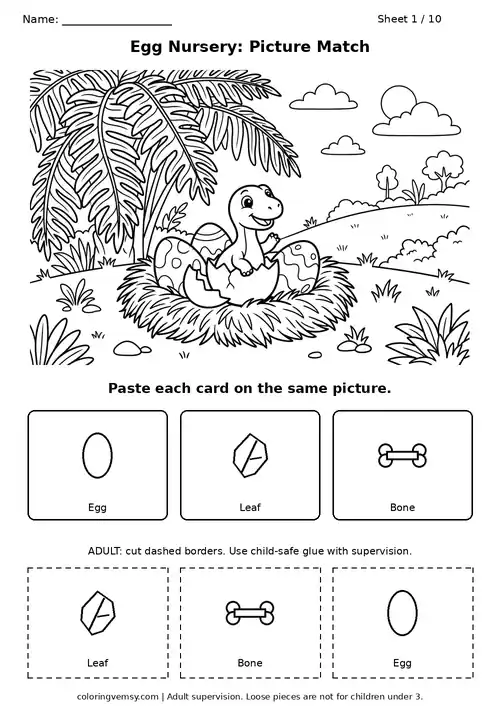
1. Mussaurus Egg Nursery
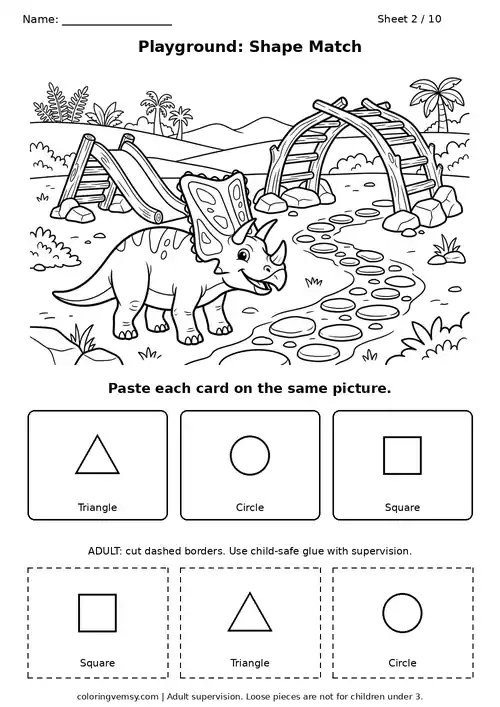
2. Chasmosaurus Shape Playground
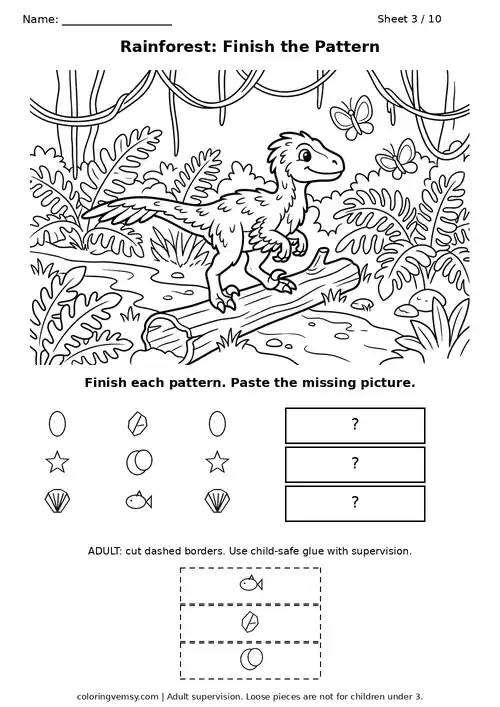
3. Deinonychus Rainforest Trail
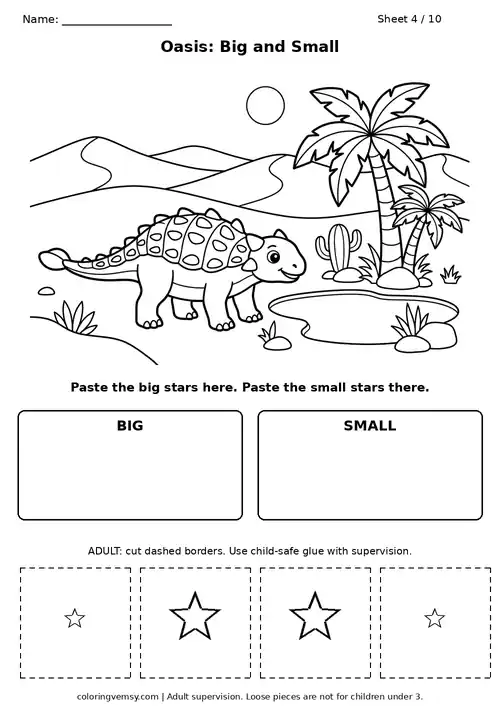
4. Minmi Desert Oasis
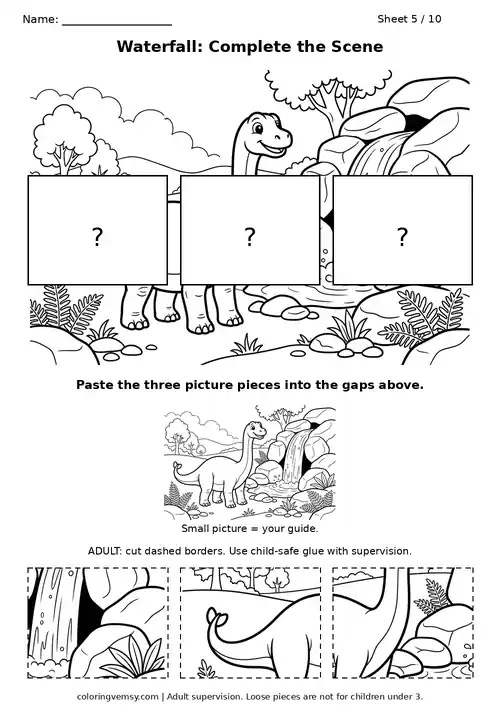
5. Shunosaurus Waterfall Grotto

6. Megalosaurus Fishing Dock
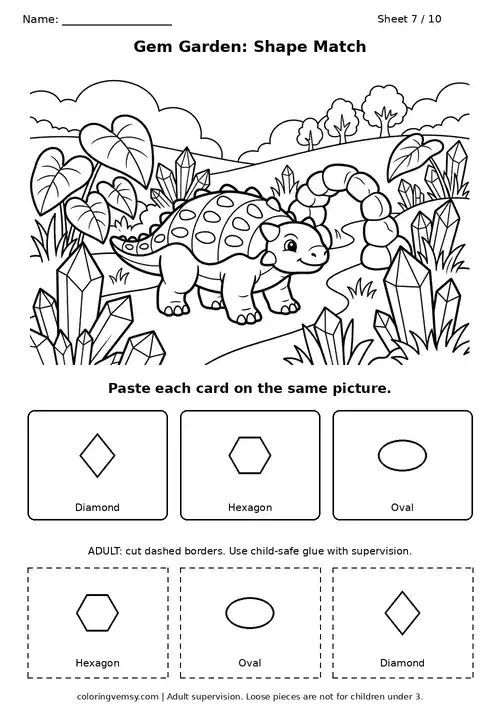
7. Nodosaurus Gem Garden
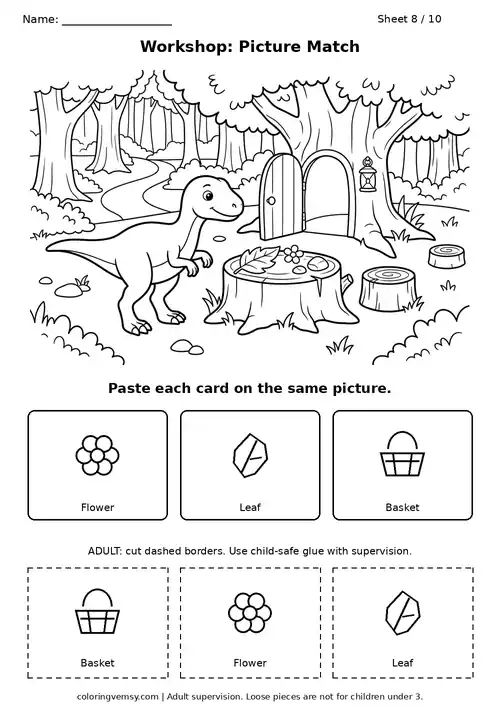
8. Ornitholestes Woodland Workshop
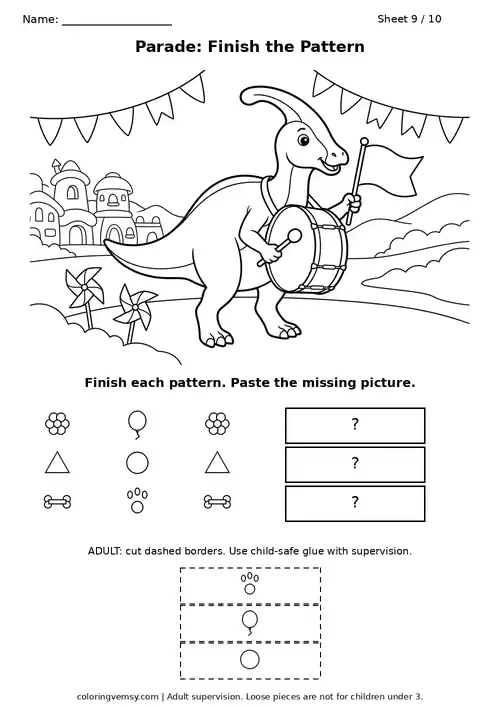
9. Tsintaosaurus Parade Square
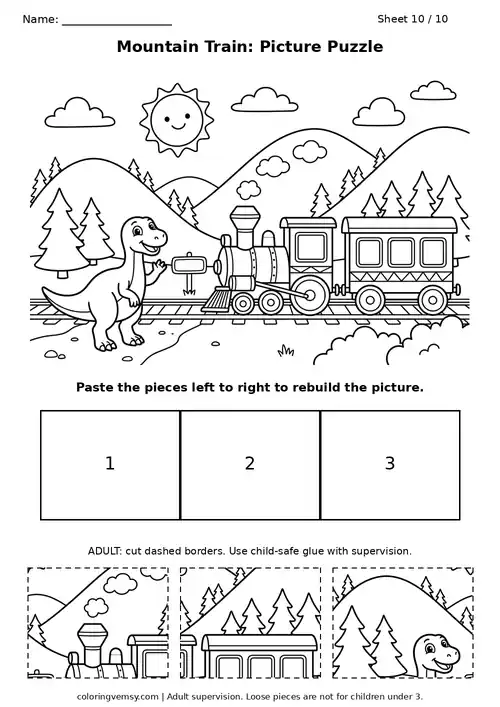
10. Gasparinisaura Mountain Train
Same page size, precise pieces: these Dinosaur cut and paste worksheets use 500 × 707 px WebP images, about 21–38 KB each. Full worksheet masters are all 1000 × 1414 px. Matching icons, counts and patterns are software-drawn. Picture patches and puzzle pieces are cropped to fit their target areas exactly.
📑 Table of Contents
- What is inside the mixed pack?
- Meet the ten new dinosaur activity pages
- How to download and print
- Skills children can practice
- Choose an easy starting point
- Safe cutting and glue preparation
- Color the different backgrounds
- Help with patterns, counts and picture pieces
- Ideas for preschool, home and small groups
- Frequently asked questions
What is inside these Dinosaur cut and paste worksheets?
This pack combines ten different dinosaur scenes with hands-on paper activities. Children match pictures, compare shapes, complete patterns, sort sizes, count fish and repair a picture. An adult prepares the cut-out pieces, then the child decides where each piece belongs before fixing it with a little suitable glue.
Every activity is contained on one sheet. The scene and paste areas stay on the upper part, while dashed borders identify the pieces below. Most sheets have three pieces; the big-and-small sorting sheet has four. Altogether the collection contains thirty-one cut-out pieces across ten activities, plus a cover in the complete PDF.
These Dinosaur cut and paste worksheets are suggested for ages three to six with adult support. They are not a test of independent scissor skills. Adults should cut and manage the pieces, supervise glue use and keep scissors out of reach between tasks. Loose pieces are not appropriate for children under three or children who mouth small objects.
Cut, try, then paste
The most useful habit is to try a piece without glue first. Let the child move it, compare it and explain a choice. Once the arrangement makes sense, use a small amount of child-appropriate glue according to its product guidance. Glue is the final step, not something needed to discover the answer.
Ten new dinosaur scenes and activities
All illustrations in these Dinosaur cut and paste worksheets are new for this collection. The nursery, playground, rainforest, oasis, waterfall, dock, gem garden, workshop, parade and train each provide a different background. All finished worksheets share the same portrait dimensions, while pieces are sized for the particular task they must fit.
1. Mussaurus Egg Nursery
A baby dinosaur waits by a fern-covered nest. Cut the egg, leaf and bone cards, try them on the identical target pictures, then paste. The simple three-choice task is a useful introduction.
2. Chasmosaurus Shape Playground
A horned visitor explores a slide and climbing frame. Match the triangle, circle and square pieces to their outlines. Talk about straight edges and round curves before coloring the playground.
3. Deinonychus Rainforest Trail
A feathered dinosaur follows a rainforest trail. Complete three repeating rows using the leaf, moon and fish strips. Say each visible A-B-A sequence aloud to discover which B picture belongs next.
4. Minmi Desert Oasis
An armored dinosaur rests by the pool. Sort four star cards: two big stars in the left BIG area and two small stars in the right SMALL area. Try the arrangement before adding glue.
5. Shunosaurus Waterfall Grotto
A long-necked visitor has three gaps across its waterfall scene. Restore the exact-size missing patches, using the small reference picture as a guide. Join the picture first, then color across the repaired edges.
6. Megalosaurus Fishing Dock
A dinosaur stands beside the water with a bucket. Count the fish printed on each cut-out card, then paste the group beneath numeral one, two or three. Ignore the decorative background fish when counting.
7. Nodosaurus Gem Garden
An armored explorer visits a crystal garden. Match the diamond, hexagon and oval cards to their targets. Follow the outlines with a fingertip and notice corners versus curves before placing a piece.
8. Ornitholestes Woodland Workshop
A little craft visitor works beside a stump table and treehouse. Paste the flower, leaf and basket pictures onto their identical targets. Afterwards, imagine what the dinosaur might make in the workshop.
9. Tsintaosaurus Parade Square
A crested dinosaur joins a parade with a drum and flags. Complete three A-B-A sequences with balloon, circle and footprint strips. These are picture patterns, not exercises in reading letters.
10. Gasparinisaura Mountain Train
A small dinosaur waves beside a mountain train. Rebuild a narrow detail band from the scene with three exact-size pieces. Put the left, middle and right sections into slots one, two and three before pasting.
The dinosaur drawings are playful cartoons. Use them to spark interest rather than as scientific identification diagrams. The activity symbols, numbers, patterns and picture pieces are prepared separately from the AI-generated artwork so the matching relationships and quantities do not depend on an image model guessing them.
How to download and print the worksheets
Use the PDF button to download all ten Dinosaur cut and paste worksheets with a cover. To save a favorite sheet individually, use Download beneath its image. The PDF pages are A4; choose Fit to page when printing on US Letter. All card and target areas on the same page will scale together.
- Print single-sided for cutting. Cutting pieces from the bottom would damage a different activity printed on the back.
- Select portrait orientation. Every complete worksheet uses the same tall page shape.
- Keep the whole page visible. Do not crop the bottom cut-outs or enlarge beyond the printer margins.
- Use a test sheet first. Check dashed borders, small icons and number labels before printing a classroom batch.
- Choose ordinary white paper. Check your printer’s guidance before choosing a heavier stock.
- Use matching print settings for replacements. A card reprinted at a different scale may not fit its old target.
Paper and a supervised glue stick are enough. Lamination is unnecessary for permanent pasting. Leave pieces loose under supervision for repeat practice without glue.
View opens the sheet image on its own. Online coloring opens the same image in a coloring tool, not as an interactive cut-and-paste game. The hands-on activity needs printed paper and adult preparation; a child can still enjoy coloring the scene on screen separately.
What children can practice
Using Dinosaur cut and paste worksheets creates opportunities to notice a visual relationship, choose a piece and place it deliberately. Different sheets ask different questions: “Which picture is the same?”, “What comes next?”, “How many fish?” or “Which piece continues this line?” These questions invite thinking before the glue is opened.
- Visual comparison: checking outlines and details when matching pictures or shapes.
- Early pattern awareness: noticing a repeating A-B sequence and selecting the missing second item.
- Quantity language: counting one, two and three fish and connecting the groups to numerals.
- Size vocabulary: comparing big and small versions of the same star symbol.
- Spatial reasoning: turning and arranging picture sections so their edges make sense.
- Hand-eye coordination: moving a paper piece onto a chosen area.
- Explaining choices: pointing, speaking or demonstrating what makes a placement work.
These are practice opportunities rather than guaranteed developmental outcomes. A child may be ready for picture matching before patterns, or enjoy counting while finding puzzle edges less obvious. Choose a manageable activity and offer support rather than interpreting one worksheet as a measure of ability.
Which activity should we try first?
Start with an activity the child can understand after a brief demonstration. The easiest introduction is often placing one picture on its identical target. Offer only one or two pieces before introducing a larger choice. Older or more experienced children may prefer to start with the picture-repair task.
| Starting point | Suggested sheets | Adult support |
|---|---|---|
| First cut-and-paste experience | 1 Nursery, 2 Playground, 8 Workshop | Show one matching pair and let the child try another without glue. |
| Ready to compare | 4 Oasis size sort, 7 Gem shapes | Talk about big/small, corners and curves. |
| Interested in number and repetition | 3 Rainforest patterns, 6 Counting, 9 Parade patterns | Name or count each item aloud before choosing. |
| Enjoys assembling pictures | 5 Waterfall repair, 10 Train detail puzzle | Point out an edge or a line that continues into another piece. |
Age labels on Dinosaur cut and paste worksheets are suggestions, not deadlines. A child can use the counting page with help even if numerals are unfamiliar: count a group together, point to the matching numeral and place it. Similarly, a child can enjoy the rainforest scene as a coloring page before being interested in the pattern task.
If a task becomes frustrating, remove some choices or leave it for another day. Finishing one successful pair can be enough. There is no requirement to glue every piece or complete the entire book in sequence.
Safe cutting, glue and small-piece preparation
Before using Dinosaur cut and paste worksheets, an adult should cut along the dashed borders and check that the correct pieces are present. Solid target borders are paste areas and should remain attached to the board. The pattern sheets use long narrow rectangular pieces; the sorting sheet has four cards; the other sheets use three larger rectangles.
- Keep scissors adult-managed. This pack assumes adult preparation rather than independent cutting by a young child.
- Choose age-appropriate glue. Follow its label, supervise use and prevent glue or caps being placed in the mouth.
- Count the pieces before and after. Collect three from most pages and four from the size-sorting page.
- Keep younger siblings away from loose pieces. Large paper cards can still be torn, folded or mouthed.
- Remove damaged fragments. Replace a torn piece rather than leaving small scraps on the table.
- Clear the work area afterwards. Store tools, spare paper and unused pieces securely.
Give a simple demonstration of using a little glue on the back of a piece rather than covering the whole board. A scrap sheet can protect the table. Help turn the piece face up without spreading adhesive onto the illustration, then let the child press gently.
For a no-glue option, arrange the pieces and take a photograph of the result. For a no-cut option, leave the page intact and point between each piece and its destination. These alternatives let the same topic work without introducing a permanent collage or loose cards.
Coloring the different backgrounds
The scenes on these Dinosaur cut and paste worksheets offer a coloring activity before or after pasting. Choose the order to suit the task. On matching pages, coloring identical pairs alike can make a first attempt simpler. On picture-repair pages, finish the repair before coloring across the joins.
- Egg nursery: use leafy greens around the nest and invent a gentle shell pattern.
- Playground: give the slide, arch and stepping stones contrasting colors.
- Rainforest: add a bright crest or feather detail against the leaves.
- Desert oasis: try warm sand colors and a cool blue pool.
- Waterfall: join the missing pieces, then color water and rocks across the repaired scene.
- Fishing dock: choose a bucket color and give each jumping fish a different shade.
- Gem garden: fill the large crystals with favorite jewel colors.
- Workshop: decorate the stump table and treehouse door.
- Parade: alternate bunting colors and design a drum pattern.
- Mountain train: make the engine and carriages stand out from the hills.
Do not worry about realistic dinosaur colors. These are imaginative cartoon settings, and a child can decide how their visitor looks. Leaving some spaces white is also fine. Ask about a choice or story instead of judging whether the whole scene has been filled.
Helping with patterns, counting and picture pieces
These Dinosaur cut and paste worksheets contain several tasks with clear answers, but the way adults offer help can stay flexible. Give a small hint first rather than immediately placing the correct piece. Invite the child to look again and decide whether the hint helps.
For repeating patterns
Read the three visible symbols in each row aloud: “egg, leaf, egg.” Repeat that rhythm, then ask what should come next. Both pattern sheets use A-B-A followed by a blank for B. The cut-out strip fits over the question-mark rectangle. Children do not need to understand the letters A and B; those labels simply describe the repeating structure for adults.
For counting groups
Touch each fish once while saying a number. Then point to the target numeral before moving the group. There is one card with one fish, one with two and one with three. Count the fish printed on the cards, not decorative fish in the background scene.
For picture completion
The waterfall page has three missing patches and a small complete reference image. Compare a patch edge with the lines around a gap. The train page rebuilds a narrow detail band from the larger scene, not the entire top illustration. Look for a roof, tree or carriage line that continues from one section to the next.
Try all placements without glue first. When an arrangement looks right, check it together and only then paste. This keeps mistakes easy to revise and preserves the child’s opportunity to make the decision.
Use the pack at home or in a small group
Offer two or three Dinosaur cut and paste worksheets as a choice rather than putting every activity and all thirty-one pieces on the table. Keep each page’s pieces in its own adult-managed envelope or tray. Check the set before passing it to a child, especially if several children are using different sheets nearby.
In a small group, demonstrate the basic routine with one piece: look, try, compare, glue and press. Children can then work on different activities while sharing the same routine. Keep glue and scissors managed so that waiting for materials does not lead to loose tools or mixed-up pieces.
At home, a favorite scene can become a short quiet activity before lunch or after a story. Read a dinosaur picture book first, then choose a related character. There is no need for a reward chart or a speed challenge. A careful explanation and a few satisfying placements are enough.
Keep completed pages flat until the glue dries according to product guidance. If a child wants to save the work, an art folder protects it better than handling damp pieces immediately. Spare uncut copies are useful when a piece is misplaced or a child asks to repeat a favorite scene.
More dinosaur and animal activities
If your child enjoys these dinosaur activity sheets, try dinosaur busy book printables for picture matching without permanent glue, or our preschool dinosaur activity sheets for tracing and coloring. The dinosaur tracing worksheets offer another pencil-based activity when cut-out pieces are not practical.
For open-ended art, browse dinosaur coloring and coloring dinosaur. Other themes include lion coloring, tiger coloring, elephant coloring, horse coloring and dog coloring. The online coloring tool gives a screen-based alternative for coloring only.
For factual dinosaur reading, adults can consult the Wikipedia dinosaur overview, the Natural History Museum’s Dino Directory and National Geographic Kids prehistoric animals. Preview outside material before using it with a young child, and keep scientific questions separate from the imaginative details of these cartoon scenes.
Frequently asked questions
Are these dinosaur cut and paste worksheets free?
Yes. The ten activity sheets and the complete PDF are free to download without signing up. Use them for personal or classroom activities. Share the page link rather than selling the files or uploading them to another website.
What activities are included in the pack?
The pack includes picture matching, shape matching, two simple pattern pages, big/small sorting, counting one to three, scene repair and a three-piece detail puzzle. Ten sheets contain thirty-one cut-out pieces in total: three per page except the four-piece size sort.
What ages are these sheets intended for?
The suggested range is three to six with adult support. Adults should prepare the pieces and supervise glue use. Loose pieces are not suitable for children under three or children who mouth small objects. Choose tasks according to interest and readiness.
Should I print the sheets single-sided?
Yes. Print single-sided for cutting and pasting so the cut-out section does not damage an activity on the reverse. Fit to page on A4 or US Letter and keep replacement print settings consistent. Double-sided copies are only for uncut pointing or coloring use.
Do children need to cut the pieces themselves?
No. This pack assumes that an adult cuts the dashed borders and manages scissors. Children can try placements and paste with suitable glue under supervision. Independent cutting is not necessary to enjoy the matching, patterns, counting or picture tasks.
Can we use the activities without glue or online?
Yes, printed pieces can be arranged without glue, or an intact sheet can be used for pointing between matches. Online coloring opens a picture to color; it does not provide interactive cutting, pasting or draggable puzzle pieces.
Download your dinosaur activity sheets book
Cover + 10 pages, one drawing per sheet, A4 + US Letter, small size for quick print. Print double-sided, flip on long edge.
For cutting and pasting, print single-sided. Double-sided copies are only suitable if all sheets remain uncut for pointing and coloring.
⬇ Download the PDF book