Dinosaur matching game printable — 10 Free Memory Pairs, 20 Cards
Dinosaur matching game printable brings ten new dinosaur designs into a classic face-down memory game. Each pair repeats the exact same card artwork, giving twenty cards from ten printable sheets. Adult-cut the rectangles, mix complete pairs, then turn two cards at a time to find a match.
Visit a snowy lodge, greenhouse, redwood valley, pumpkin patch, lagoon and more new settings. All twenty cards have the same dimensions. Free to download without signing up. Loose cards are not suitable for children under three or children who mouth small objects.
- 🦕 10 new designs
- 🃏 10 pairs · 20 cards
- 🧒 Ages 3+ supervised
- 📕 Free PDF
- 🖨 A4 + US Letter
For memory play, print single-sided with plain opaque backs. Each activity sheet repeats one drawing on two cards. The shared book-bar double-sided option is only for uncut coloring copies, not memory play.
10 Dinosaur matching game printable to download
Each preview sheet contains two identical memory cards. Print selected sheets once, adult-cut the dashed borders, then mix complete pairs for play. View opens the sheet full-size; Online coloring is for coloring only, not an interactive memory game.

1. Albertosaurus Snowy Lodge

2. Microceratus Tulip Greenhouse

3. Argentinosaurus Redwood Valley
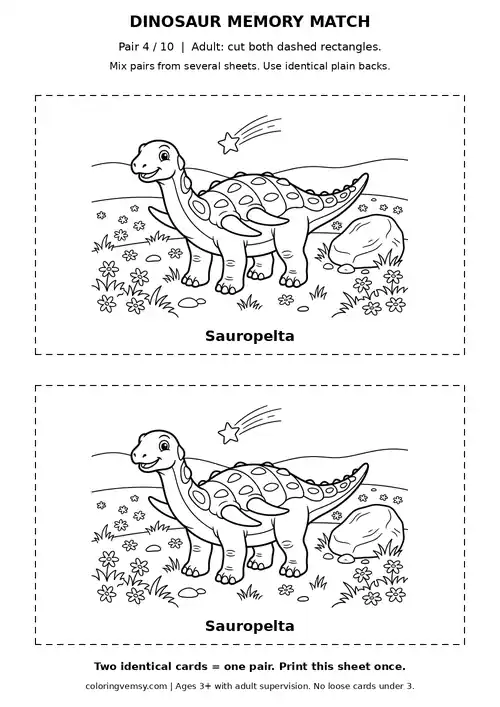
4. Sauropelta Meteor Meadow

5. Therizinosaurus Pumpkin Harvest
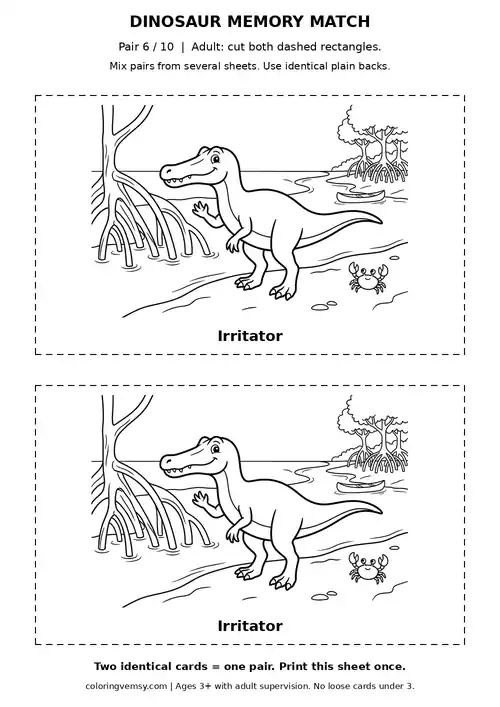
6. Irritator Mangrove Creek
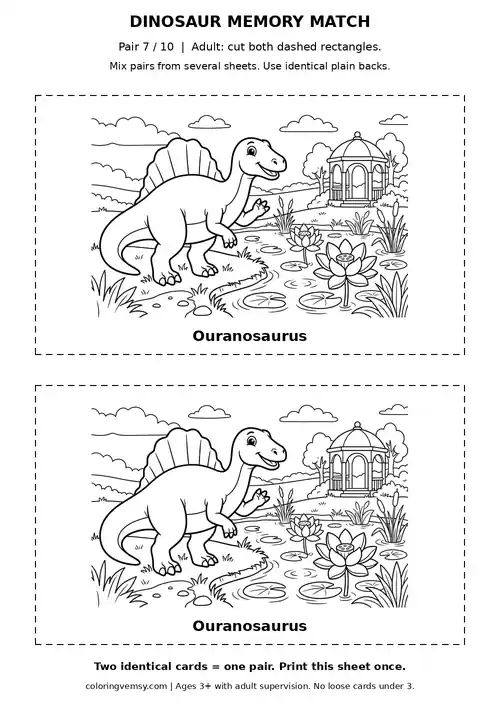
7. Ouranosaurus Lotus Lagoon
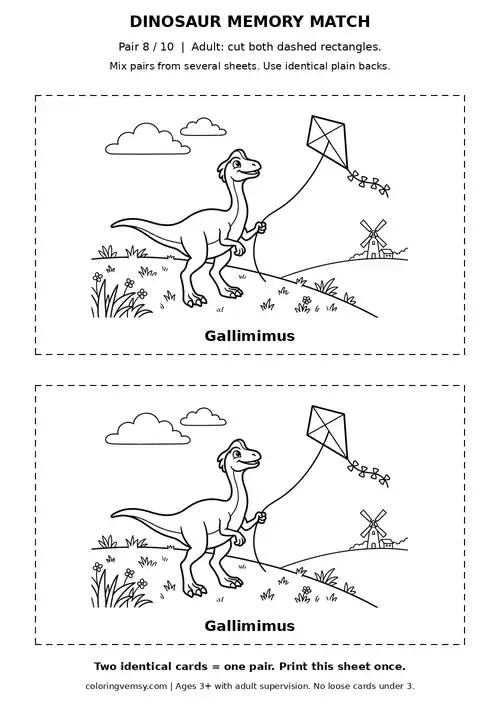
8. Gallimimus Kite Hill
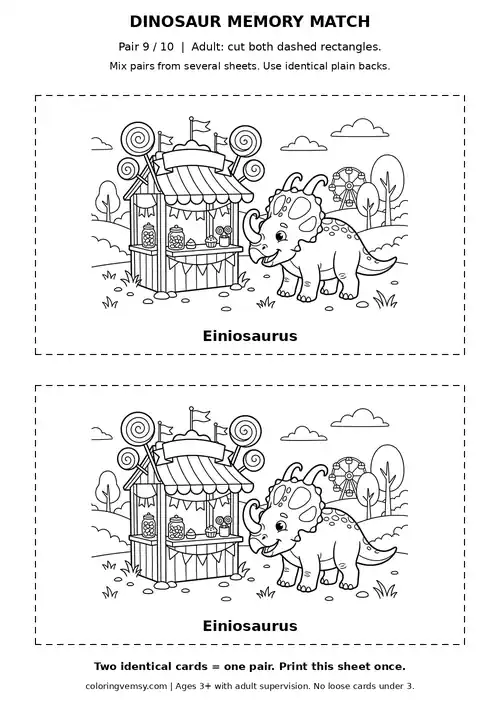
9. Einiosaurus Candy Fair
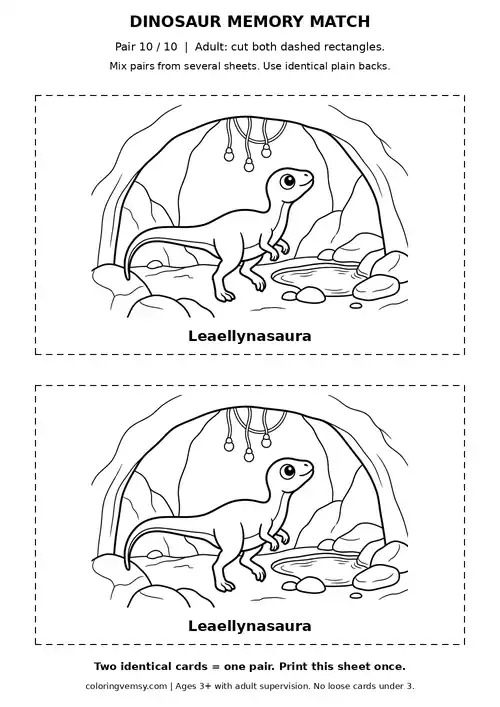
10. Leaellynasaura Glowworm Cavern
Same size, identical pairs: these Dinosaur matching game printable use 500 × 707 px WebP images, about 24–37 KB each. Full worksheet masters are all 1000 × 1414 px. Every card is 860 × 520 px in the masters. The two cards on each sheet are duplicated from the same image and checked for pixel equality.
📑 Table of Contents
What is included in this Dinosaur matching game printable?
This is a classic picture-memory game with a dinosaur theme. The collection has ten different designs, and each design appears on two identical cards. Print the ten activity sheets once to make twenty cards, or ten matching pairs. A cover is included at the front of the complete PDF book.
Each sheet contains both copies of one design, not two different dinosaurs. An adult cuts the two dashed rectangles, then combines cards from several sheets to build a playable set. One sheet alone gives only one pair; start with two or three sheets if you want a small game with a genuine choice.
The new scenes in this Dinosaur matching game printable range from a snowy lodge and tulip greenhouse to a pumpkin harvest and glowworm cavern. Dinosaur pictures and settings change between designs, while card dimensions and borders remain consistent. Within each pair, the artwork and name label are duplicated from the same card image.
Which ages can play?
The suggested starting age is three and up with adult supervision. The important question is whether a child can use loose paper cards safely and enjoy a short turn-taking activity. Do not offer loose cards to children under three or children who still mouth paper and small objects. Adults should prepare, count and store the cards.
Meet the ten new dinosaur pairs
Every design in this Dinosaur matching game printable was created for this set rather than reused from the previous dinosaur activities. The characters are imaginative cartoons, not scientific anatomy references. Children can identify a pair by the animal, its background or the combination of both; reading the name is optional.
1. Albertosaurus Snowy Lodge
A scarf-wearing dinosaur stands beside a snowy lodge. Look for the scarf, fir tree and cabin to recognize the pair. Both copies use the same artwork and label; print this sheet once to obtain two cards.
2. Microceratus Tulip Greenhouse
A little beaked visitor explores a tulip greenhouse. The rounded glasshouse and flowers make this design easy to describe. A child can say “the greenhouse dinosaur” without needing to read its species name.
3. Argentinosaurus Redwood Valley
A gentle long-necked dinosaur stands among tall redwood trees. Its long neck and tree trunks provide a distinctive silhouette. Pair it with more visually different scenes when introducing a small deck.
4. Sauropelta Meteor Meadow
An armored dinosaur visits a meadow with a rounded space rock and shooting star. The shoulder spikes and starry details distinguish this design from the other scenes without changing either copy of the pair.
5. Therizinosaurus Pumpkin Harvest
A fluffy visitor with long claws stands beside pumpkins and a barn. The harvest setting gives children a familiar object to name while remembering a location. Match the whole picture, not just a shared feature.
6. Irritator Mangrove Creek
A long-snouted dinosaur explores a creek with curved roots and a crab. Use the mangrove tree or water as a spoken clue. The two cards are identical even though the scene itself contains several different objects.
7. Ouranosaurus Lotus Lagoon
A sail-backed dinosaur visits a lagoon full of lotus flowers. The tall back and decorative waterside setting give this pair its own character. Color both copies alike if you plan to use a colored deck.
8. Gallimimus Kite Hill
A slender dinosaur flies a kite on a hill. The large kite makes a clear introductory clue for a face-up matching round. This playful cartoon activity is imaginative rather than a claim about real dinosaur behavior.
9. Einiosaurus Candy Fair
A horned dinosaur waits beside a candy stall with large lollipops. Look for the curved horn and striped awning. When coloring, repeat the same stripe choices on both copies to keep the visual matching rule simple.
10. Leaellynasaura Glowworm Cavern
A small, big-eyed explorer visits a cavern with hanging glowworm details. The rounded cave entrance and little pool distinguish the setting. Combine this pair with the snowy lodge and kite hill for a three-pair beginner round.
The pairs are intentionally identical, not mirrored, recolored or redrawn separately. A tiny change between two similar pictures can be confusing in an introductory matching game. Here the child is looking for the same complete card design, including the setting and dinosaur name.
How to download, print and prepare the cards
The PDF button downloads the whole Dinosaur matching game printable book. Download beneath a preview saves one sheet, and View opens its image separately. The PDF uses A4 pages; select Fit to page on US Letter so the dashed borders remain complete. Both cards on a sheet scale together.
- Print each selected sheet once. It already contains the two copies needed for one pair.
- Use single-sided printing. The reverse of every card should remain plain and indistinguishable from the others.
- Keep print settings consistent. Mixing scales can make some cards larger and give away their identity.
- Check opacity. Hold a sample face down under your normal room lighting. The dinosaur should not show through.
- Use printer-compatible stock. Opaque card can help; follow your printer’s material and weight limits.
- Let an adult cut. Cut both dashed rectangles carefully, keeping all twenty cards the same finished size.
If ordinary paper shows through, an adult can mount every card onto the same kind of opaque backing and trim them consistently. Do not use a different backing color for each pair: that would reveal which cards belong together before anyone turns them over.
Print a sample before preparing a full classroom set. The compact PDF is convenient for sharing, but your printer settings and paper determine the final result. Check line clarity, readable labels, matching dimensions and hidden fronts before starting a memory round.
What the game gives children a chance to practice
Playing with a Dinosaur matching game printable can invite children to look closely, remember a location and wait for a turn. It also provides an easy reason to talk: “I saw the pumpkin dinosaur over there” is a useful explanation even when the child cannot pronounce the species name.
- Visual recognition: noticing which animal and background belong together.
- Location memory: remembering where a previously revealed picture sits.
- Turn taking: waiting while another player chooses and checks two cards.
- Simple counting: counting cards, pairs or the number of turns used.
- Descriptive language: identifying a scarf, kite, greenhouse or flower to explain a choice.
- Flexible strategy: using newly revealed information on the next turn.
These are practice opportunities rather than promises of measurable improvement. A child can enjoy a face-up matching activity without being ready for a larger face-down game. Keep the challenge comfortable and use a variety of play activities rather than treating one printable as a developmental test.
Notice a specific strategy instead of rewarding speed alone. You might say, “You remembered the card beside the corner” or “You looked at the background before deciding.” Looking carefully and taking time are welcome parts of the game.
Choose the right number of pairs
The full twenty-card deck is not the best starting point for every player. A smaller game is easier to explain, quicker to finish and less likely to feel overwhelming. You can increase the number of pairs when a child asks for more.
| Starting level | Cards to use | Suggested arrangement |
|---|---|---|
| New to matching | 2 pairs: 4 cards | Keep pictures face up and find identical designs. |
| First memory round | 3 pairs: 6 cards | Use a tidy two-by-three face-down grid. |
| Comfortable player | 5 pairs: 10 cards | Arrange two rows of five, keeping positions fixed. |
| Ready for the full deck | 10 pairs: 20 cards | Use four rows of five with generous turning space. |
Within this Dinosaur matching game printable, a player can start with favorites such as the kite, scarf and pumpkin pictures. Choose complete pairs, not random individual cards, or the game may contain a picture without a partner. Count the selected cards before laying out the grid.
For mixed ages, agree on a simple adjustment together. Younger players might briefly see all cards face up before the round, while older players help name the scenes without pointing to a hidden partner. The aim is shared play, not an unavoidable advantage for the person with the quickest recall.
How to play the memory matching game
Before starting this Dinosaur matching game printable, check that every chosen design has exactly two copies. Shuffle the selected cards and arrange them face down with enough space to lift a corner. A regular grid makes the locations easier to discuss and remember.
- Choose a first player. Decide whether a successful match earns another turn before the round begins.
- Turn over two cards. Reveal one, then another, leaving both visible long enough for everyone to look.
- Compare the pictures. A match means the complete design is identical, not merely that both cards show dinosaurs.
- Keep a matching pair. Set it aside together so the remaining grid stays clear.
- Turn a non-match back down. Return each card to its original position rather than shuffling it into a new spot.
- Continue until every pair is found. Count collected pairs if you are playing a scored round.
A cooperative version works well for beginners. Everyone helps find the deck’s pairs, and there is no individual winner. Players can take turns choosing two cards while the group tries to remember useful locations together. End with all the dinosaurs reunited rather than a comparison of scores.
If a child becomes frustrated, reduce the deck at the next round or turn a few cards face up. Avoid moving cards secretly to make a match happen. A simpler, clearly explained rule change is easier to understand than a board whose positions keep changing.
Color matching pairs without giving away the game
This Dinosaur matching game printable is also a black-and-white coloring activity. If you want to play memory with colored cards, color both copies of a design in the same way. Different colors do not make the pictures wrong, but identical-looking pairs give beginners a clearer matching rule.
- Snowy lodge: choose a bright scarf and keep the snow pale.
- Tulip greenhouse: repeat the same flower colors on both copies.
- Redwood valley: use matching tree trunks and a favorite dinosaur color.
- Meteor meadow: give the starflowers a simple repeating palette.
- Pumpkin harvest: pick matching pumpkin oranges and barn colors.
- Mangrove creek: try blue-green water and a contrasting crab.
- Lotus lagoon: choose bright flowers beside the sail-backed dinosaur.
- Kite hill: repeat a bold two-color kite pattern.
- Candy fair: use the same awning stripes on the two cards.
- Glowworm cavern: add gentle bright accents around the cave details.
Check the reverse after coloring. Markers can bleed through, and heavy pressure may leave dents that identify a particular card when it is face down. Colored pencils or crayons may be more suitable for your chosen paper, but a test is still useful. Mount or replace any marked cards before playing.
Easy variations after the first few rounds
Once the basic Dinosaur matching game printable feels familiar, try one small variation at a time. Keep the card pictures unchanged so the child can focus on the new rule rather than learning a completely different set.
Face-up partner hunt
Place one copy of each selected design in a row, then offer the other copies in a shuffled pile. Find the partner for each visible card. This uses visual comparison without requiring a child to remember hidden positions and works as an introduction before a face-down round.
Describe and find
An adult describes a visible scene without naming the dinosaur: “Find the dinosaur beside a greenhouse.” The child chooses its card, then finds the duplicate. Swap roles so the child can invent clues. Accept references to backgrounds, objects and colors rather than insisting on difficult species names.
What changed?
Lay out a few different cards face up, look together, then ask the child to look away while an adult removes one. Ask which scene is missing. Start with a small selection and return the removed card after each attempt. Keep the loose cards supervised throughout.
You can also build a short story using three visible scenes: a dinosaur leaves its snowy lodge, visits the pumpkin patch and ends at the greenhouse. Storytelling needs no score and provides another way to enjoy the pictures between matching rounds.
Storage, safety and classroom use
Store this Dinosaur matching game printable as one complete set in an adult-managed envelope or container. Count twenty cards before putting away the full deck. If a pair is missing one copy, remove its remaining card until a replacement has been prepared; otherwise a memory round cannot finish properly.
Suggested use is ages three and up with adult supervision, not children under three or anyone who mouths paper or small objects. Adults should handle cutting, remove damaged scraps and keep preparation tools away from younger siblings. Large cards still need supervision because they can be folded, torn or placed in the mouth.
In a classroom, give each small group its own complete mini-deck. If you print multiple sets, avoid mixing them during a round: four copies of a design changes the intended two-card pairing format. Store group sets separately and identify their containers rather than adding different identifying marks to individual card backs.
Use a spacious, stable surface and allow enough room for children to see revealed cards. Agree on turn rules in advance. A quiet cooperative round with six or ten cards can be more practical than a competitive twenty-card game in a crowded activity area.
More dinosaur and animal activities
If your child enjoys this dinosaur memory sheets, try dinosaur busy book printables for matching boards, or dinosaur cut-and-paste worksheets for mixed paper activities. Our preschool dinosaur activity sheets and dinosaur tracing worksheets offer quieter pencil-based options.
For coloring without game rules, browse dinosaur coloring, coloring dinosaur, lion coloring, tiger coloring, elephant coloring, horse coloring or dog coloring. The online coloring tool colors worksheet images; it does not provide a playable digital memory game.
Adults looking for factual dinosaur information can consult the Wikipedia dinosaur overview, the Natural History Museum’s Dino Directory and National Geographic Kids prehistoric animals. Preview outside resources before sharing them, and remember that scarves, cottages and candy stalls belong to these imaginative scenes, not dinosaur history.
Frequently asked questions
Is this dinosaur matching game printable free?
Yes. The ten pair sheets and the complete PDF are free to download without signing up. Use them for personal or classroom play. Share this page link rather than selling or republishing the downloadable files.
How many cards and matching pairs are included?
There are ten different designs, each printed twice on its own sheet. Printing the ten activity sheets once gives twenty cards and ten pairs. The full PDF also includes a cover. You do not need to print every sheet twice.
Are the two cards in each pair really identical?
Yes. Both cards are duplicated from the same composed card image, with identical artwork, background, border and name label. Their equality is checked in the source worksheets. Cut and color them consistently so they remain equally sized and easy to compare.
Should I print the memory cards double-sided?
No. Print single-sided and make sure the reverse is plain and opaque on every card. Double-sided activity printing or pair-specific backing colors would give away matches. The shared book-bar double-sided option is only for copies left uncut for coloring.
How many pairs should a beginner use?
Begin face up with two pairs, then try three pairs face down. Add more when the child is comfortable. Always include both cards of every selected design. A cooperative round can be gentler than a scored game.
Can children play the memory game online?
The Online coloring button opens a worksheet image for coloring, not a digital flip-card game. Print and adult-cut the cards for memory play. Suggested use is ages three and up with supervision; loose cards are not suitable for under-threes or children who mouth small objects.
Download your dinosaur memory sheets book
Cover + 10 pages, one drawing per sheet, A4 + US Letter, small size for quick print. Print double-sided, flip on long edge.
Memory-card exception: each activity sheet repeats one drawing on two identical cards. Print single-sided for the game so every reverse stays plain. The shared double-sided option is only for uncut coloring copies.
⬇ Download the PDF book