Dinosaur seek and find printable — 10 Free Mixed Search Activities
Dinosaur seek and find printable brings ten new dinosaur scenes together with hidden-symbol searches, I Spy counting and same-picture hunts. Look carefully, find the targets, count or tick your discoveries, then color the scene. No cutting or assembly needed.
Explore a fern library, sunflower farm, cloud castle, rainbow canyon, coconut cove and more new settings. All sheets have the same dimensions. Search symbols and quantities are software-defined, with a separate adult answer key. Free to download without signing up.
- 🦕 10 new scenes
- 🔍 Find · count · circle
- 🧒 Ages 3–6
- 📕 Free PDF
- 🖨 A4 + US Letter
- ✅ No cutting
10 Dinosaur seek and find printable to download
Choose a find-five scene, I Spy counting board or same-picture hunt. View opens the sheet full-size, Download saves it, and Online coloring opens the image for coloring. Follow each page instruction to know whether to search the scene or only the outlined box.
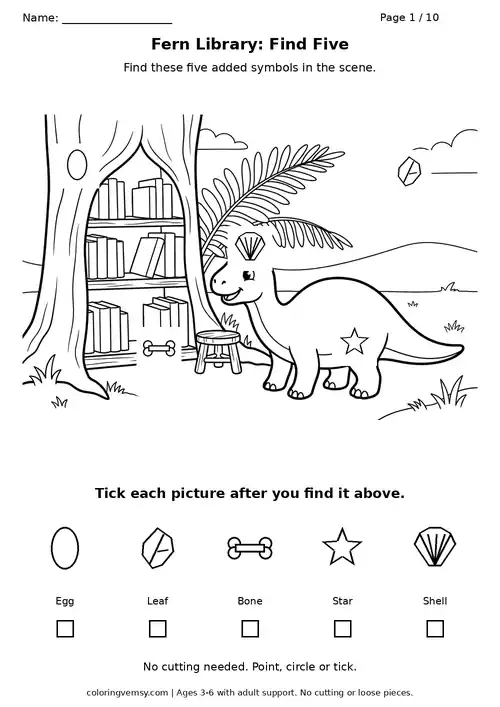
1. Camptosaurus Fern Library
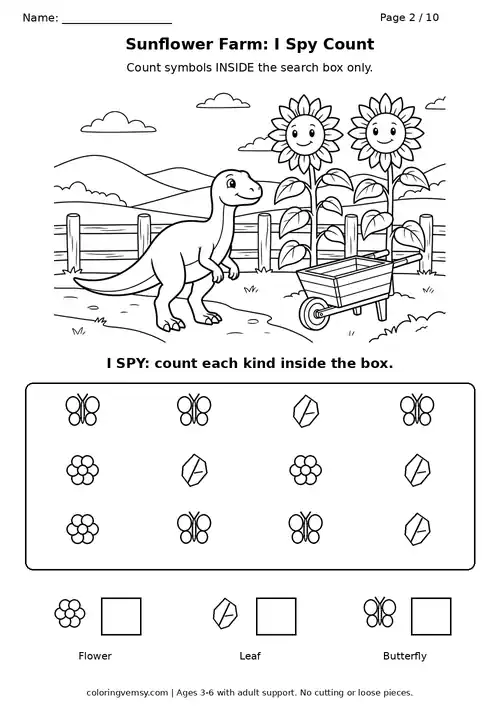
2. Lesothosaurus Sunflower Farm
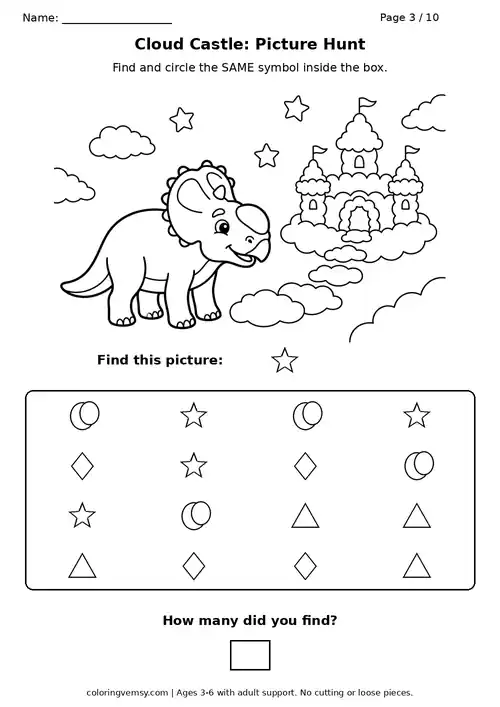
3. Pachyrhinosaurus Cloud Castle

4. Jobaria Rainbow Canyon
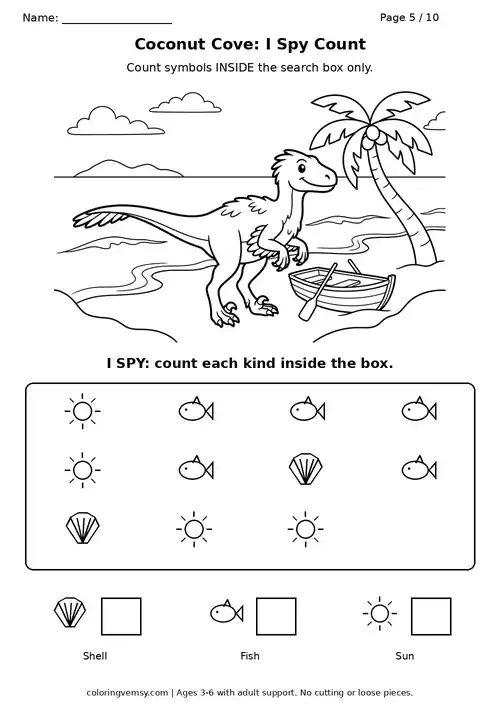
5. Austroraptor Coconut Cove

6. Zuniceratops Apple Bakery
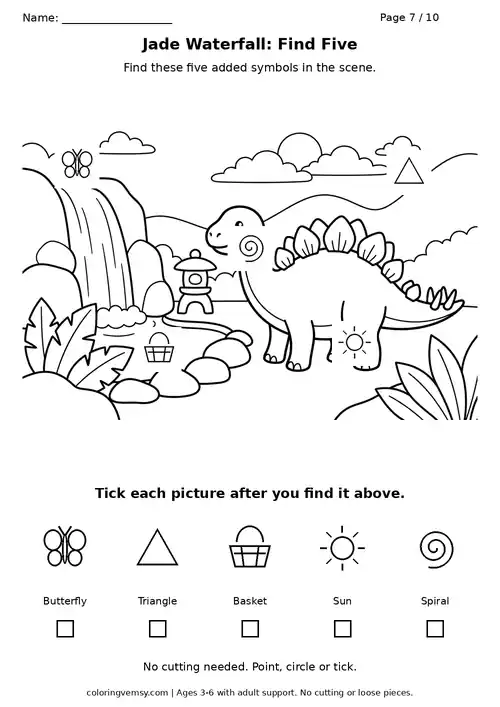
7. Tuojiangosaurus Jade Waterfall
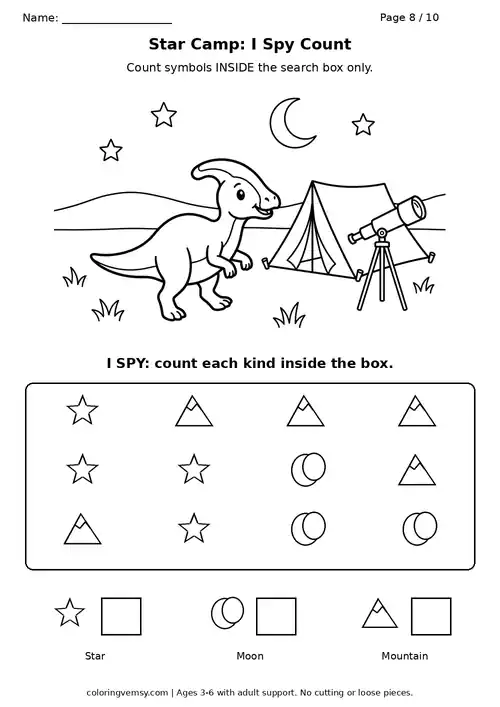
8. Velafrons Star Camp
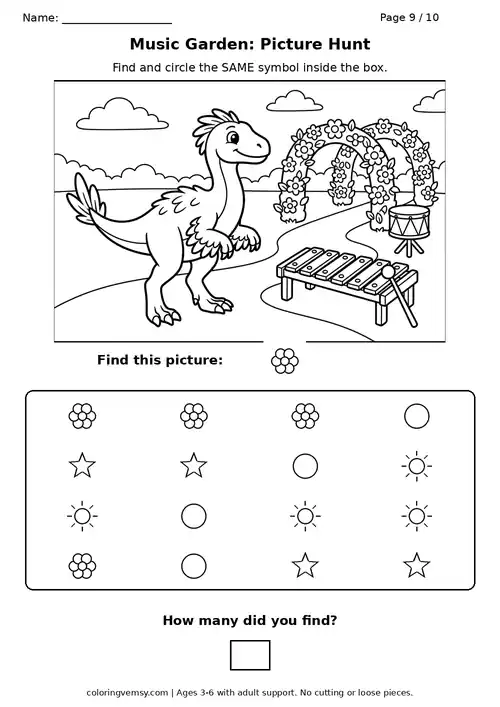
9. Alxasaurus Music Garden
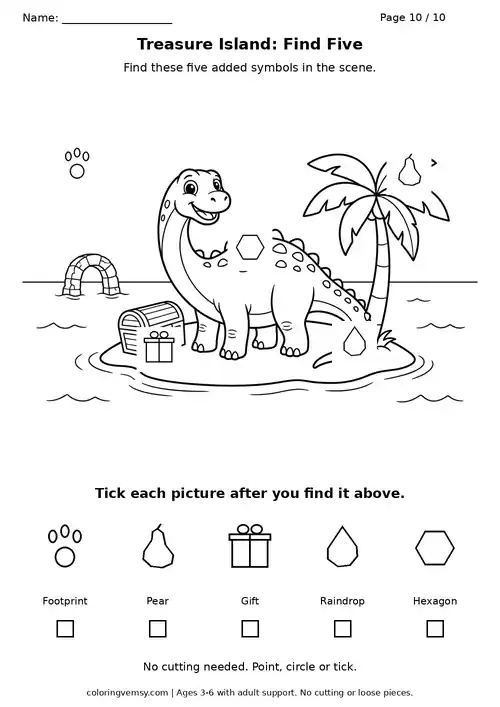
10. Saltasaurus Treasure Island
Same size, clear searches: these Dinosaur seek and find printable use 500 × 707 px WebP images, about 16–25 KB each. Full worksheet masters are all 1000 × 1414 px. Hidden targets are deliberately placed, and counting boards use exact symbol lists. The separate adult answer key records the results.
📑 Table of Contents
- What is inside the mixed search pack?
- Explore the ten new dinosaur search pages
- How to download and print
- Skills children can practice
- Choose a comfortable starting point
- How to search and count carefully
- Color the different backgrounds
- Hints and the answer key
- Ideas for home and small groups
- Frequently asked questions
Adult answer key — open after trying the activity
Scene clues are measured from the scene left/top, not the whole page. Boxed tasks exclude illustration, checklist and sample symbols. Grid rows and columns start at 1, top-left.
- Page 1: Egg (12% across, 17% down), Leaf (85% across, 19% down), Bone (30% across, 77% down), Star (73% across, 75% down), Shell (50% across, 44% down)
- Page 2: Flower: 3, Leaf: 4, Butterfly: 5
- Page 3: Star: 4. Grid cells (row, column): [[1, 2], [1, 4], [2, 2], [3, 1]]
- Page 4: Flower (12% across, 17% down), Fish (85% across, 19% down), Diamond (30% across, 77% down), Moon (73% across, 75% down), Apple (50% across, 44% down)
- Page 5: Shell: 2, Fish: 5, Sun: 4
- Page 6: Apple: 4. Grid cells (row, column): [[2, 4], [3, 2], [4, 1], [4, 2]]
- Page 7: Butterfly (12% across, 17% down), Triangle (85% across, 19% down), Basket (30% across, 77% down), Sun (73% across, 75% down), Spiral (50% across, 44% down)
- Page 8: Star: 4, Moon: 3, Mountain: 5
- Page 9: Flower: 4. Grid cells (row, column): [[1, 1], [1, 2], [1, 3], [4, 1]]
- Page 10: Footprint (12% across, 17% down), Pear (85% across, 19% down), Gift (30% across, 77% down), Raindrop (73% across, 75% down), Hexagon (50% across, 44% down)
What is inside this Dinosaur seek and find printable?
This collection combines ten new dinosaur scenes with three kinds of visual-search activity. Some pages ask children to find five small symbols added to a scene. Others ask them to count different pictures inside a search box, or circle every copy of one example symbol. There are no cut-out cards, missing pieces or glue tasks.
The activities are designed to be clear about what counts. A hidden-object page uses the five checklist pictures as its targets. An I Spy page counts symbols only inside its outlined search box. A picture-hunt page also uses the search box, excluding the sample picture above it and any decorative details in the dinosaur scene.
This Dinosaur seek and find printable is suggested for ages three to six with adult support. Children can point, circle, tick or say an answer aloud, depending on what feels comfortable. An adult can record numbers if writing numerals is not yet enjoyable. The search itself matters more than neat handwriting or completing a whole sheet.
Three activity types, one familiar routine
Start by reading the page instruction together. Look at the target pictures, decide where to search, then find one example before working independently. The collection includes four find-five scenes, three I Spy counting boards and three same-picture hunts. A separate answer-key text file helps adults check results without putting solutions on the activity pages.
Explore the ten new dinosaur search pages
Every illustration in this Dinosaur seek and find printable was created for this pack rather than reused from previous activities. The fern library, sunflower farm, cloud castle, canyon, cove, bakery, waterfall, camp, garden and treasure island all have different backgrounds. The final worksheet size stays the same across the collection.
1. Camptosaurus Fern Library
Explore a tree-trunk library with a friendly dinosaur. Find the five inserted egg, leaf, bone, star and shell symbols in the scene, then tick their checklist boxes. Similar decorative details do not change the five-target task.
2. Lesothosaurus Sunflower Farm
Visit a sunny farm, then search only inside the outlined symbol box. Count flowers, leaves and butterflies separately. The large sunflowers and other details in the top illustration are not part of the counting total.
3. Pachyrhinosaurus Cloud Castle
A horned visitor explores a castle above the clouds. Study the star example, then circle every identical star inside the search box. Ignore stars in the scene and the sample above the box when writing the total.
4. Jobaria Rainbow Canyon
A long-necked dinosaur stands beneath a rainbow. Find the inserted flower, fish, diamond, moon and apple symbols in the scene. Use the checklist to keep track, then decorate the rainbow and canyon.
5. Austroraptor Coconut Cove
A feathered visitor explores a beach with a palm and boat. Count the shell, fish and sun symbols in the outlined box below. Each symbol is drawn separately, so count one type at a time.
6. Zuniceratops Apple Bakery
A little horned dinosaur visits a bakery cottage. Match the apple sample to copies inside the box, where pears, flowers and leaves are distractors. The decorative apples in the background tree are excluded from the hunt total.
7. Tuojiangosaurus Jade Waterfall
A plated dinosaur visits a waterfall garden. Find the butterfly, triangle, basket, sun and spiral icons added to the scene. Some are near the edges, so inspect the full picture rather than only the dinosaur.
8. Velafrons Star Camp
A crested dinosaur enjoys a tent and telescope. Count stars, moons and mountains in the outlined search box. Decorative sky symbols above the box and the answer-row pictures below it are not part of the totals.
9. Alxasaurus Music Garden
A feathered musician visits a garden of instruments and flowers. Look for the exact flower symbol inside the box. Suns, stars and circles provide different outlines to compare against the example.
10. Saltasaurus Treasure Island
An armored long-necked visitor finds an island treasure chest. Search the scene for footprint, pear, gift, raindrop and hexagon icons. Tick each checklist picture once, then invent a story about the treasure.
The dinosaur drawings are imaginative cartoons, not scientific identification diagrams. The search symbols are separate software-drawn elements. This lets the targets, quantities and search-box arrangements be defined deliberately, rather than relying on an image generator to include the right number of tiny objects.
Download and print the activities
The PDF button downloads the complete Dinosaur seek and find printable book with a cover and ten activity pages. Download below a preview saves a single worksheet image. View opens that sheet separately. The PDF uses A4 pages; select Fit to page when printing on US Letter to keep instructions, answer boxes and lower checklists visible.
- Choose portrait orientation. Every finished page has the same tall format.
- Test one sheet first. Check small symbol outlines and labels before printing a full class set.
- Use grayscale or black-only printing. The activity pages are black and white; the cover has color accents.
- Keep all page areas visible. Avoid cropping the bottom checklist or enlarging beyond printer margins.
- Have a pencil or crayon ready. Children can circle pictures, tick boxes or give answers orally.
- Save the answer key separately. It is supplied as a text file, not extra solution pages inside the book.
Single-sided printing is convenient for drawing and coloring. If you choose double-sided printing for a book, flip on the long edge and check that the paper does not show distracting pictures from the reverse. There are no pieces to cut from these pages, so reverse-side damage is not an issue as it is in a cut-and-paste pack.
The compact download is useful for sharing, but final clarity depends on your paper and printer settings. Inspect a sample under normal light, particularly when a child needs a larger or clearer picture. Adults can enlarge a page with consistent proportions if that makes the activity more accessible.
What children can practice while searching
Using a Dinosaur seek and find printable creates opportunities to notice details, compare pictures and follow a search plan. A child may find one symbol immediately but need to look more carefully for another. Talking about that process can be more useful than simply marking answers right or wrong.
- Visual comparison: checking whether the shape matches the example rather than choosing something merely similar.
- Scanning: looking through an area in an organized way instead of repeatedly checking the same corner.
- One-to-one counting: touching or marking each symbol once while saying a number.
- Direction vocabulary: using words such as above, below, beside, left and right.
- Following a short instruction: searching the scene on one page and the box on another.
- Explaining a choice: showing what detail helped identify a target.
These are practice opportunities, not guarantees of a particular learning outcome. A child who enjoys pointing at hidden shapes may not yet be interested in counting a whole board. Offer a suitable version of the activity rather than treating the sheet as a developmental assessment.
Praise a specific action: “You checked the bottom row” or “You remembered not to count that fish twice.” Keep time pressure optional. A thoughtful search and a comfortable conversation are worthwhile even when the child completes only part of the page.
Choose a comfortable starting point
Start with a task you can explain in a sentence and demonstrate with one example. A child who likes finding objects in illustrations may enjoy a find-five scene first. Another may prefer the tidy search box of a same-picture hunt, where the search boundary is obvious.
| Starting point | Suggested pages | Adult support |
|---|---|---|
| New to picture searching | 1 Fern library, 4 Rainbow canyon | Choose one checklist symbol at a time and point out the search area. |
| Likes comparing shapes | 3 Cloud castle, 6 Apple bakery, 9 Music garden | Compare each symbol with the example before circling. |
| Interested in counting | 2 Sunflower farm, 5 Coconut cove, 8 Star camp | Count only inside the box and help record the number. |
| Ready for a longer scene search | 7 Jade waterfall, 10 Treasure island | Suggest scanning across the picture in sections. |
Within this Dinosaur seek and find printable, age guidance is flexible. A younger child might find only two of the five symbols and then color the dinosaur. An older child might finish a search independently and describe where every target was located. Both approaches can fit the same page.
If the sheet looks busy, cover the unused portion with a plain piece of paper. Reveal another section after the child has checked the first. This reduces the amount to inspect at once without changing the answers or introducing new rules.
How to search without missing or counting twice
Before beginning a page from this Dinosaur seek and find printable, identify its activity type. The same scene may contain decorative stars, fish or flowers, but those are not automatically part of a boxed counting task. Read the boundary instruction first and keep it visible.
- Find the example. Point to the checklist or sample picture and describe its outline.
- Identify the search area. Decide whether you are looking in the dinosaur scene or inside the outlined box.
- Search in a direction. Try left to right, then move down, instead of jumping randomly between corners.
- Mark a discovery. A small circle or light tick helps keep track of a picture already counted.
- Recheck once. Look through the area again to confirm the total or find a missed target.
- Record the result. Write a numeral, tick a checklist box or tell an adult the answer.
On find-five pages, the task is to locate each inserted checklist symbol at least once, not count every vaguely similar object in the illustration. On picture-hunt pages, circle all exact copies inside the box and leave the sample outside the box uncounted.
If a child counts a symbol twice, show how a tiny pencil mark can track progress. Do not erase the entire attempt unnecessarily. A brief correction is enough to preserve the useful parts of the search and keep the activity relaxed.
Coloring ideas after the search
The scenes in this Dinosaur seek and find printable can be colored after the targets have been found. Using a light circle or small tick during the search keeps the drawing open for coloring. A child can also use one color for a target and another for its matching checklist picture.
- Fern library: choose leafy greens and invent different book-cover colors.
- Sunflower farm: try bright petals, warm flower centers and a favorite wheelbarrow color.
- Cloud castle: decorate the turrets and leave some clouds white.
- Rainbow canyon: use the rainbow as a place to try a repeating color order.
- Coconut cove: pick sea colors and a contrasting boat.
- Apple bakery: decorate the cottage, pie and apple tree.
- Jade waterfall: choose cool water tones against bright leaves.
- Star camp: add color to the tent, telescope and friendly dinosaur.
- Music garden: give each xylophone bar a different shade.
- Treasure island: invent colorful treasures and a sandy island palette.
A cartoon dinosaur can be any color your child chooses. The aim is creative expression, not reproducing a museum illustration. If a child would rather tell a story about the picture than color it, that is another useful way to enjoy the page.
Use hints and the answer key thoughtfully
This Dinosaur seek and find printable includes a separate adult answer key with scene-location clues, counting totals and picture-hunt grid positions. Keep it aside while the child tries the task. A small hint is often more helpful than immediately pointing to the final answer.
For find-five scenes
Suggest a broad section such as “look near the upper-right part” before pointing to the symbol itself. The key gives approximate positions within the illustrated scene, not percentages across the whole paper. Added symbols are clean outline icons; decorative background objects do not need to be identical to them.
For I Spy counting
Choose one symbol type and mark or point to each copy inside the box. Then count a different type separately. If the answer differs from the key, scan one row at a time together rather than simply announcing the correct number.
For same-picture hunts
Compare the example with the candidate symbol. A flower is not the same as a sun just because both have round centers and marks around them. Name a distinguishing feature and let the child decide whether it matches. The sample above the box is only a guide, not another item in the total.
Afterwards, invite the child to make a clue for you: “Find the picture below the dinosaur.” Giving directions lets them explain the layout from a different perspective and turns checking into a shared game.
Ideas for home, preschool and small groups
Offer two or three Dinosaur seek and find printable as a choice instead of setting out the whole collection. Explain the different activity types before children begin, especially if some pages search the scene while others search a separate box. A short example can prevent confusion later.
For shared use, pair children who enjoy taking turns pointing. One child can choose a checklist symbol while the other searches, then swap roles. Avoid a race in which a faster finder makes every discovery before the other child has looked.
At home, a sheet can follow a dinosaur story or fill a quiet moment before lunch. Children can answer orally if they do not want to write. No scissors, glue, fasteners or loose cards are needed, making this pack a different option from cut-and-paste activities.
If using a wipe-clean pocket, choose age-appropriate tools, follow product guidance and supervise marker use. Otherwise ordinary paper and a pencil are enough. Keep art materials managed around young children and remove damaged paper or small accessories after the activity.
More dinosaur and animal adventures
If your child enjoys this dinosaur search sheets, explore dinosaur memory matching cards, dinosaur busy book printables or dinosaur cut-and-paste worksheets. Our preschool activity sheets and dinosaur tracing worksheets offer simple pencil-based activities.
For coloring, browse dinosaur coloring, coloring dinosaur, lion coloring, tiger coloring, elephant coloring, horse coloring and dog coloring. The online coloring tool colors the worksheet image but does not automatically score searches or count symbols.
Adults can explore factual dinosaur information through the Wikipedia dinosaur overview, the Natural History Museum’s Dino Directory and National Geographic Kids prehistoric animals. Preview outside material before sharing it with a young child, and keep the imaginative castles and bakeries separate from real dinosaur history.
Frequently asked questions
Is this dinosaur seek and find printable free?
Yes. The ten worksheets and the complete PDF are free to download without signing up. Use them for personal or classroom activities. Share this page link rather than selling or republishing the downloadable files.
What activities are included?
There are four find-five hidden-symbol scenes, three I Spy counting boards and three same-picture hunts. Every page has a new dinosaur scene. No cutting, glue, loose cards or extra assembly materials are needed.
Are the search objects and counts checked?
The target symbols and search boards are software-drawn. The placement list defines the hidden icons, exact counting quantities and matching-picture locations. A separate adult answer key records the results. Count only the area specified in each page instruction.
Is an answer key included in the PDF?
The activity PDF contains a cover and ten worksheet pages, without solution pages. A separate answer-key text file is included with the package. It lists scene-location clues, I Spy totals and picture-hunt grid positions for adults.
What ages are these activities suitable for?
The suggested range is ages three to six with adult support. Children can point, circle or answer aloud, and adults can record numbers. Begin with one target or a small part of a page rather than expecting every child to finish a full sheet.
Can children use the pages online?
Online coloring opens the worksheet image for coloring, but it does not automatically check found objects, score answers or count symbols. Paper and a pencil are recommended for circling and recording answers, while pointing together at the image is another option.
Download your dinosaur search sheets book
Cover + 10 pages, one drawing per sheet, A4 + US Letter, small size for quick print. Print double-sided, flip on long edge.
The adult answer key is supplied separately. Point, circle, count and color — no cutting needed.
⬇ Download the PDF book