Dinosaur pattern worksheets — 10 Fierce T-Rex Activity Pages
Dinosaur pattern worksheets pair huge, fierce T-Rex scenes with twenty repeating-pattern challenges. Find the next picture or missing symbol, circle one answer, then color the dramatic scene. Expect giant jaws, sharp teeth and powerful poses — without graphic violence.
Explore a lava bridge, petrified forest, glacier cave, ancient dam, crater, bamboo ravine, fortress, swamp, mushroom forest and sunrise badlands. Every illustration is new, all final sheets share the same dimensions, and sequences and answers are software-defined. Free to download without signing up.
- 🦕 10 new scenes
- 🔁 20 pattern questions
- 🧒 Ages 4–7
- 📕 Free PDF
- 🖨 A4 + US Letter
- 🦖 Huge fierce T-Rex
10 Dinosaur pattern worksheets to download
Choose a T-Rex scene below. View opens the worksheet full-size, Download saves it, and Online coloring opens the image for coloring. On paper, inspect each sequence and circle one of three answers per row. No cutting or glue required.
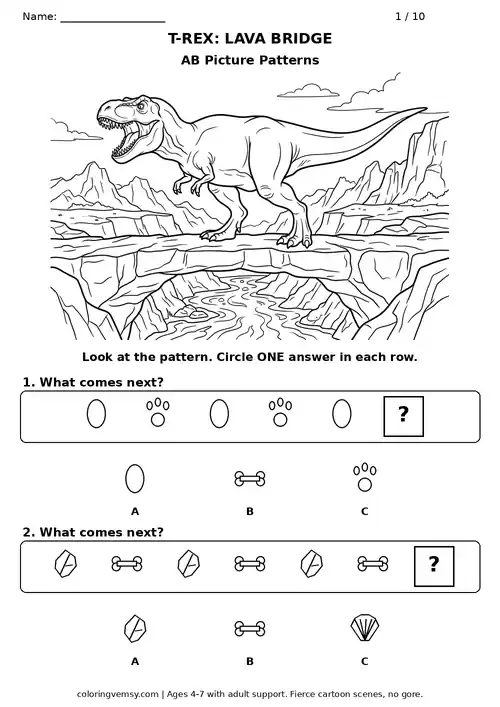
1. T-Rex Lava Bridge
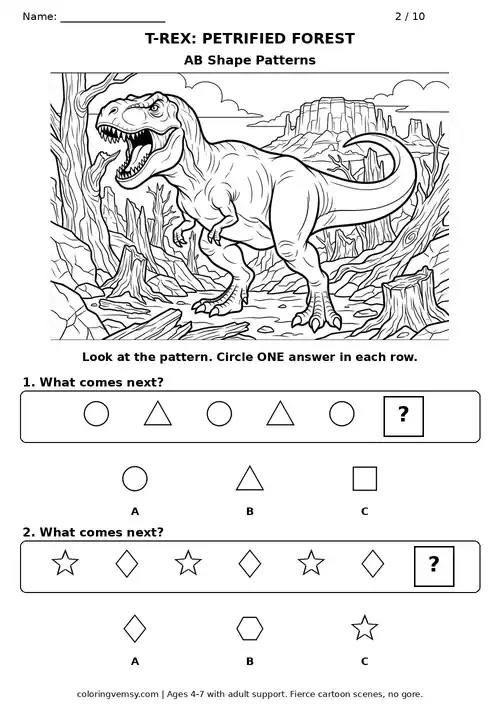
2. T-Rex Petrified Forest
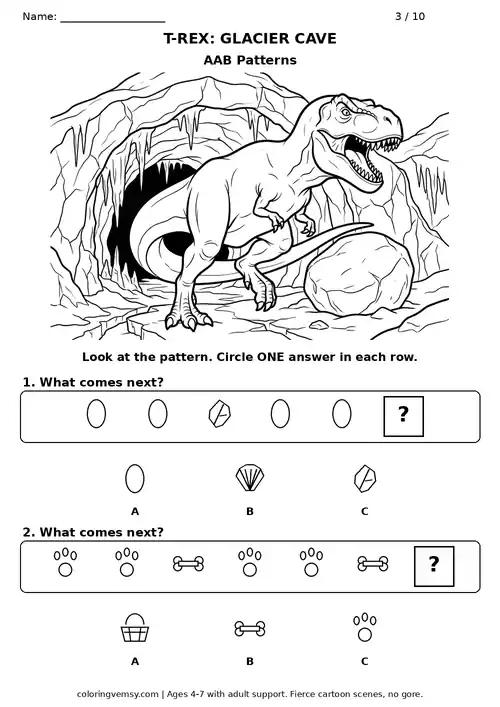
3. T-Rex Glacier Cave
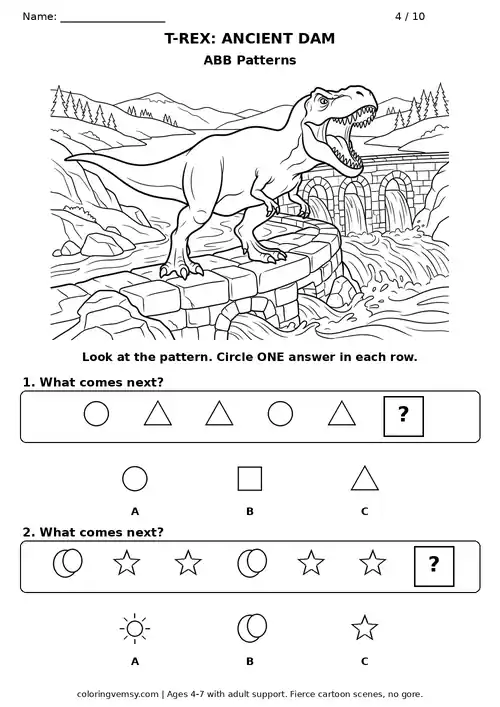
4. T-Rex Ancient Dam
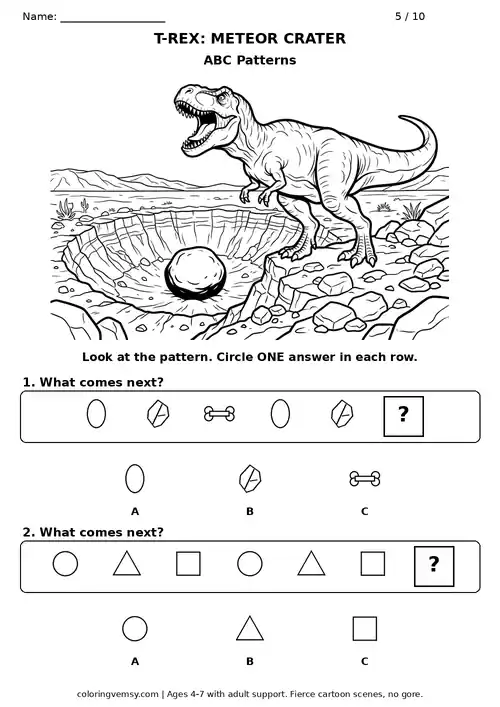
5. T-Rex Meteor Crater
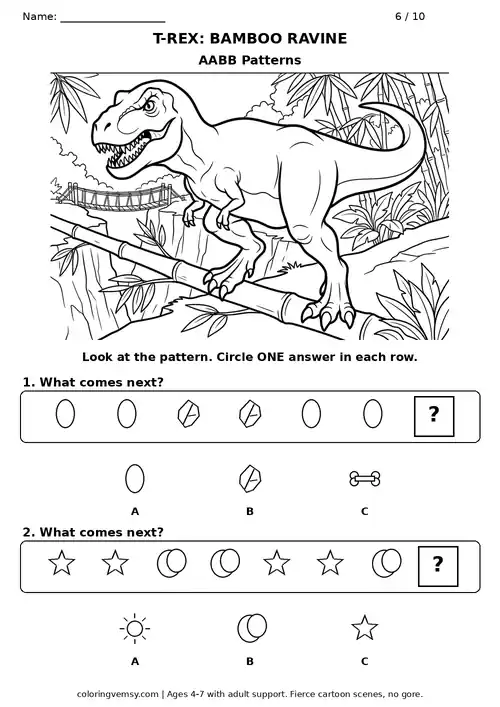
6. T-Rex Bamboo Ravine
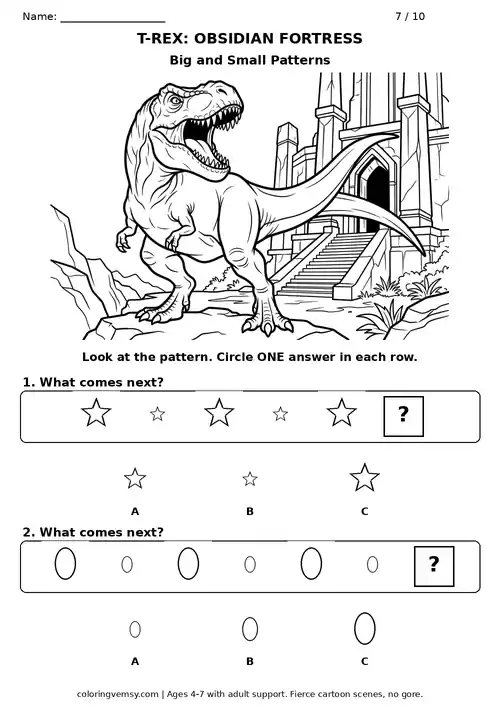
7. T-Rex Obsidian Fortress
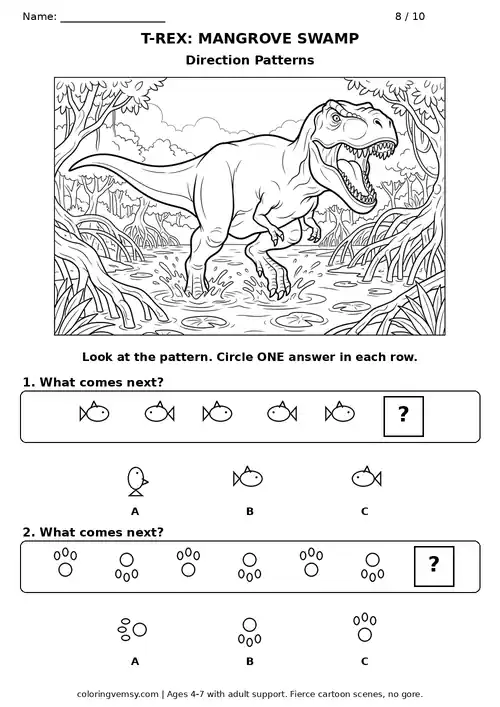
8. T-Rex Mangrove Swamp
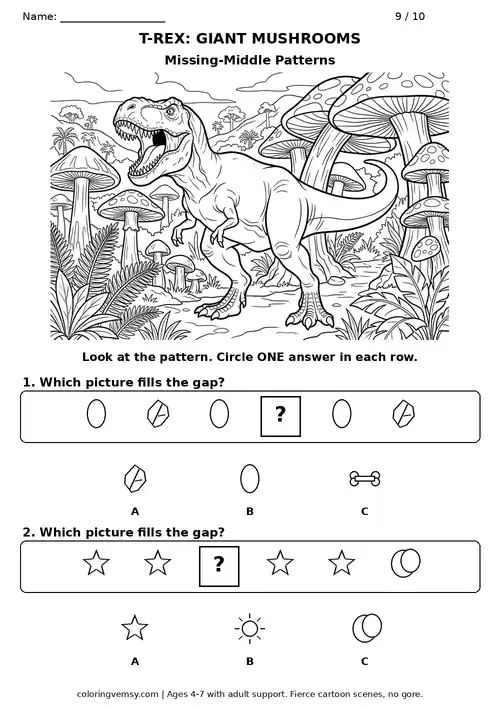
9. T-Rex Giant Mushrooms
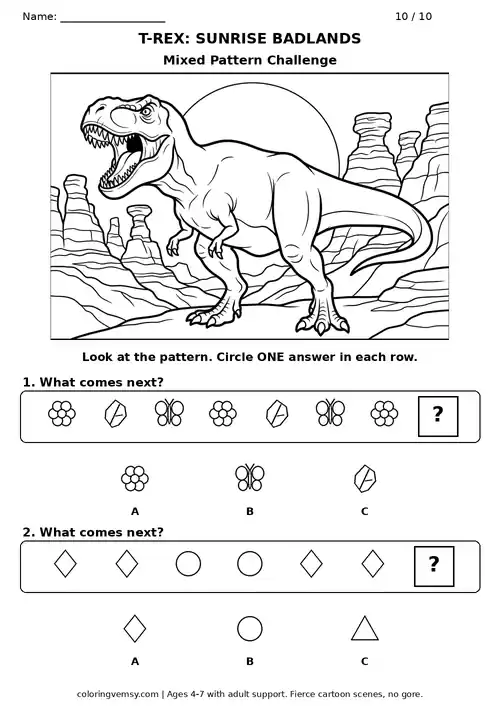
10. T-Rex Sunrise Badlands
Same size, clear pattern choices: these Dinosaur pattern worksheets use 500 × 707 px WebP images, about 26–38 KB each. Full worksheet masters are all 1000 × 1414 px. Each page contains two programmatically constructed questions. Intended repeats, missing positions and correct options are recorded in the separate answer key.
📑 Table of Contents
- What is inside the pattern pack?
- Ten new T-Rex scenes and pattern challenges
- How to download and print
- Skills children can practice
- Choose a comfortable starting point
- How to solve the pattern questions
- Color the different backgrounds
- Explain AB, AAB and other rules
- Ideas for home and small groups
- Frequently asked questions
Adult answer key — open after trying the patterns
A, B and C below the choices are option labels. Size and direction are part of a symbol identity. A separate text key is supplied with the package.
- Page 1: Row 1: C (Footprint); Row 2: A (Leaf)
- Page 2: Row 1: B (Triangle); Row 2: C (Star)
- Page 3: Row 1: C (Leaf); Row 2: C (Footprint)
- Page 4: Row 1: C (Triangle); Row 2: B (Moon)
- Page 5: Row 1: C (Bone); Row 2: A (Circle)
- Page 6: Row 1: B (Leaf); Row 2: B (Moon)
- Page 7: Row 1: B (Star:small); Row 2: C (Egg:big)
- Page 8: Row 1: C (Fish:left); Row 2: C (Footprint:up)
- Page 9: Row 1: A (Leaf); Row 2: C (Moon)
- Page 10: Row 1: C (Leaf); Row 2: B (Circle)
What is inside these Dinosaur pattern worksheets?
This collection combines ten new fierce T-Rex scenes with twenty repeating-pattern questions. Each sheet has a large dinosaur illustration above two activity rows. Children inspect a sequence, decide which picture belongs next or in the missing position, then circle one of three answer choices underneath.
The pack begins with alternating AB picture and shape patterns, then introduces AAB, ABB, ABC and AABB repeats. Later pages explore big-and-small alternation, changes in direction and gaps inside an existing sequence. A final mixed page brings two familiar rules together without introducing a completely new activity format.
These Dinosaur pattern worksheets are suggested for ages four to seven with adult support as needed. The simplest rows can suit a first pattern activity, while other questions need closer attention. The dinosaur artwork is intense, with huge jaws and sharp teeth, but there is no blood, injury or graphic violence. Preview the scenes for each child’s comfort.
One page, two short questions
There is no cutting, gluing or assembly. Print a page, set out a pencil or crayon and read the instruction together. Children can point to an answer instead of circling if they prefer. The separate adult key gives the correct option letter and picture description for all twenty questions.
Ten new giant T-Rex scenes and pattern challenges
Every illustration in these Dinosaur pattern worksheets was created for this pack rather than reused from earlier dinosaur pages. All ten show powerful adult T-Rex-style characters in different settings. The art is imaginative cartoon line work, not a scientific reconstruction of anatomy, behavior or prehistoric habitats.
1. T-Rex Lava Bridge
A huge T-Rex crosses a natural lava bridge. Begin with two-item alternation using egg, footprint, leaf and bone pictures. Read the sequence aloud, predict the next item and compare the three choices before circling.
2. T-Rex Petrified Forest
A powerful dinosaur strides among ancient stone trunks. The rows alternate familiar geometric shapes. Notice which shape is present in each position, rather than choosing the picture you like best.
3. T-Rex Glacier Cave
An enormous T-Rex emerges from an icy cave. Each repeated group has two of the first picture followed by one of the second. Point out the double picture before predicting what comes next.
4. T-Rex Ancient Dam
A fierce dinosaur stands above a stone dam. These rows reverse the grouping emphasis: one first item followed by two of the second. Read a whole repeating unit before extending it.
5. T-Rex Meteor Crater
A roaring dinosaur guards a crater rim. Follow three different pictures in a repeating order. The answer depends on where the displayed row stops, not on always returning to the first symbol.
6. T-Rex Bamboo Ravine
A giant T-Rex steps across a fallen bamboo trunk. Repeat two of one item, then two of another. Longer rows make it helpful to group the symbols mentally rather than treating each as unrelated.
7. T-Rex Obsidian Fortress
A massive dinosaur looms before an ancient fortress. Alternate big and small versions of the same shape. The options include a medium-size distractor, so compare size carefully rather than checking object identity alone.
8. T-Rex Mangrove Swamp
A fearsome T-Rex splashes between mangrove roots. Fish alternate left and right; footprints alternate up and down. Orientation is the changing feature, and an extra direction appears among each row’s distractors.
9. T-Rex Giant Mushrooms
A huge dinosaur stands in a fantasy mushroom forest. Restore a missing picture inside an existing AB or AAB sequence. Use the pictures after the blank as well as those before it to check your choice.
10. T-Rex Sunrise Badlands
A colossal T-Rex crosses layered rock towers at sunrise. Try one ABC row and one AABB row as a final review. Name each repeating group before looking through the answer choices.
The illustration is a coloring scene, while the bordered rows below it contain the pattern questions. Decorative objects in the background are not part of the sequence. This keeps the activity clear even when the scene has many rocks, leaves or other details to enjoy later.
How to download and print the worksheets
The PDF button downloads all ten Dinosaur pattern worksheets with a cover. Download beneath a preview saves a single worksheet image; View opens it separately. The PDF pages are A4. Choose Fit to page for US Letter so the entire sequence, answer options and bottom row remain visible.
- Use portrait orientation. Every final worksheet has the same tall layout.
- Check a test print. Small and large symbols must be visibly different on the size-pattern page.
- Keep the whole page. Avoid cropping the third answer choice or the lower activity.
- Choose grayscale or black-only. The worksheet pages use black outlines; a color printer is not needed.
- Keep the answer key aside. The separate text file is for adult checking, not another activity sheet.
- Set out a simple drawing tool. A pencil or crayon is enough for circling answers and coloring the picture.
Single-sided printing is convenient for drawing and coloring. For a book, double-sided printing with long-edge flipping is possible because nothing is cut from the pages. Check show-through first, especially if children will use markers or if the paper is thin.
The compact PDF is easy to share, but final clarity depends on paper, printer settings and scaling. Inspect a sample rather than assuming every small direction or size detail will look equally clear on every printer. Enlarge proportionally when a child needs bigger symbols.
What children can practice through repeating patterns
Working with Dinosaur pattern worksheets invites children to notice what changes, what stays the same and which part repeats. A sequence is more than a row of unrelated pictures: it has an intended repeating rule. Naming that rule gives children a reason for their answer rather than relying on a quick guess.
- Visual comparison: checking which symbols are alike and which differ.
- Recognizing a repeat: finding a short group that appears again in the same order.
- Prediction: applying the rule to the next position.
- Checking a missing part: using pictures on both sides of a gap.
- Size vocabulary: describing big, small and medium differences.
- Direction language: noticing left, right, up and down.
- Explaining a choice: describing the repeated group in words, gestures or sounds.
These are practice opportunities rather than promises of a particular learning result. A child may enjoy alternating two pictures before understanding a longer repeat. Offer a manageable question and support the comparison instead of treating a single worksheet as an assessment of general ability.
Try specific comments such as “You checked the group again” or “You noticed the two leaves together.” Keep speed optional. Carefully explaining one sequence can be more useful than circling every answer quickly without looking at the rule.
Choose a comfortable starting point
Start with a short two-item alternation if repeating patterns are new. Read the pictures aloud in order and invite the child to join in. When the rhythm feels familiar, ask what should come next. There is no requirement to complete the collection in page order.
| Starting point | Suggested sheets | Helpful support |
|---|---|---|
| First repeating patterns | 1 AB pictures, 2 AB shapes | Name each picture in sequence and repeat the two-item rhythm. |
| Ready for grouped repeats | 3 AAB, 4 ABB, 5 ABC | Point to the short repeating unit before choosing an answer. |
| Interested in another feature | 7 Size, 8 Direction | Describe size or orientation rather than naming the object alone. |
| Ready to inspect longer rows | 6 AABB, 9 Missing middle, 10 Mixed | Check the full repeat and pictures on either side of a gap. |
Within these Dinosaur pattern worksheets, a younger child can work on one row and color the scene afterwards. An older child might explain both rows and make a new example of the same rule on scrap paper. Adjust the amount of work rather than expecting every player to use the same pace.
If the fierce dinosaur face is uncomfortable, choose a gentler collection instead. Liking a pattern task does not mean a child must enjoy roaring T-Rex pictures. An adult can also cover the illustration temporarily while working on the lower activity rows.
How to solve the repeating pattern questions
Each row in these Dinosaur pattern worksheets has a clearly outlined question area and three options below it. The letters A, B and C beneath the answer pictures are choice labels, not instructions to choose the first, second or third kind of symbol used in the sequence.
- Read the row from left to right. Say the picture names, sizes or directions aloud.
- Find the repeating group. Look for the short unit that happens again.
- Continue that same rule. Decide what belongs at the question mark.
- Compare all three choices. Look for the exact picture, size or direction you predicted.
- Circle one answer picture or its letter. Pointing is also fine if an adult records the choice.
- Check the row again. Read the completed sequence to see whether the intended repeat is consistent.
On a missing-middle question, do not treat the blank as the end of the row. Look at the pictures after it as well. A correct replacement should preserve the repeating rule across the whole displayed sequence.
Adults can model the process briefly without supplying every answer. Point to one repeated group, then invite the child to find another. If the question is too difficult, return to a simple alternating example using familiar objects before trying the printed row again.
Color the giant T-Rex scenes after solving
The large illustrations above these Dinosaur pattern worksheets can be colored freely. They are not color-by-number or color-by-shape tasks, so the dinosaur and its setting do not have a fixed palette. Bright fantasy colors and earth tones are both welcome.
- Lava bridge: contrast warm lava with darker rock and a bold dinosaur color.
- Petrified forest: try earthy stone trunks and a contrasting background hill.
- Glacier cave: use cool blues around the ice and a warmer T-Rex.
- Ancient dam: choose stone colors and flowing water shades.
- Meteor crater: decorate the crater rim and give the meteor a different tone.
- Bamboo ravine: explore several greens around a bright dinosaur.
- Obsidian fortress: leave some areas light so architectural outlines stay clear.
- Mangrove swamp: contrast roots, water and floating leaves.
- Giant mushrooms: invent colorful caps for the fantasy forest.
- Sunrise badlands: try a warm sky behind layered rock towers.
Leave the pattern symbols unchanged until the question is answered, especially on size and direction pages. Coloring them first in different ways could introduce an unintended extra clue. Once the task is complete, children can decorate the small pictures too.
Explain AB, AAB and the other pattern rules
The letters used to describe Dinosaur pattern worksheets are a shorthand for adults, not a reading test. A means one kind of item, B another and C a third. Children can say “egg, leaf” instead of “A, B” and still be describing the same relationship.
Two kinds of items
AB alternates two different items. AAB repeats two of the first item followed by one of the second. ABB repeats one of the first and two of the second. AABB repeats two of each in order. Count the items in one unit before extending it, rather than assuming every page alternates one at a time.
Three kinds of items
ABC repeats three different items in a fixed order. If the displayed row stops after the first or second item of the next unit, continue from that position. The next answer is not always A simply because a new question has begun.
Size and direction
On the size page, the same object appears big and small; a medium version is a distractor among the choices. On the direction page, the symbol’s orientation is part of its identity. Saying only “fish” or “footprint” is not enough to explain which version belongs next.
The adult key lists the option letter and a description for each answer. Use it to check the intended rule after the child has tried the question. A useful follow-up is “How did you know?” rather than simply announcing whether a letter was correct.
Ideas for home, preschool and small groups
Offer a small choice of Dinosaur pattern worksheets rather than expecting a child to complete ten sheets in one sitting. Introduce one pattern type at a time. A page can take only a few minutes, or become a longer coloring project after its two questions are finished.
In a small group, read a practice sequence together using objects or gestures before using the worksheet. Clap once, tap once, then repeat for AB; clap twice and tap once for AAB. Keep the physical example simple and explain how it relates to the pictured repeat.
At home, use a favorite dinosaur scene as an invitation, not a reward that must be earned through perfect answers. Children can enjoy the illustration and try a short question with support. If they lose interest, keep the page for another day rather than turning it into a race.
No scissors, glue or loose game pieces are needed. Use child-appropriate coloring tools and manage small accessories such as caps and sharpeners. If you use a reusable pocket, follow the product guidance and supervise marker use. Ordinary paper and a pencil remain a complete option.
More dinosaur activities and factual reading
After these T-Rex pattern sheets, try T-Rex color-by-shape worksheets, seek-and-find activities, memory matching cards or busy book printables. Our cut-and-paste worksheets, preschool activity sheets and tracing worksheets offer other styles of practice.
For free coloring, browse dinosaur coloring, coloring dinosaur, lion coloring, tiger coloring, elephant coloring, horse coloring and dog coloring. The online coloring tool opens a worksheet image but does not automatically grade pattern answers.
Adults can consult the Wikipedia dinosaur overview, the Natural History Museum’s Dino Directory and National Geographic Kids prehistoric animals for factual reading. Preview outside resources before sharing them with a child, and keep fantasy fortresses, bridges and giant mushrooms separate from real prehistoric evidence.
Frequently asked questions
Are these dinosaur pattern worksheets free?
Yes. The ten worksheets and complete PDF are free to download without signing up. Use them for personal or classroom activities. Share this page link instead of selling or republishing the downloadable files.
Which pattern types are included?
There are twenty questions across AB, AAB, ABB, ABC and AABB repeating patterns, plus big/small alternation, direction changes and missing-middle gaps. Each sheet has two questions with three answer choices per row.
Are the sequences and answers checked?
Yes. The symbols, repeating units, gaps and choices are built programmatically. The intended answer is calculated from the repeating unit and checked against the options. A separate adult key gives the option letter and picture description for every row.
Do children need scissors or glue?
No. Children circle one answer picture or option letter per row, or point while an adult records the choice. The dinosaur illustration can be colored afterwards. There are no cut-out cards or loose pieces.
What ages and dinosaur style are these pages for?
The suggested range is four to seven with adult support. All ten scenes feature huge fierce T-Rex-style cartoons, with sharp teeth and dramatic settings but no blood or injuries. Preview the faces and offer gentler artwork if needed.
Is the answer key in the PDF or online game?
The PDF contains a cover and ten activity sheets. The adult key is supplied separately as text and also in a closed section on this page. Online coloring opens the worksheet image for coloring; it does not automatically score or grade the pattern questions.
Download your T-Rex pattern sheets book
Cover + 10 pages, one drawing per sheet, A4 + US Letter, small size for quick print. Print double-sided, flip on long edge.
Twenty pattern questions, ten new fierce T-Rex scenes and a separate adult answer key. No cutting needed.
⬇ Download the PDF book